
Roman Infamia Stigma Calculator
Explore how a Roman citizen's status changed after being marked as infamis. Adjust the parameters to see how rank, wealth, and external intervention affected their ability to recover rights.
Select your profile and click Calculate to see the historical simulation.
Legal Strikes
- Select a profile to view specific legal barriers.
Reintegration Path
Details on how this citizen might recover status will appear here.
Imagine being a soldier in the Roman Empire. You are brave, disciplined, and expected to be tough. Now imagine you are captured by an enemy who humiliates you sexually. In modern times, we might call you a survivor of war crimes. But in Rome? You were infamis is a person stripped of legal rights and social standing due to moral disgrace or criminal activity. The word itself carries a weight that still echoes through history books today. It wasn't just about what happened to your body; it was about what it did to your name, your family's reputation, and your right to vote or hold office.
We often think of ancient societies as rigidly patriarchal, where men held all the power and women were entirely subordinate. While true in many ways, this view misses a crucial nuance: for Roman men, sexual vulnerability was not just a personal trauma. It was a public scandal. It was a threat to the entire social order. This article explores how infamia functioned as a tool of social control, specifically targeting male survivors of sexual violence during wartime. We will look at why these exceptions existed, how they differed from the treatment of female victims, and what this tells us about the fragility of Roman masculinity.
The Definition of Infamia and Its Social Weight
To understand the impact on male survivors, we first need to define infamia is a formal state of dishonor that excluded individuals from certain civic duties and social interactions. In the Roman Republic and later Empire, citizenship came with privileges. You could own property, enter contracts, and participate in politics. But if you committed a crime like theft, fraud, or adultery, you could be marked as infamis. Once marked, you lost the ability to give testimony in court. You couldn't serve as a witness. Your word was essentially worthless in legal settings.
For a male citizen, this was devastating. Roman society was built on the concept of dignitas, or personal worth. Your status depended on your honor. If you were seen as weak, submissive, or sexually penetrated, you were viewed as having lost your masculine agency. This wasn't just gossip; it had legal consequences. A man who suffered sexual violence by an enemy was often presumed to have been passive, which contradicted the ideal of the active, dominant Roman male. Therefore, the stigma of infamia stuck to him, making it difficult to reintegrate into high-status society.
Warfare as the Primary Context for Male Sexual Violence
Unlike in many other ancient cultures where sexual violence against men was rare or mythologized, Rome frequently encountered it in the context of warfare is armed conflict between states or groups, often involving organized military forces. When Roman soldiers were captured, especially during the Punic Wars or conflicts with Germanic tribes, they faced brutal treatment. Enemy forces used sexual humiliation as a tactic to break morale. By forcing Roman men to submit sexually, enemies aimed to strip them of their identity as warriors.
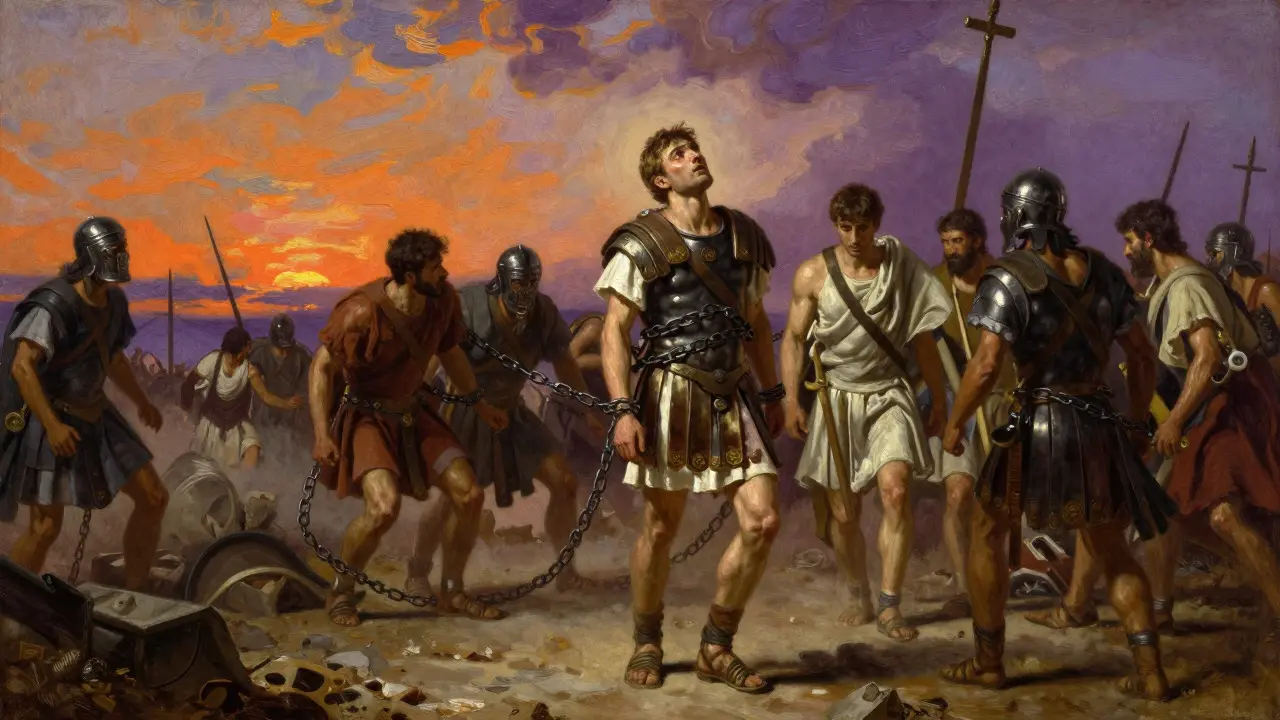
Historical records, such as those from Livy and Tacitus, mention instances where captured Romans were paraded in chains, sometimes naked, before returning home. These public displays were designed to maximize shame. The community would see the victim and immediately categorize him. Was he a hero who resisted? Or was he a victim who submitted? The distinction was blurry, and often, the mere fact of capture implied a lack of courage. Thus, the line between victim and perpetrator became blurred in the eyes of society, leading to the application of infamia.
The Double Standard: Male vs. Female Victims
One of the most striking aspects of Roman social dynamics was the double standard regarding sexual violence. For women, sexual violation was primarily a matter of family honor. If a woman was raped, her father or husband had to decide whether to keep the shame within the household or expose it publicly. However, for men, the issue was civic. A woman’s sexuality belonged to her family; a man’s sexuality belonged to the state.
This difference meant that male survivors faced unique challenges. A female victim might receive protection or compensation from her guardian. A male survivor, however, had no such institutional support. He was an adult citizen responsible for his own actions. If he was raped, he was expected to have fought back. If he didn’t, he was weak. If he did and was injured, he was damaged goods. There was no clear path to recovery that restored his full social standing. This asymmetry highlights how deeply intertwined sex, power, and citizenship were in Roman life.
Legal Implications and Loss of Rights
The practical effects of infamia extended far beyond social awkwardness. Let’s look at specific legal barriers:
- Testimony: An infamis man could not testify in court. This meant if he tried to report a crime or claim property, his word carried no weight.
- Civic Office: Holding public office required a clean moral record. Being marked as infamis effectively ended any political career.
- Contractual Capacity: Some contracts required both parties to be of good standing. This limited business opportunities for survivors.
These restrictions created a cycle of disadvantage. Without legal rights, it was harder to prove innocence or seek justice. Without economic stability, it was harder to maintain a respectable appearance. And without respectability, social isolation deepened. Many male survivors simply disappeared from the historical record, not because they died, but because they faded out of public life.
Case Studies: Historical Accounts of Humiliation
Historical texts provide glimpses into these experiences. One notable example involves the aftermath of the Battle of Cannae in 216 BCE. After this massive defeat, thousands of Roman prisoners were taken by Hannibal. While most were eventually ransomed, some remained captive for years. Upon return, many faced suspicion. Had they served the enemy? Had they been broken? The ambiguity fueled rumors, and many returned to find their social circles had shrunk significantly.
Another instance comes from the Gallic Wars. Julius Caesar noted in his Commentarii de Bello Gallico that Gauls often humiliated Roman captives. While Caesar focused on military strategy, his descriptions reveal a cultural understanding that sexual domination was a key part of conquest. The Roman response was not always consistent, but the underlying fear of losing masculine dignity remained constant.

Comparing Roman Stigma to Other Ancient Societies
How did Rome compare to its neighbors? Greek society, particularly Athens, also valued male dominance. However, the concept of infamia was less codified in Greek law. Instead, shame was more socially enforced through ostracism or exile. In Persia, sexual relations between men were more accepted in certain contexts, so the stigma of being penetrated was less absolute. Rome stood out because it tied sexual behavior directly to legal status. This made the punishment for male sexual violence uniquely bureaucratic and enduring.
| Society | Primary Stigma Mechanism | Legal Consequences | Reintegration Path |
|---|---|---|---|
| Rome | Infamia (Loss of Legal Rights) | Inability to testify, hold office | Very Limited; Required Imperial Pardon |
| Athens | Ostracism / Social Shame | Exile or Property Confiscation | Possible after Time; Depended on Family Support |
| Persia | Less Severe; Context-Dependent | Rarely Codified | Easier; Less Impact on Status |
Why Did This System Persist?
You might wonder why such a harsh system lasted for centuries. The answer lies in the structure of Roman power. The state needed citizens to be reliable, predictable, and hierarchical. If a man could be sexually dominated without consequence, it suggested that the social hierarchy was fragile. By enforcing infamia, the state reinforced the idea that order must be maintained at all costs. It was a way of policing the boundaries of masculinity to ensure political stability.
Additionally, the elite class benefited from this system. Wealthy families could afford to buy back their sons from captivity and use influence to mitigate infamia. Poorer citizens, however, had no such safety net. This created a class divide in how sexual violence was experienced and remembered. The rich could recover their names; the poor often could not.
Modern Relevance and Historical Lessons
While we live in a very different world, the lessons from Roman infamia are relevant today. We still struggle with the stigma surrounding male sexual violence. Men are often discouraged from reporting abuse because of fears of being judged as weak. The legal systems in many countries still reflect biases that make it hard for male survivors to get justice. Understanding how Rome codified this stigma helps us recognize that these attitudes are not natural or inevitable. They are constructed, and they can be dismantled.
By studying these historical exceptions, we gain a clearer picture of how power operates through language and law. The word infamis was more than a label; it was a mechanism of control. Recognizing this allows us to challenge similar mechanisms in our own society, ensuring that survival is not punished, but supported.
What exactly was infamia in Roman law?
Infamia was a legal status that stripped a citizen of certain rights, including the ability to testify in court and hold public office. It was applied to those deemed morally dishonorable, including criminals and, in specific cases, male victims of sexual violence.
Why were male victims of war stigmatized more than female victims?
In Roman society, a man's sexual autonomy was linked to his civic duty and masculine identity. Being penetrated was seen as a loss of agency, threatening the social order. Women's sexuality was controlled by their families, so their violations were private matters, whereas men's were public civic issues.
Could a Roman man lose his infamia status?
Yes, but it was difficult. It usually required a pardon from the Emperor or significant intervention by powerful patrons. For ordinary citizens, the stigma often lasted a lifetime, affecting their social and professional prospects permanently.
Did all Roman soldiers face this risk?
Any captured soldier was at risk, but the severity of the stigma varied based on rank and wealth. Higher-ranking officers might have better chances of rehabilitation through political connections, while common soldiers faced greater isolation.
How does this compare to modern views on male sexual violence?
Modern society is moving toward recognizing male victims as legitimate survivors, though stigma persists. Unlike Rome, modern legal systems generally do not strip rights based on victimhood, but social biases can still hinder access to justice and support.