Consummation Ritual: How Sex Became a Sacred Act in History
When you think of a consummation ritual, a formal act that completes a marriage through sexual intercourse, often with witnesses or symbolic meaning. Also known as marital consummation, it was once a legal requirement, a religious duty, and sometimes a public spectacle. This wasn’t just about sex—it was about proof. In medieval Europe, if a marriage was challenged, the couple might be locked in a room together while neighbors listened. If they didn’t consummate, the union could be annulled. Women’s bodies became legal documents. Men’s ability to perform, often measured by the presence of blood or witness testimony, decided whether a family’s wealth, land, or political alliance would stand.
Across cultures, the consummation ritual, a formal act that completes a marriage through sexual intercourse, often with witnesses or symbolic meaning. Also known as marital consummation, it was once a legal requirement, a religious duty, and sometimes a public spectacle. was tied to deeper beliefs about fertility, divine approval, and social order. In ancient Egypt, couples slept on goat skins to ensure fertility. In parts of India, the ritual was linked to goddess worship—sex as a sacred offering. Meanwhile, in Etruscan tombs, sexual scenes weren’t just art—they were guides for the soul’s journey after death, showing that pleasure and death were connected long before modern taboos. Even today, some religious traditions still require proof of consummation before a marriage is fully recognized, showing how deeply this practice is wired into our systems of power.
What we call a "wedding night" today is a stripped-down version of what once was a complex, sometimes violent, always political act. The consummation ritual, a formal act that completes a marriage through sexual intercourse, often with witnesses or symbolic meaning. Also known as marital consummation, it was once a legal requirement, a religious duty, and sometimes a public spectacle. wasn’t about love—it was about control. Who got to witness it? Who could annul it? Who was blamed if it failed? These questions shaped laws, gender roles, and even how we think about consent. The Victorian idea that women should be passive in marriage? That came from trying to erase the reality that women had desires, needs, and power in these rituals. And when you look at the history of prostitution, the medicalization of female pleasure, or the erasure of lesbian relationships, you’re seeing the same pattern: sex was never just private. It was always public, policed, and packaged.
What follows are articles that dig into the hidden corners of this history—how sex was used to build empires, how medicine turned pleasure into pathology, and how women fought back to reclaim their bodies. You’ll read about Etruscan tomb paintings that linked sex to the afterlife, medieval dowries that made marriage a financial contract, and Victorian doctors who treated "hysteria" with steam-powered vibrators. These aren’t just old stories. They’re the roots of how we still think about marriage, power, and what it means to say "yes."
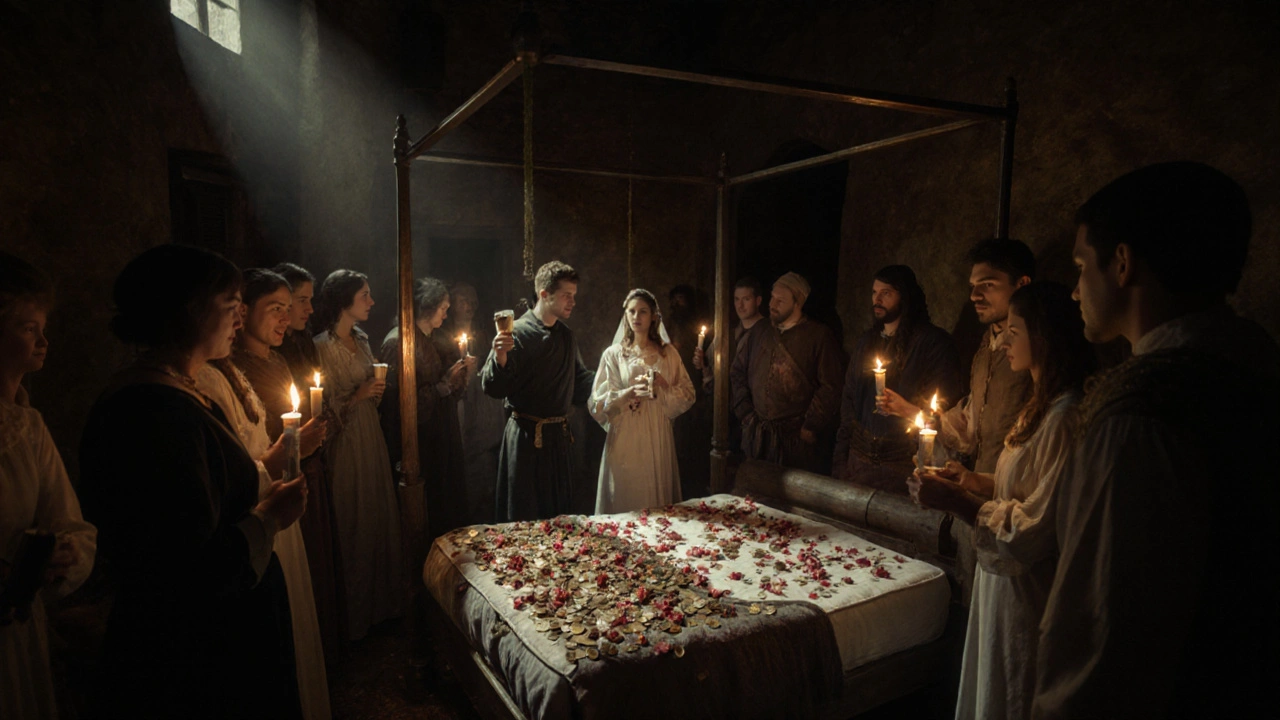
Bedding Ceremonies: How Communities Once Validated Marriage Through Consummation Rituals
Nov 24 2025 / EconomicsBedding ceremonies were once common in medieval Europe, where communities watched newlyweds consummate their marriage to legally validate the union. This practice shaped inheritance, religion, and gender norms-and its echoes survive in today's wedding traditions.
VIEW MORE