Historical Virginity Proof Calculator
Based on historical records, only about 43% of women bleed during first intercourse, yet for centuries, blood on sheets was considered legal proof of virginity. This calculator demonstrates the statistical reality versus historical expectations.
Expected Results:
Why this matters historically:
The article explains how communities historically required proof of consummation through blood on sheets. With only 43% of women bleeding during first intercourse, this created many invalid marriages by historical standards. The tool demonstrates how often a woman's lack of bleeding would have been used to invalidate a marriage, despite this being a medical fallacy.
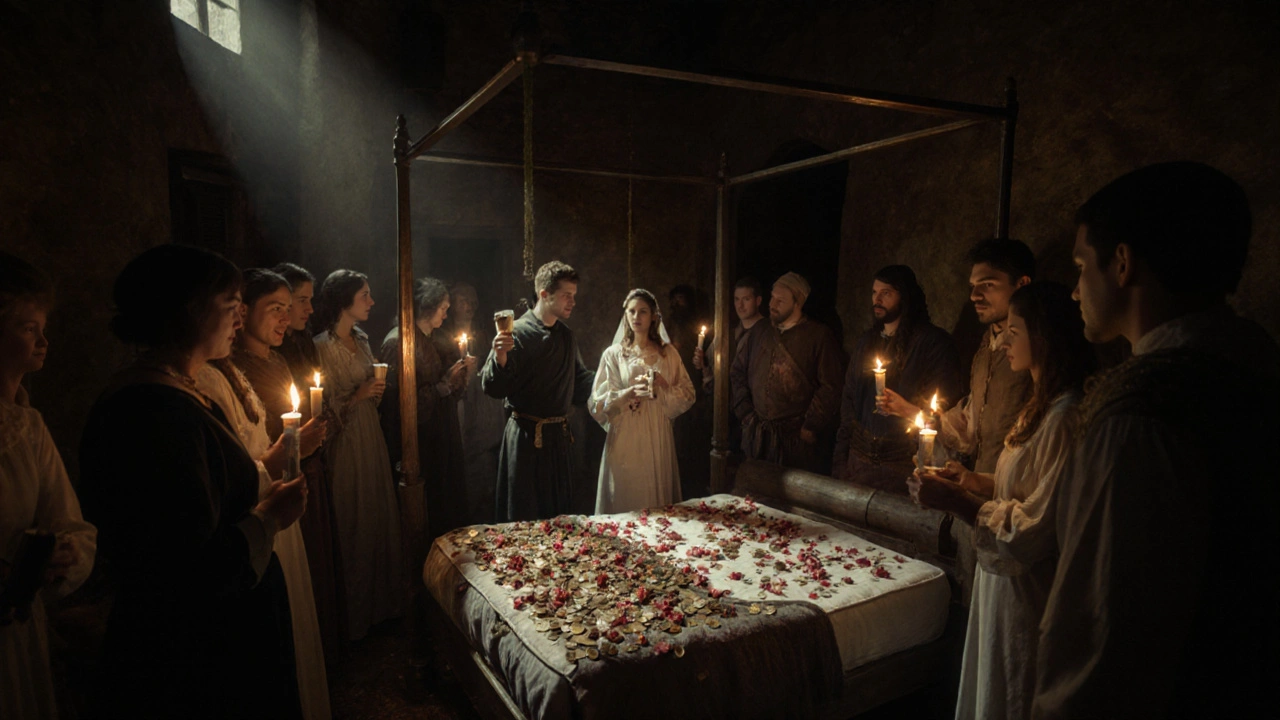
For centuries, marriage wasn’t just a private vow between two people-it was a public contract, enforced by the whole village. One of the most startling ways communities made sure that contract stuck? By watching the newlyweds go to bed. Not as a prank, not as entertainment, but as a legal and religious requirement. The bedding ceremony was a widespread ritual across medieval and early modern Europe, where family, friends, and sometimes even local officials escorted the couple to their bed, cheered them on, and stayed until they were satisfied the marriage had been consummated.
Why Did People Need to Watch Couples Go to Bed?
In a world without birth control, marriage licenses, or DNA tests, proving a marriage was real mattered. A marriage that wasn’t consummated could be annulled. That meant property, titles, and inheritance could vanish overnight. For nobility, an unconsummated union could trigger political crises. For peasants, it could mean losing access to land or a dowry. The bedding ceremony was the community’s way of verifying that the marriage was more than paperwork-it was physical, biological, and binding.Historians like Alison Weir and George Monger document how royal weddings in 14th-century England had entire galleries of witnesses. After the church ceremony, the bride and groom were dressed in their nightclothes-sometimes even stripped naked by attendants in Scandinavia-and led to the marital chamber. A priest blessed the bed. A spiced wine called a benediction posset was shared. Then, the guests stayed. Not just for a few minutes. Sometimes, they stayed until the couple had finished.
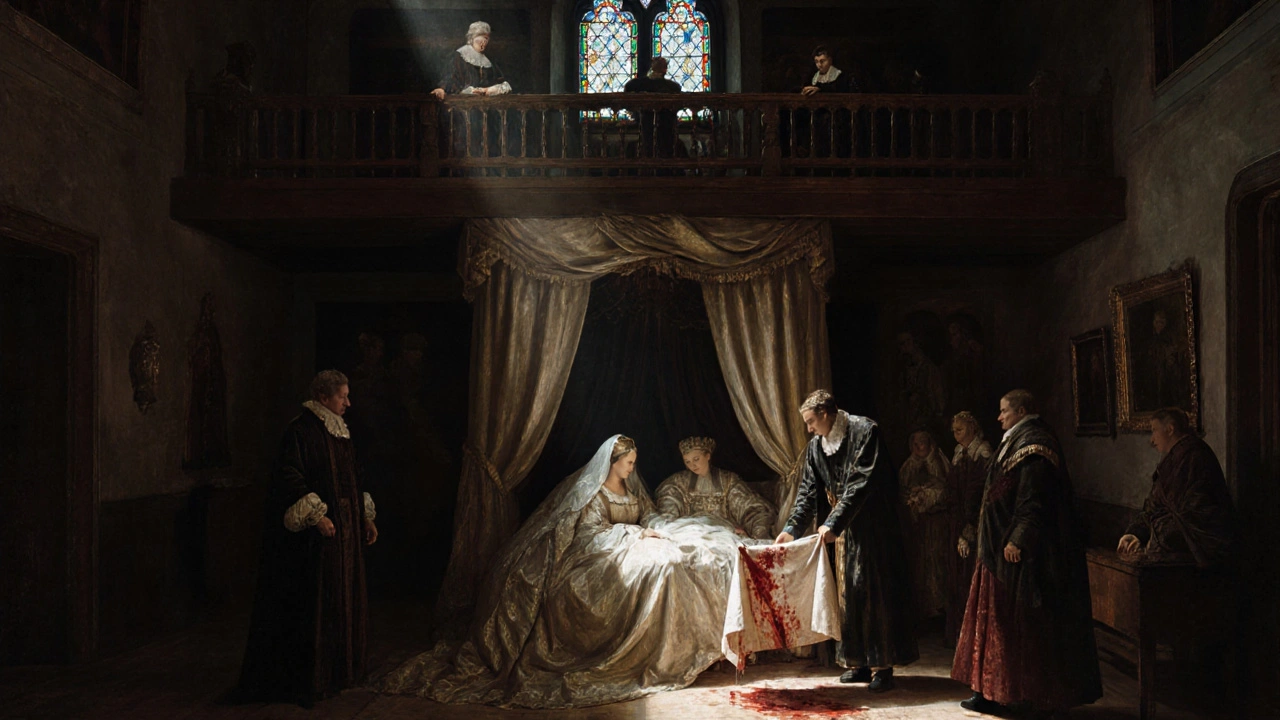
This wasn’t just about sex. It was about heirs. The primary goal? To confirm the bride could bear children. If she didn’t bleed on the sheets the next morning (a common but medically flawed belief), the marriage could be declared invalid. Studies show only about 43% of women bleed during first intercourse, yet for centuries, blood on linen was treated as legal proof of virginity. The sheets were often displayed publicly the next day, turning a private act into a public document.
How Did the Ceremony Work? It Varied Wildly
There was no single rulebook. The bedding ceremony changed based on class, region, and time.In royal courts, it was a formal affair. The 1559 wedding of Mary, Queen of Scots and Lord Darnley had courtiers present throughout the entire process. Witnesses were assigned to verify everything. In contrast, in 15th-century French villages, neighbors gathered outside the couple’s cottage, pressing their ears to the walls or peering through roof cracks to hear signs of activity. In Germanic regions, guests circled the bed, chanting and clapping. In Renaissance Italy, some homes had small viewing platforms built above the bed-like a balcony for spectators.
Even the rituals around the bed had meaning. Guests threw grains, coins, or flower petals onto the mattress to bless the couple with fertility and wealth. In England, the tradition of throwing stockings over the shoulder was common. Two men sat on one side of the bed, two women on the other. If a man’s stocking landed on the bride, it meant he’d be next to marry. Same for women. This evolved into today’s garter toss and bouquet toss-both hollow echoes of a much heavier ritual.
The Church and the Law: Sacred and Legal Validation
The Catholic Church treated unconsummated marriages as ratum sed non consummatum-ratified but not consummated. That meant a pope could dissolve the union. This wasn’t just theology. It was law. The 1917 Code of Canon Law made this official. If a husband couldn’t perform, or a wife refused, the marriage could be annulled. That’s why public validation mattered. A priest’s blessing wasn’t enough. Someone had to see it happen.Protestants had a different view. Martin Luther called the marriage bed “holy” and celebrated its consummation as a joyful act. But other reformers like John Calvin called the bedding ceremony “superstitious.” By the 1563 Council of Trent, the Catholic Church began pushing for privacy. The 1614 Roman Catechism said the marriage bed should be honored-but in private. The shift was clear: intimacy was becoming something to hide, not display.
Who Did This? And Who Didn’t?
It wasn’t universal. Historian Amy Louise Erickson studied English parish records and found only 22% of rural marriages in the 1500s included a bedding ceremony. But among nobility? That number jumped to 67%. The ritual was a tool of the powerful. It protected land, titles, and alliances. For peasants, it was less common-not because they didn’t care, but because they had less to lose. If a marriage failed, a peasant family didn’t lose a dukedom. They lost a few sheep.Still, the practice lingered in folk culture. E.P. Thompson, a folklorist, found 178 “bedding ballads” from 16th- to 18th-century England-songs that celebrated, mocked, or detailed the ceremony. Archaeologists found evidence too. In 2015, excavations at Crichton Castle in Scotland uncovered a raised platform above what was once a bedroom. It matched historical descriptions of viewing decks used for wedding observation.
Why Did It Disappear?
Three things killed the bedding ceremony: privacy, law, and architecture.First, the idea of privacy changed. By the 1600s, homes started having lockable doors. Bedrooms became personal spaces, not communal stages. You couldn’t force your way into a locked room without breaking the law.
Second, the law caught up. After the 1215 Fourth Lateran Council, English common law began accepting a marriage as valid the moment two people consented to it-not when they had sex. Legal proof shifted from physical acts to spoken vows and witness signatures.
Third, religion changed. The Catholic Church, once okay with public bedding, started seeing it as crude. Protestant ministers denounced it as vulgar. By 1680, it was nearly gone from cities. The last recorded case in England? In 1743, neighbors in Bedfordshire were prosecuted for bursting into a newlywed couple’s room to check if they’d had sex. The court fined them. The era was over.
What’s Left Today?
You won’t find bedding ceremonies anymore. But you’ll find their ghosts.The garter toss? It’s the stocking throw, stripped of its legal weight. The bachelor party? It’s the last night of freedom before the ritual of entry into married life. Even the phrase “tying the knot” comes from the tradition of tying the couple’s hands together during the ceremony to symbolize their union.
And in some cultures, the idea hasn’t faded at all. According to the World Health Organization, 20% of countries still permit “virginity testing” before marriage. It’s not a ceremony with cheering guests, but it’s the same belief: a woman’s body must be proven before her marriage is accepted.
Modern Western weddings are built on privacy. We don’t want to know what happens behind closed doors. But for centuries, the opposite was true. Marriage wasn’t just about love. It was about lineage, land, and law. And the only way to make sure it stuck? Make sure everyone saw it happen.