Essentialism in Sex and Gender: How Rigid Categories Shape History and Identity
When we say men are essentialism—that they’re naturally aggressive, women are naturally nurturing—we’re not describing biology. We’re repeating a story that was written centuries ago to control behavior, justify power, and erase complexity. This idea, called essentialism, assumes that gender, sexuality, and even desire have fixed, natural cores. But history shows us otherwise. From Victorian doctors labeling women’s pleasure as madness to modern laws assuming only two genders exist, essentialism has been used to silence, exclude, and pathologize anyone who doesn’t fit the mold. It’s not science. It’s a social tool dressed up as truth.
Essentialism doesn’t just live in old textbooks. It shows up in how we talk about gender roles, social expectations tied to being male or female, often enforced by family, media, and law, in the way sexual identity, how a person understands and labels their own attraction and desire, often shaped by culture and personal experience gets reduced to binary labels, and in the silence around biological determinism, the belief that biology alone decides behavior, ignoring environment, history, and choice. Think about how the Victorian idea of separate spheres—men in public, women at home—was sold as natural, when it was really a legal and economic system. Or how the female orgasm was dismissed as evolutionary noise, even though it’s tied to the same anatomy as the male orgasm. These aren’t facts. They’re myths built on essentialist thinking.
And it’s still happening. Bisexual erasure? That’s essentialism. Saying you must be either straight or gay, and nothing in between, ignores how desire actually flows. The medical myth that masturbation causes insanity? That was essentialism too—forcing a moral belief into a biological claim. Even today, when people say transgender identities are "just a trend," they’re clinging to the idea that gender is fixed at birth. But history doesn’t support that. Etruscan tombs show men and women enjoying pleasure together without shame. Ancient Egyptian cosmetics signaled power, not just gender. Medieval marriages were economic deals, not love stories. People have always bent, broken, and rewritten the rules. The real question isn’t whether these categories are natural—it’s who benefits when we pretend they are.
What you’ll find below isn’t theory. It’s proof. Articles that dig into how these rigid ideas were made, who enforced them, and how people fought back—from Anne Koedt dismantling the vaginal orgasm myth to activists reclaiming lesbian history from archives that tried to erase it. These aren’t just stories about the past. They’re maps for understanding the present—and how to move beyond the boxes we’ve been told to live in.
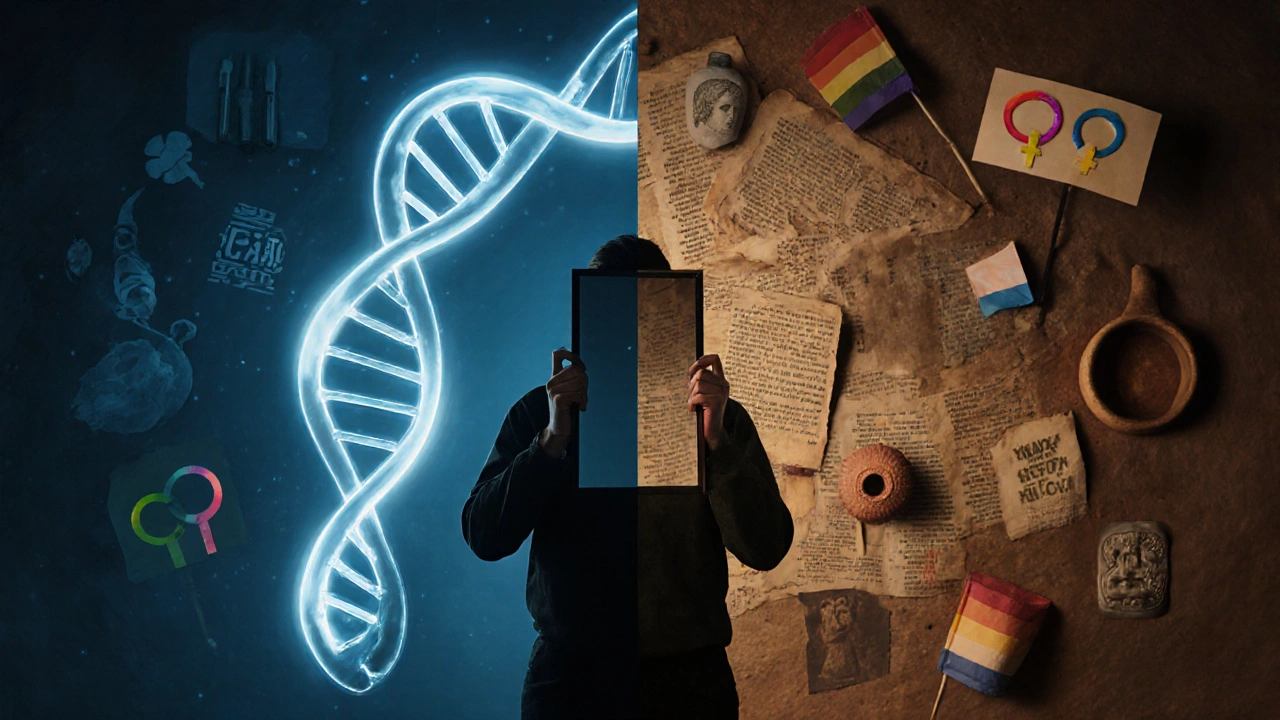
Constructivism vs Essentialism: How We Understand Sexuality Today
Oct 27 2025 / LGBTQ+ HistoryThe debate between constructivism and essentialism shapes how we understand sexual identity. Is sexuality innate or shaped by culture? This article explores the history, politics, and personal impact of both views-and why the truth may lie somewhere in between.
VIEW MORE