Sexuality Framework Quiz
How do you think about sexual orientation?
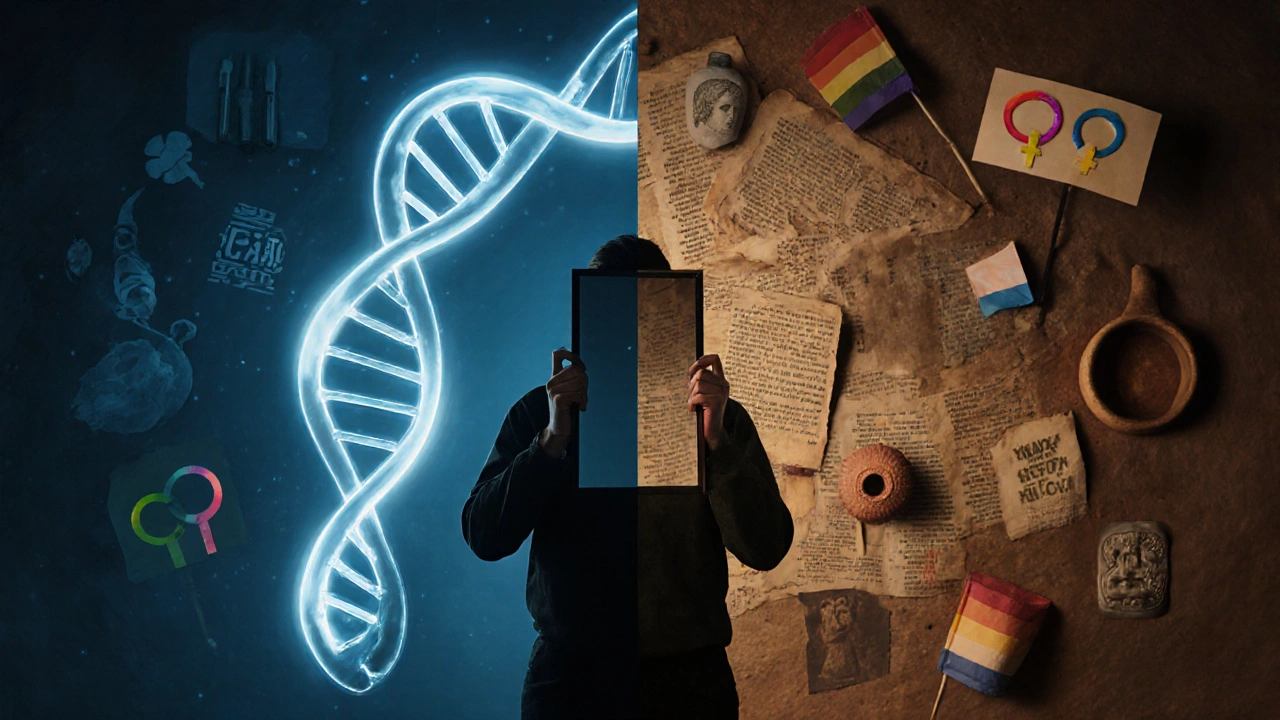
What if who you’re attracted to isn’t something you were born with-but something your culture taught you? And what if it’s both? The debate between constructivism and essentialism isn’t just academic. It shapes laws, therapy, activism, and how people understand their own identities.
Essentialism: Sexuality as an Inner Truth
Essentialism says sexuality is fixed. It’s in your genes, your brain, your biology. If you’re gay, you were always gay-deep down, before society ever had a chance to label you. This view became powerful in the 1980s and 90s, especially among LGBTQ+ rights groups. Why? Because if being gay is natural, like being left-handed, then denying rights based on it becomes illogical.Studies like Simon LeVay’s 1991 research on brain structures in gay men gave this idea scientific weight. Later, twin studies showed that if one identical twin is gay, the other has about a 50% chance of being gay too-far higher than fraternal twins, who share only half their genes. That’s why many activists leaned into the phrase “born this way.” It worked. Courts cited immutability in landmark rulings like Obergefell v. Hodges (2015), where the Supreme Court recognized same-sex marriage as a constitutional right.
But essentialism has limits. It assumes categories like “gay” and “straight” are universal. They’re not. In ancient Greece, same-sex relationships were common-but not tied to identity labels. In some Indigenous cultures, Two-Spirit people weren’t seen as “homosexuals” but as a distinct social and spiritual role. Essentialism flattens these differences. It also struggles with fluidity. A 2010 national survey found that nearly 1 in 7 women and over 1 in 20 men changed their sexual identity over five years. If sexuality is fixed, why does it shift?
Constructivism: Sexuality as a Social Invention
Constructivism flips the script. It says sexuality isn’t hidden inside us-it’s built around us. Michel Foucault argued in the 1970s that before the 19th century, people didn’t think of themselves as “homosexuals” or “heterosexuals.” Those categories were created by doctors, priests, and lawmakers to classify and control behavior. Before then, people had same-sex acts-but not same-sex identities.Think about it: in the 1800s, medical texts talked about “urnings” and “hermaphrodites.” Today, we have pansexual, asexual, queer, nonbinary. The labels changed. The experiences didn’t necessarily. That’s the core of constructivism: categories are cultural tools, not biological facts.
This view explains why sexual norms vary so wildly across time and place. In some societies, marriage between men is normal. In others, kissing in public is criminal. If sexuality were purely biological, these differences wouldn’t exist. But they do. Constructivists point to this as proof that culture shapes what we feel, how we name it, and who we’re allowed to love.
But there’s a catch. If sexuality is socially constructed, opponents say it can be deconstructed too. That’s the logic used by conversion therapists: if it’s learned, it can be unlearned. This has made many LGBTQ+ people wary of constructivism. It sounds like your identity isn’t real-if it’s made up, can it be erased?
The Political Tightrope
The battle between these views isn’t just about truth. It’s about survival.Essentialism wins in courtrooms. When courts need to decide if a group deserves legal protection, they look for immutability. Race, gender, religion-these are protected because you can’t change them. So activists leaned hard into “born this way.” A 2016 study found that 78% of U.S. LGBTQ+ organizations used essentialist language in advocacy materials between 1990 and 2010. It helped pass anti-discrimination laws. But it also created pressure to fit into narrow boxes. If you’re not “born gay,” are you still valid?
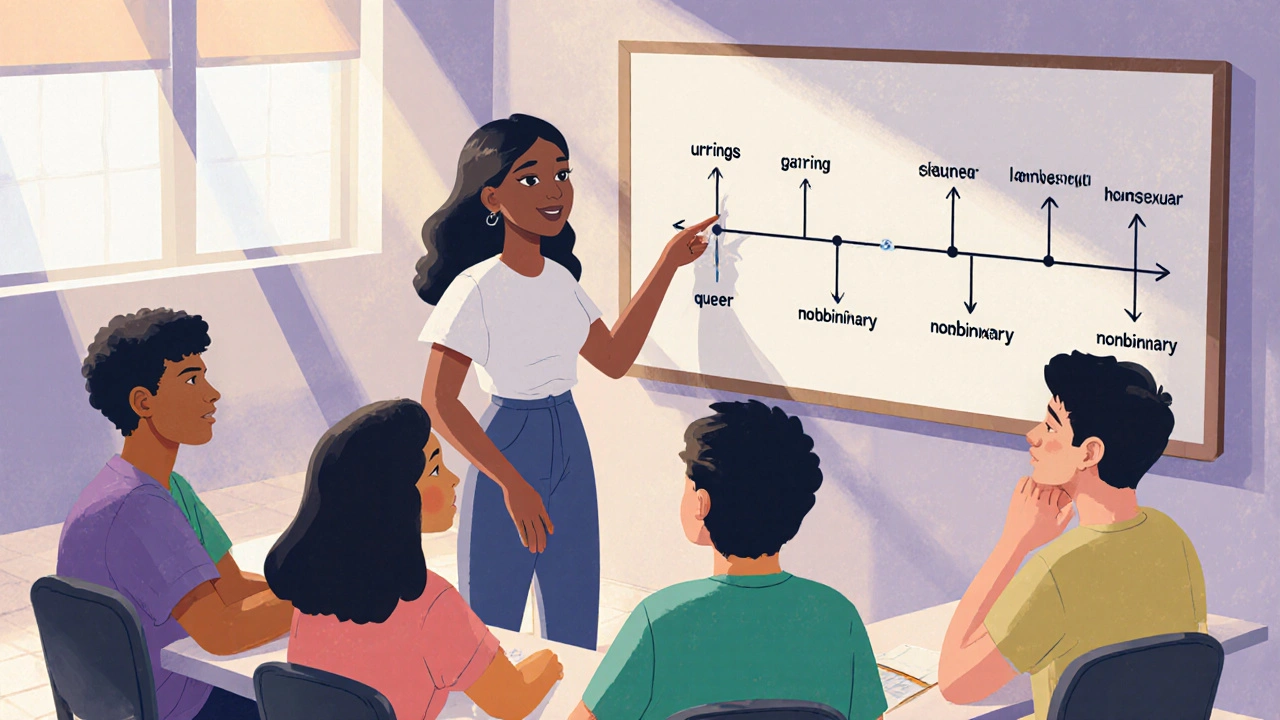
Constructivism wins in therapy and classrooms. A 2021 National Education Association report showed schools using constructivist approaches-teaching that identities can change, that attraction is fluid-had 22% fewer incidents of anti-LGBTQ+ bullying. Why? Because students learned that there’s no single “right” way to be queer. No checklist. No biological test.
But constructivism struggles when it comes to legal rights. If your identity is fluid, can you claim protection under civil rights law? Courts still struggle with that. Nonbinary people, genderfluid individuals, people who identify as asexual-these identities don’t fit neatly into “born this way” narratives. And yet, they need protection too.

The Middle Ground: Weak Constructivism
A growing number of researchers are moving past the either/or. They call it “weak constructivism.” It says: culture shapes how we understand sexuality, but that doesn’t mean our feelings are fake.Think of it like language. You didn’t invent English. You didn’t choose your native tongue. But you still use it to express your deepest thoughts. Similarly, you didn’t invent “gay” or “bisexual”-but the way you feel, the way you experience attraction, is real to you.
Lisa Diamond’s research at the University of Utah found that while biology plays a role in attraction, context matters just as much. A woman might feel drawn to men in her teens, women in her 30s, and both in her 40s-not because she’s confused, but because her environment, relationships, and self-understanding shift over time.
A 2022 survey of 598 participants found that people who held weak constructivist views were more likely to accept fluidity in others and less likely to police someone’s “authenticity.” They also didn’t reject biological influences. They just refused to reduce identity to DNA.
Today, 58% of sexuality researchers say they use this middle path in their work. It’s not perfect. But it’s more honest. It lets someone say: “I’ve always known I was gay,” and also: “I didn’t understand I could be queer until I met people who showed me it was possible.” Both can be true.
What This Means for You
If you’re LGBTQ+, this debate isn’t abstract. It affects how you see yourself. If you grew up hearing “it’s a phase,” that’s essentialism talking-it assumes your identity should be fixed from the start. If you’ve been told “you’re just confused because of social media,” that’s a distorted version of constructivism-it denies your feelings are real because they changed.The truth? Your sexuality is yours. It doesn’t need to be proven by science or validated by culture. But understanding these frameworks helps you push back when others try to define you.
Essentialism gives you the right to say: “I didn’t choose this. I was born this way.”
Constructivism gives you the right to say: “I’m still figuring it out-and that’s okay.”
The strongest position? The one that lets you hold both. You can feel something deep inside you-and still know that the words you use to describe it, the labels you wear, the communities you find-they’re shaped by the world around you. That doesn’t make your truth less real. It makes it human.
Is being gay a choice?
No, being gay isn’t a choice in the way you choose a career or a hobby. People don’t wake up and decide to be attracted to the same gender. But whether that attraction is fixed from birth or shaped by life experiences is still debated. Most experts agree that while the *feeling* isn’t chosen, the *label* and *expression* of that attraction are influenced by culture, relationships, and personal growth.
Why do some LGBTQ+ activists say ‘born this way’?
The phrase ‘born this way’ became popular because it helped win legal rights. Courts protect groups based on immutable traits-like race or religion. If being gay is seen as something you can’t change, then denying you rights becomes discrimination. This strategy worked: it helped legalize same-sex marriage and anti-discrimination laws. But it also pressured people to fit into a single, unchanging identity.
Can someone’s sexual orientation change over time?
Yes, for some people. Research shows that sexual identity can shift over time, especially among women. A 2010 national survey found that 14.4% of women and 5.8% of men reported changes in their identity over five years. This doesn’t mean they were ‘confused’ or ‘fake.’ It means attraction is complex. It can be influenced by relationships, life stages, self-acceptance, and social safety. Change isn’t the same as being a choice.
Does constructivism mean sexuality isn’t real?
No. Constructivism says the *categories* we use to describe sexuality-like ‘gay,’ ‘straight,’ or ‘bisexual’-are shaped by culture. But the feelings, desires, and connections people experience are real. It’s like money: the dollar bill isn’t inherently valuable, but the system we built around it has real power. Similarly, the label isn’t the feeling-but the feeling still matters.
Why do some people reject the idea that sexuality is socially constructed?
Because it can feel like their identity is being dismissed. If someone has spent years coming to terms with being queer, being told “it’s just a social construct” can sound like “it’s not real.” That’s why weak constructivism is gaining ground-it acknowledges that while culture shapes how we understand sexuality, the internal experience is still valid and deeply personal.