The story of Prophet Lot is often cited as the foundation for Islamic prohibitions on homosexuality. But if you read the Qur’an closely, you’ll find something surprising: the text never uses the word "homosexuality," and it doesn’t spell out a punishment. Instead, it describes a community that committed acts of violence, greed, and inhospitality-then was destroyed. For centuries, scholars have debated whether this story was meant to condemn same-sex acts, or something far more specific: rape, coercion, and the violation of sacred hospitality norms.
Traditional interpretations, especially those shaped by later texts, have turned this into a blanket ban. But history tells a different story. In the Ottoman Empire, where Islamic law was practiced for over 600 years, same-sex love was openly celebrated in poetry, art, and court life. Poets like Abdallah al-Shabrawi, who led al-Azhar-the most respected Islamic university in Cairo-wrote love poems to young male students. These weren’t hidden secrets. They were part of the culture. And no one was punished for it.
Why? Because pre-modern Islamic societies didn’t think in terms of sexual identities like "gay" or "straight." They focused on actions. A man could love another man without crossing a line into what jurists called "liwat"-anal penetration. Even then, punishment wasn’t automatic. The Hanafi school of law, followed by millions across South Asia and the Ottoman Empire, rarely imposed physical penalties. Judges had discretion. Confessions had to be repeated four times. Four eyewitnesses had to testify they saw penetration. That’s not just strict-it’s nearly impossible to meet. Most cases never went to trial.
Then came colonialism.
In 1858, the Ottoman Empire officially decriminalized same-sex relations, becoming the first Muslim-majority state to do so. But that wasn’t because of internal reform alone. It was because the empire was under pressure to modernize-and to match European legal standards. Meanwhile, British colonizers were busy exporting their own laws. Penal Code 377, passed in India in 1861, criminalized "carnal intercourse against the order of nature." It was copied across Africa, Southeast Asia, and the Caribbean. Today, 37 of the 76 countries that still criminalize homosexuality are former British colonies. Twelve of them are Muslim-majority nations. And guess what? None of them had laws against homosexuality before the British arrived.
Fast forward to today, and you’ll see a fractured landscape. In Brunei, Sharia law introduced in 2019 made same-sex relations punishable by stoning. No executions have happened yet-but the threat is real. In Iran and Saudi Arabia, executions do occur, though rarely. In Indonesia, the world’s largest Muslim-majority country, police raid gay bars and arrest people for "indecent behavior." In Turkey, where homosexuality has been legal since 1858, LGBTQ+ activists are being silenced. The government shut down Pride events, banned LGBTQ+ education in schools, and labeled activists as "foreign agents."
But not all Muslim communities follow the same path. In South Africa, the Muslim Judicial Council issued a statement in 2013 affirming that same-sex relationships deserve dignity under Islamic principles. In Indonesia, some progressive imams quietly preach tolerance. And in the U.S., the annual conference of Muslims for Progressive Values has grown from 50 people in 2012 to over 300 in 2022. These aren’t fringe groups. They’re scholars, imams, and activists who say: the Qur’an doesn’t condemn love.
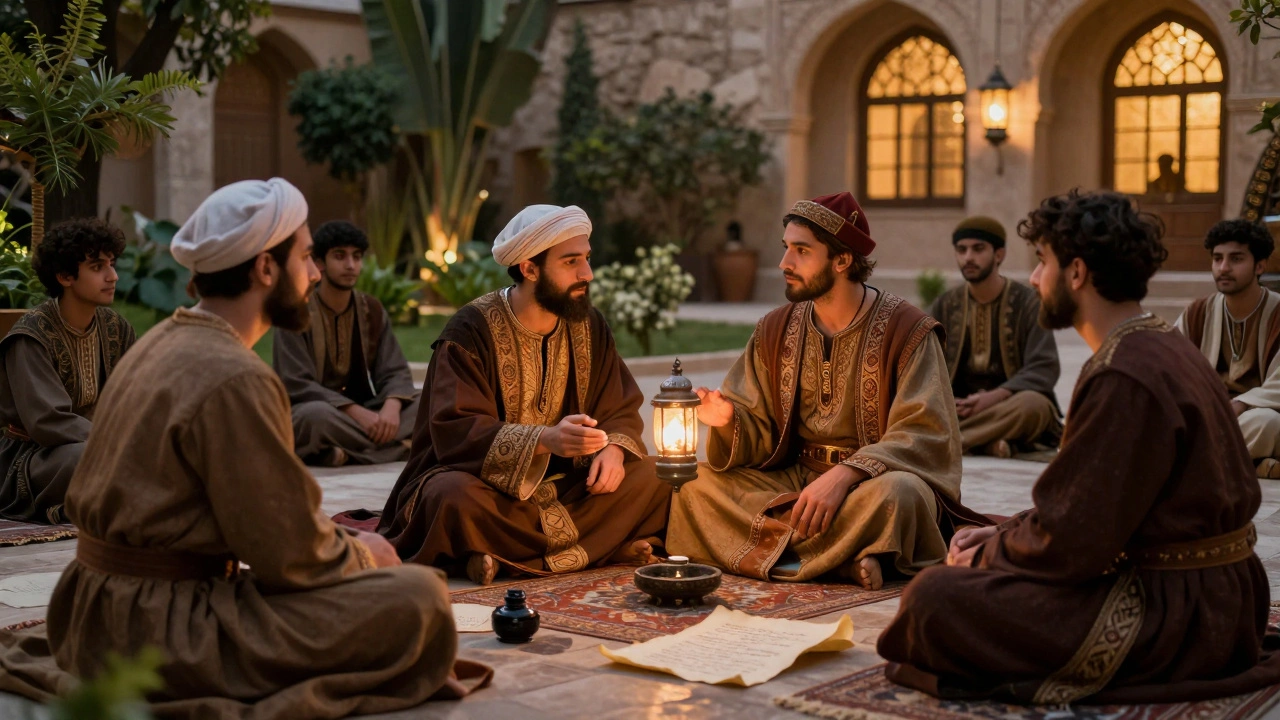
Scott Kugle, a leading Islamic scholar, argues that the story of Lot is about power-not sexuality. He points out that the men of Lot’s city demanded to sexually assault male guests in their home. That’s not consensual love. That’s gang rape. And the Qur’an condemns it as a crime against hospitality, not as a sin of desire. Kugle’s work, along with that of Khaled El-Rouayheb, shows that the concept of "homosexuality" as a fixed identity didn’t exist in the medieval Islamic world. People were judged by their actions, not their orientation.
Meanwhile, conservative scholars like Yusuf al-Qaradawi insist that the punishment for sodomy is death by stoning. His fatwa from 2003 is still cited by governments that use religion to justify repression. But here’s the gap: his argument relies on hadiths-sayings attributed to the Prophet Muhammad that were written down 100 to 250 years after his death. These texts weren’t part of the Qur’an. They were compiled by men with their own political agendas. And not all of them agree. One hadith says to punish only if the act is repeated. Another says to exile the person. Another says to beat them. There’s no single, clear rule.
The Organization of Islamic Cooperation, representing 57 Muslim-majority nations, rejected a 2011 UN resolution recognizing LGBTQ+ rights as human rights. But 17 Muslim-majority countries still have no laws against same-sex relations. Turkey, Tunisia, Indonesia, Albania, Senegal, and Bosnia are just a few. These countries aren’t rejecting Islam. They’re rejecting the colonial legal systems that were forced onto them-and returning to older, more flexible interpretations.
What does this mean for Muslims today? It means the debate isn’t just about religion. It’s about power, identity, and who gets to define what Islam is. For some, banning homosexuality is a way to assert moral purity. For others, it’s a tool to silence dissent, control bodies, and distract from corruption or economic failure. And for a growing number of Muslims, it’s simply wrong.
There’s no single Islamic view on homosexuality. There never has been. The Qur’an doesn’t mention it. The hadiths are contradictory. The history is rich and messy. The colonial legacy is brutal. And today’s laws? Many of them were written by foreign rulers, not by God.
What’s clear is this: the future of Islam’s stance on homosexuality won’t be decided by fatwas from distant capitals. It will be shaped by ordinary Muslims-teachers, students, poets, parents-who are asking new questions. What does justice look like? What does mercy mean? And can love between two people, no matter their gender, be a reflection of divine compassion?
The answer isn’t in ancient texts alone. It’s in how we choose to live today.