Medieval Sodomy Law Comparison Tool
Explore how legal definitions and penalties for male same-sex acts varied significantly across medieval Europe. Use the controls below to filter by region or view the full comparative table.
| Region | Jurisdiction Type | Primary Punishment | Notable Characteristics |
|---|
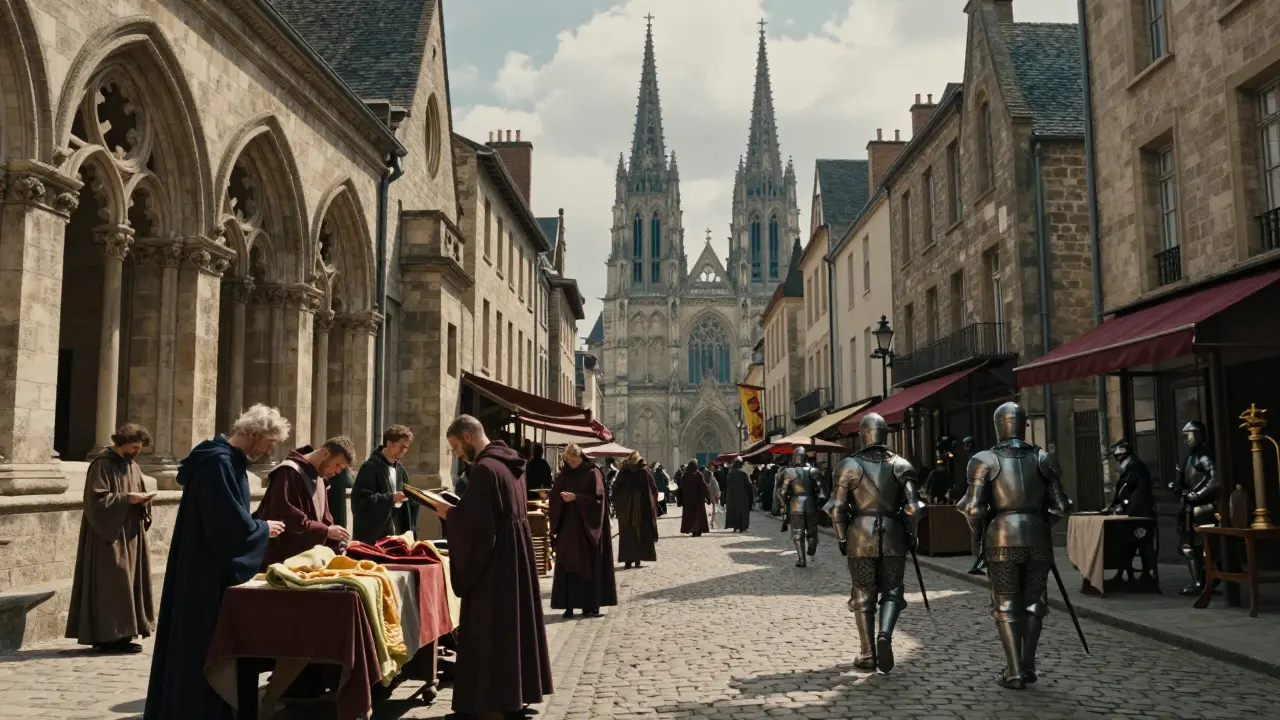
Imagine walking through the streets of 14th-century Paris or Florence. You might see merchants haggling over silk, monks chanting in nearby cloisters, and soldiers patrolling for bandits. But beneath this daily bustle lay a legal shadow that defined life for millions: sodomy was not just a sin; it was a crime punishable by death. For centuries, European societies didn't just frown upon male same-sex acts-they actively hunted them down, tried them in court, and executed them. This wasn't about modern identity labels like "gay" or "homosexual." It was about controlling bodies, property, and religious order. Understanding these laws reveals how deeply intertwined law, religion, and social control were in medieval life.
The Origins: From Sin to Statute
To understand why these laws existed, you have to look at where they came from. The concept of sodomy didn't start in secular courts. It began in the Church. Canon law, the legal system of the Catholic Church, declared certain sexual acts as sins against nature. The primary source here was the Bible, specifically Leviticus, which prohibited "lying with a man as with a woman." Early Church Fathers, such as Augustine and Jerome, interpreted these passages broadly, often conflating all non-procreative sex-whether between men, women, or even humans and animals-under one umbrella term: peccatum contra naturam, or sin against nature.
However, for most of the early Middle Ages (roughly 500-1100 CE), enforcement was inconsistent. Priests handled cases during penance. If a man confessed to having sex with another man, he might be given a prayer, a fast, or a pilgrimage. It was private, spiritual, and rarely involved the state. The shift happened when the Church began to formalize its legal codes. In the 12th century, as universities rose and legal scholarship flourished, canon lawyers started writing detailed commentaries on what constituted a crime worthy of public punishment. They argued that if a sin disrupted social order or threatened the stability of the family unit, the state had a duty to intervene. This was the bridge between church discipline and civil law.
What Counted as a Crime?
A common misconception is that medieval law targeted "homosexuality" as we understand it today. There was no such category. Instead, the law targeted specific acts. The key act was anal intercourse. Whether it occurred between two men, a man and a boy, or a man and an animal, it was legally identical in many jurisdictions. This meant that a married man who had sex with his wife vaginally was protected by law, but if he used anal penetration-even with his own wife-it could theoretically be prosecuted, though this was rare in practice.
The victim's status mattered less than the act itself. A nobleman committing sodomy with a servant was guilty. A peasant doing the same was also guilty. However, social class influenced the severity of the sentence. Nobles might pay fines or face exile, while peasants faced harsher physical punishments. Another critical factor was age. While there was no universal "age of consent," boys under twelve were often considered incapable of giving consent, making acts with them closer to rape in legal terms, though still prosecuted under sodomy statutes. This distinction highlights that the law was less about protecting individuals and more about maintaining a rigid hierarchy of acceptable behavior.
The Role of the Inquisition
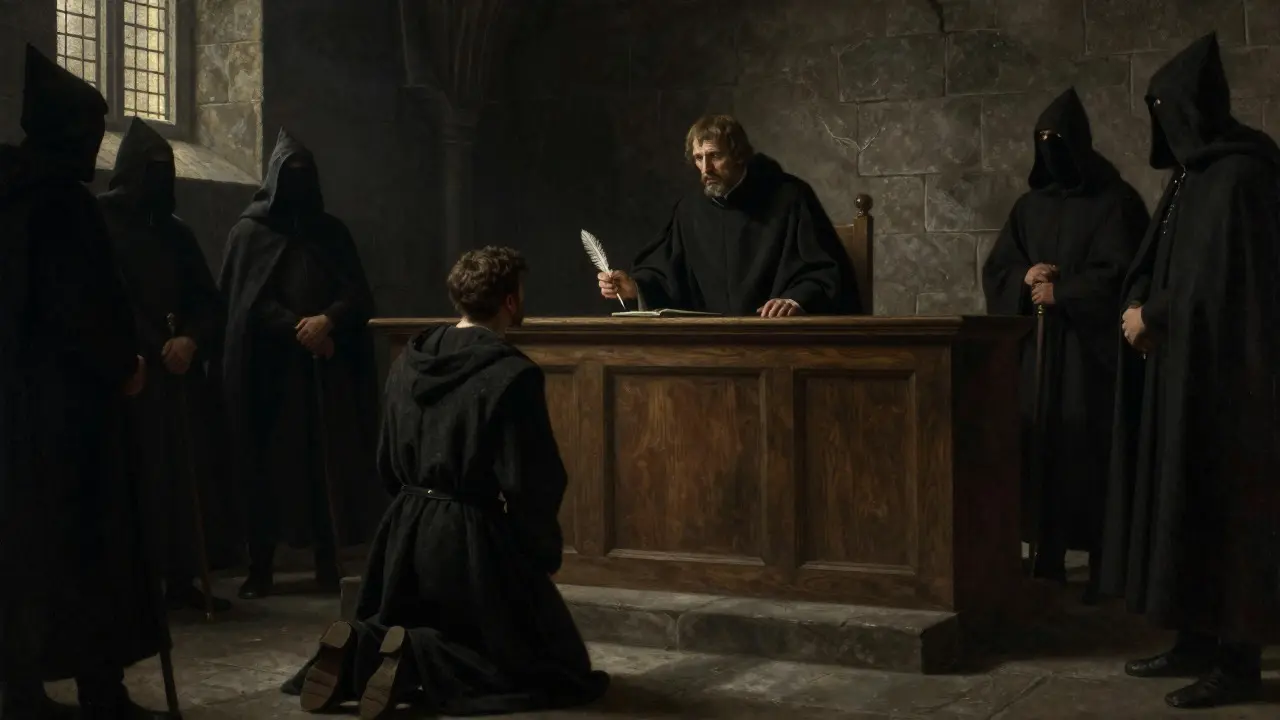
In some regions, particularly in France, Spain, and Italy, the Inquisition played a massive role in enforcing these laws. The Inquisition was not just a witch-hunting body; it was a tool for policing orthodoxy in all areas of life, including sexuality. When local courts were too lenient or corrupt, the Inquisition would step in. They established special tribunals that operated outside normal legal procedures. Defendants had limited rights, evidence could include anonymous accusations, and torture was permitted to extract confessions.
One notable example is the case of the Knights Templar in the early 1300s. Though their downfall was largely political, accusations of sodomy were part of the smear campaign used by King Philip IV of France to dissolve the order. This shows how sodomy charges could be weaponized for political gain. In other cases, like those in 15th-century Rome, the Inquisition kept meticulous records of trials. These documents reveal that prosecutors often focused on gathering witness testimony from servants, friends, or rivals. A single accusation could trigger a full investigation, turning private moments into public spectacles.
Punishments and Public Spectacle
If convicted, what happened? The most famous punishment was burning at the stake. This method was reserved for heretics, but sodomy was frequently treated as a form of heresy because it violated natural law. Burning was public, designed to terrorize the community and reinforce moral boundaries. However, not everyone was burned. Some defendants were whipped, branded, or exiled. In England, for instance, the punishment for buggery (the English term for sodomy) was initially death, but later shifted to imprisonment and whipping, especially after the Tudor period.
Public execution served a dual purpose. First, it punished the individual. Second, it educated the masses. Banners would be displayed before executions, listing the crimes. Sermons would precede the event, explaining why the act was unnatural. This theatricality turned justice into performance. Yet, despite the severity, conviction rates were surprisingly low. Why? Because proving the act required two witnesses or a confession. Since the act was usually private, finding witnesses was difficult. Many accused people fled, bribed officials, or simply disappeared. The law was strict on paper, but enforcement was often selective and sporadic.
Regional Differences and Legal Evolution
Medieval Europe was not a monolith. Laws varied significantly by region. In the Holy Roman Empire, local princes and city-states had their own codes. Nuremberg, for example, had stricter penalties than some Italian city-states. In Scandinavia, the influence of the Church was strong, but local customs sometimes softened enforcement. In England, the common law tradition developed differently, focusing more on property rights and less on theological definitions. By the 16th century, as the Reformation split Christendom, Protestant regions like Germany and the Netherlands began to codify sodomy laws in civil statutes, moving away from purely ecclesiastical jurisdiction.
This fragmentation meant that a person could be a criminal in one town and a free citizen in the next. Merchants traveling across borders had to know the local rules. This variability also allowed for pockets of tolerance. In some port cities, where diverse populations mixed, enforcement was laxer because authorities prioritized trade over moral policing. In rural areas, however, isolation made communities tighter, and gossip could lead to quicker accusations. The interplay between urban commerce and rural tradition created a complex patchwork of legal realities.

Why Did These Laws Persist?
You might wonder why these laws lasted so long, well into the 18th and 19th centuries. The answer lies in the structure of power. Sodomy laws reinforced the authority of the Church and the State. By defining what was "natural," rulers could legitimize their control over reproduction, inheritance, and labor. If a man had no children, his land passed to others, disrupting the feudal system. Ensuring procreative sex was a way to secure economic stability. Additionally, these laws provided a clear boundary between the sacred and the profane. In a world without modern science, religion explained everything. To violate religious norms was to threaten the cosmic order. As long as that worldview dominated, the laws remained relevant.
It wasn't until the Enlightenment, with its emphasis on reason and individual rights, that these laws began to crumble. Philosophers like Voltaire questioned the morality of punishing private acts. Legal reformers argued that the state had no business in bedrooms. By the late 1700s, many European countries began decriminalizing sodomy, replacing it with lighter penalties or abolishing it entirely. This shift marked the beginning of the end for the medieval legal framework, paving the way for the modern understanding of sexuality as a personal matter rather than a public crime.
| Region | Jurisdiction Type | Primary Punishment | Notable Characteristics |
|---|---|---|---|
| France | Ecclesiastical & Royal | Burning at the stake | Inquisition active; high-profile political cases |
| England | Common Law | Death, later whipping/imprisonment | Term "buggery"; focus on property rights |
| Italy (City-States) | Municipal & Papal | Fines, exile, occasional execution | Variable by city; commercial tolerance in ports |
| Holy Roman Empire | Local Princes/Cities | Whipping, branding, execution | Fragmented laws; Nuremberg stricter than others |
Legacy and Modern Perspectives
Today, we view these laws through a lens of human rights and historical context. We recognize that "sodomy" was a broad, often arbitrary label applied to various behaviors. The lack of a distinct identity for same-sex attraction meant that people lived their lives in a gray area, hiding parts of themselves to avoid danger. This history reminds us that legal systems are not neutral; they reflect the values and fears of the time. The struggle for LGBTQ+ rights in the modern era can be seen as a direct response to centuries of such criminalization. Understanding the medieval roots helps explain why stigma persisted long after the laws were repealed. Cultural attitudes change slower than statutes. Even after decriminalization, social prejudice remained, rooted in the same theological arguments that fueled the original laws.
Did medieval law distinguish between gay men and straight men?
No. The concept of sexual orientation did not exist. The law focused on the act (usually anal intercourse), not the identity. A man could be married and have children yet still be prosecuted for having sex with another man. Conversely, a bachelor who never engaged in the act was safe. Identity was irrelevant; behavior was everything.
How common were executions for sodomy?
Less common than popular culture suggests. While the penalty was severe, proof was difficult. Most cases ended in fines, penance, or exile. Executions were reserved for high-profile cases, repeat offenders, or when political motives were involved. Records show hundreds of trials, but only a fraction resulted in capital punishment.
Were women ever prosecuted for sodomy?
Rarely. The laws primarily targeted male acts. Female same-sex relations were often ignored by the law unless they involved bestiality or adultery. Since the legal definition centered on anal penetration, which was easier to prove in male-male cases, women faced fewer direct prosecutions under specific sodomy statutes, though they could be charged with general immorality.
When did sodomy laws start to disappear?
The process began in the late 18th century with the Enlightenment. France abolished the death penalty for sodomy in 1791. Other countries followed in the 19th century. By the mid-1800s, most Western European nations had either decriminalized the act or reduced the penalty to minor offenses. The final holdouts were in Eastern Europe and colonial territories, which maintained the laws longer.
How does this history affect LGBTQ+ rights today?
It provides historical context for ongoing stigma. Many anti-LGBTQ+ arguments today echo medieval theological views. Understanding that these prejudices have deep legal and religious roots helps activists frame their campaigns as a continuation of a long struggle for dignity and privacy. It also highlights the importance of separating religion from state law, a principle that took centuries to establish.