Bisexual Mental Health Impact Calculator
How Bisexual Erasure Affects Mental Health
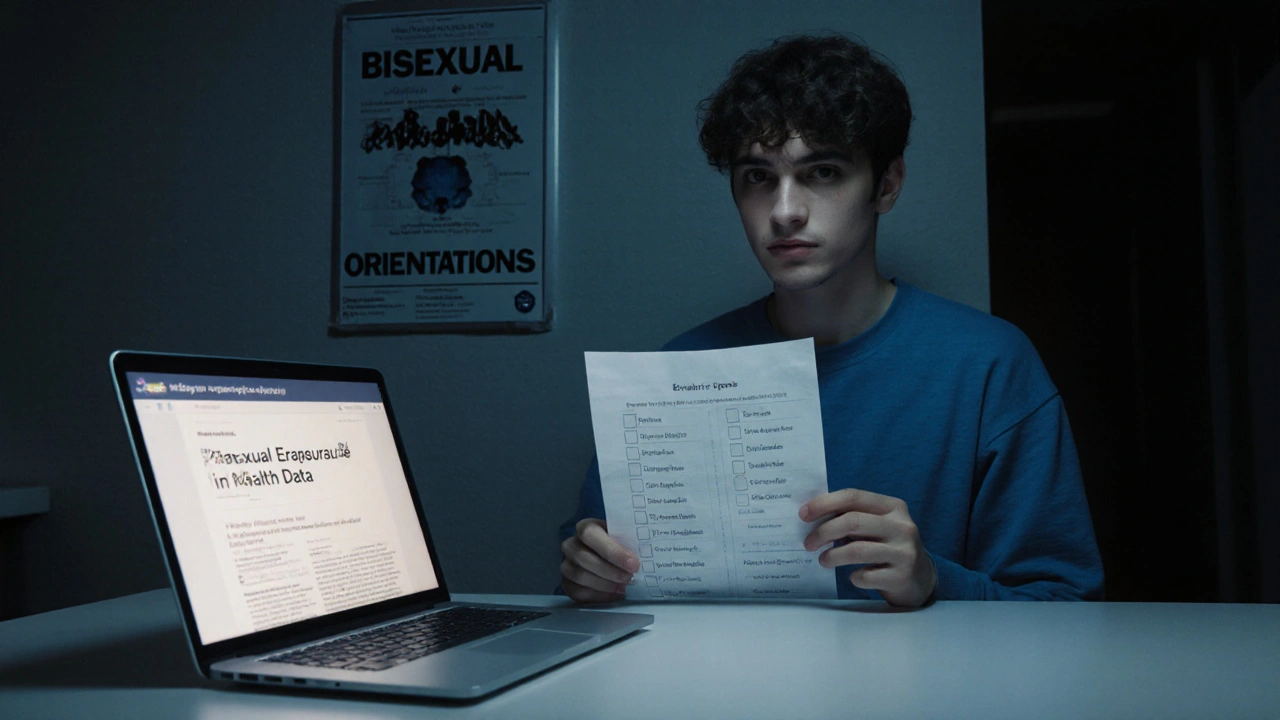
Research shows that bisexual people experience significantly higher rates of mental health challenges due to erasure and invalidation. This tool helps visualize the real-world impact of this phenomenon based on national statistics.
Estimated Mental Health Impact
Based on data from the National Health Interview Survey and CDC, if you have 0 bisexual people in your community, approximately 0 may experience depression, 0 may experience anxiety, and 0 may experience serious psychological distress.
*Note: These statistics reflect national averages and may vary by location, age, and other factors. Bisexual erasure is a systemic issue affecting mental health outcomes for individuals who experience ongoing invalidation of their identity.
Most people think of sexual orientation as a simple choice: straight or gay. But what if that’s not just wrong-it’s dangerous? For nearly half of all LGBTQ+ people in the U.S., that binary doesn’t fit. Bisexual erasure isn’t just ignorance. It’s a systemic refusal to see bisexuality as real, stable, and valid. And it’s killing people.
What Bisexual Erasure Actually Looks Like
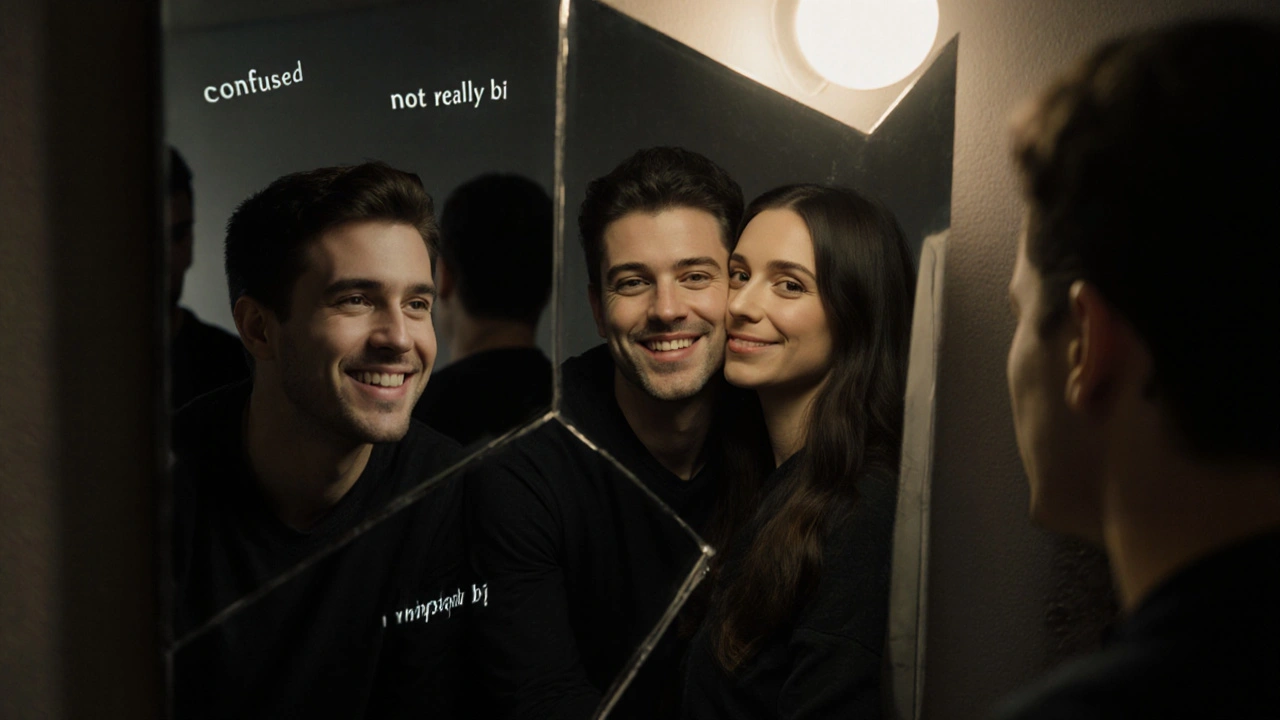
Bisexual erasure isn’t a single act. It’s a thousand tiny moments that add up to invisibility. It’s when a woman who dates men for years and then starts dating women is told, “Oh, so you’re gay now.” It’s when a man who’s been with both men and women is called “confused” or “going through a phase.” It’s when surveys ask if you’re straight or gay-and don’t give you a third option. It’s when your therapist assumes your relationship problems are because you’re “not really bi.” The term was first defined by legal scholar Kenji Yoshino in 1999, but the pattern goes back much further. The core idea? Society refuses to accept that someone can be attracted to more than one gender. Instead, people are forced into a binary: if you’re with a man, you’re straight. If you’re with a woman, you’re gay. Your past doesn’t matter. Your feelings don’t matter. Your identity is rewritten based on who you’re dating right now. This isn’t just social awkwardness. It’s institutional. In 2018, the U.S. Census Bureau classified people with same-sex partners as “gay” and those with opposite-sex partners as “straight”-no matter if they’d ever dated both. That means millions of bisexual people vanished from official data. Researchers couldn’t track their health, income, or housing needs because they weren’t counted as their own group.The Three Layers of Erasure
Bisexual erasure doesn’t happen in one way. It works in three overlapping layers, each more damaging than the last. The first is societal erasure: the outright denial that bisexuality exists. This is the “you’re just confused” line. It’s when schools teach only two sexual orientations. It’s when media only shows characters who are either straight or gay, never bi. The second is individual erasure: the demand for proof. A 2022 study found that 78.3% of bisexual people have been asked invasive questions like, “How do you know you’re not just experimenting?” or “Have you slept with both men and women?” These aren’t casual questions. They’re tools of control. They treat bisexuality as a lie until proven true-something no other identity has to endure. The third layer is delegitimization: accepting bisexuality exists, but only to paint it as broken. In TV shows from 2021 to 2023, 65.7% of bisexual characters were portrayed as untrustworthy, promiscuous, or emotionally unstable. These aren’t just bad stereotypes. They’re narratives that justify discrimination. If you’re seen as incapable of monogamy, why would anyone trust you with custody, a job, or even medical care?Why This Isn’t Just About Labels
This isn’t about identity politics. It’s about survival. Data from the National Health Interview Survey shows that 40.6% of bisexual adults suffer from depression-compared to 25.5% of gay or lesbian adults. Anxiety rates are even higher: 36.8% for bisexual people versus 24.3% for others. The 2021 National Survey on Drug Use and Health found that 52.3% of bisexual adults experienced serious psychological distress. That’s more than double the rate of straight people. These numbers aren’t random. They’re the result of constant invalidation. When your identity is dismissed by your family, your friends, your doctor, and even your own community, it wears you down. The Bisexual Resource Center’s 2022 survey found that 82.4% of bisexual people feel excluded from both straight and LGBTQ+ spaces. That’s not just loneliness. It’s isolation with no escape. And it gets worse for transgender bisexual people. Dr. Julia Serano’s research found that 68.9% of trans individuals who identify as bisexual face double erasure-rejected by mainstream society and also pushed aside within LGBTQ+ communities. Their identity is erased twice, and the mental health toll reflects that.
How Research Has Made It Worse
Science has been complicit. For decades, psychological studies treated bisexuality as a transitional phase, a mistake, or a statistical error. In 2008, researchers Barker and Langdridge found that nearly 90% of studies either ignored bisexual participants or forced them into the gay/straight binary based on their current partner. That bias didn’t just skew data-it shaped clinical practice. A 2018 study found that 63.2% of mental health professionals had no training in working with bisexual clients. Many assumed bisexuality was a sign of instability. Others thought it was irrelevant-why treat a “phase” differently from being gay? The consequences were deadly. A 2011 analysis of CDC data showed bisexual youth were 3.58 times more likely to attempt suicide than their straight peers-and 1.87 times more likely than gay or lesbian youth. Why? Because they had no one to turn to. No one who understood them. No one who even acknowledged they existed. The Klein Sexual Orientation Grid, developed in 1978, was one of the first tools to measure attraction, behavior, fantasy, and identity across multiple dimensions-not just partner gender. But it took until 2020 for researchers like Dr. Brian Dodge to start using it widely. Even now, most surveys still ask: “Are you straight, gay, or lesbian?” No room for bi.Even the LGBTQ+ Community Lets Them Down
You’d think the LGBTQ+ community would be a safe space. But too often, it’s not. Dr. Weiss’s 2004 research found that 58.7% of bisexual people had been turned away from gay bars or excluded from LGBTQ+ events because they weren’t “queer enough.” Some were told they didn’t belong because they’d dated men. Others were accused of “straight privilege” for being in opposite-sex relationships. A 2021 campaign collecting 347 personal stories found that 76.3% of respondents were labeled as straight or gay based on their current partner. One woman described being called “lesbian” after dating her girlfriend for a year-despite having been married to a man for a decade. Another man said he was told he was “not really bi” because he didn’t have sex with men in the last five years. This exclusion has real costs. Ross et al.’s 2010 study showed bisexual people who felt rejected by LGBTQ+ spaces were 2.34 times more likely to have suicidal thoughts than those who felt accepted. When your community turns its back on you, where do you go?