Medieval Marriage Law Simulator
Explore how medieval Canon Law determined if a union was legally binding. Adjust the variables below to see the legal outcome.
Imagine getting married today. You say your vows, you kiss, and legally, you are husband and wife. If you never touch each other again, the marriage still stands. Now rewind to the 13th century in Europe. You say your vows, but if you don't sleep together, you aren't actually married. In fact, you might be free to marry someone else tomorrow. This isn't a modern misunderstanding of ancient customs; it was hard law. For centuries across medieval Europe, consummation was the single most important factor in determining whether a union was real. The church didn't just care about love or social status; they cared about biology.
This sounds bizarre to our modern ears, right? We view marriage as a legal contract or a spiritual covenant that begins the moment two people agree to it. But for medieval theologians and lawyers, sex wasn't just an act within marriage-it was the engine that made the machine run. Without it, the gears never turned. To understand why, we have to look at how the Catholic Church viewed the body, sin, and the purpose of human connection. It wasn't just prudishness; it was a complex legal framework designed to solve a very specific problem: how do you prove someone is actually married when there are no marriage certificates?
The Two-Step Process: Consent vs. Consummation
To get this straight, you need to unlearn what you know about wedding ceremonies. Medieval marriage wasn't a single event. It was a process with two distinct stages. The first stage was Sponsalia, which is Latin for betrothal or engagement. This involved public promises, often sealed with a ring or a handshake. At this point, the couple was considered "espoused." They were committed, but they weren't fully married in the eyes of God or the community. They could live separately, and crucially, they could break off the engagement without a formal divorce trial.
The second stage was the actual marriage, known as Matrimonium. This required more than just words. It required physical union. The theological logic came from St. Paul’s letter to the Corinthians, where he wrote that "the two shall become one flesh." Medieval canonists took this literally. Until the couple became "one flesh" through sexual intercourse, they remained two separate entities. The consent started the relationship, but the sex finalized it.
This distinction mattered because it changed everything about property, inheritance, and social standing. If a nobleman died after the betrothal but before the wedding night, his fiancée got nothing. She wasn't his widow. She was just a woman who had promised to marry him. But if they had slept together-even once-she was his wife, and she owned half his estate. The bed was the courtroom where these claims were settled.
Why Did the Church Insist on Sex?
You might ask, why make it so complicated? Why not just accept the verbal promise? The answer lies in the medieval fear of fraud and the desire for clear evidence. In a world without paper trails, digital records, or witnesses who stayed around forever, how did you prove a secret marriage? People sometimes married in secret to escape disapproving parents or to grab an inheritance quickly. If a man claimed he married a woman privately, and she denied it, who was telling the truth?
Canon Law, the legal system of the Catholic Church, developed strict rules to handle these disputes. One major rule was that a marriage had to be witnessed by a priest and posted publicly (the banns) to be valid. But even with witnesses, doubts lingered. Sexual consummation provided undeniable biological proof. It created a new reality. It produced children, yes, but more importantly, it demonstrated that the couple intended to fulfill the duties of marriage. A refusal to have sex was seen as a refusal to participate in the sacrament.
There was also a moral dimension. The Church taught that sex outside of marriage was a mortal sin. But sex inside marriage was a duty. If a couple refused to have sex, they were living like siblings, not spouses. This state was called "continence," and while holy in monasteries, it was suspicious in marriage. If you said "I do" but wouldn't touch your spouse, were you really trying to build a life together? Or were you hiding something? Maybe you were already married to someone else. Maybe you were impotent. Maybe you didn't want the financial burden of a wife. The requirement of sex forced couples to confront their intentions.
The Impotence Trials: When Proof Was Physical
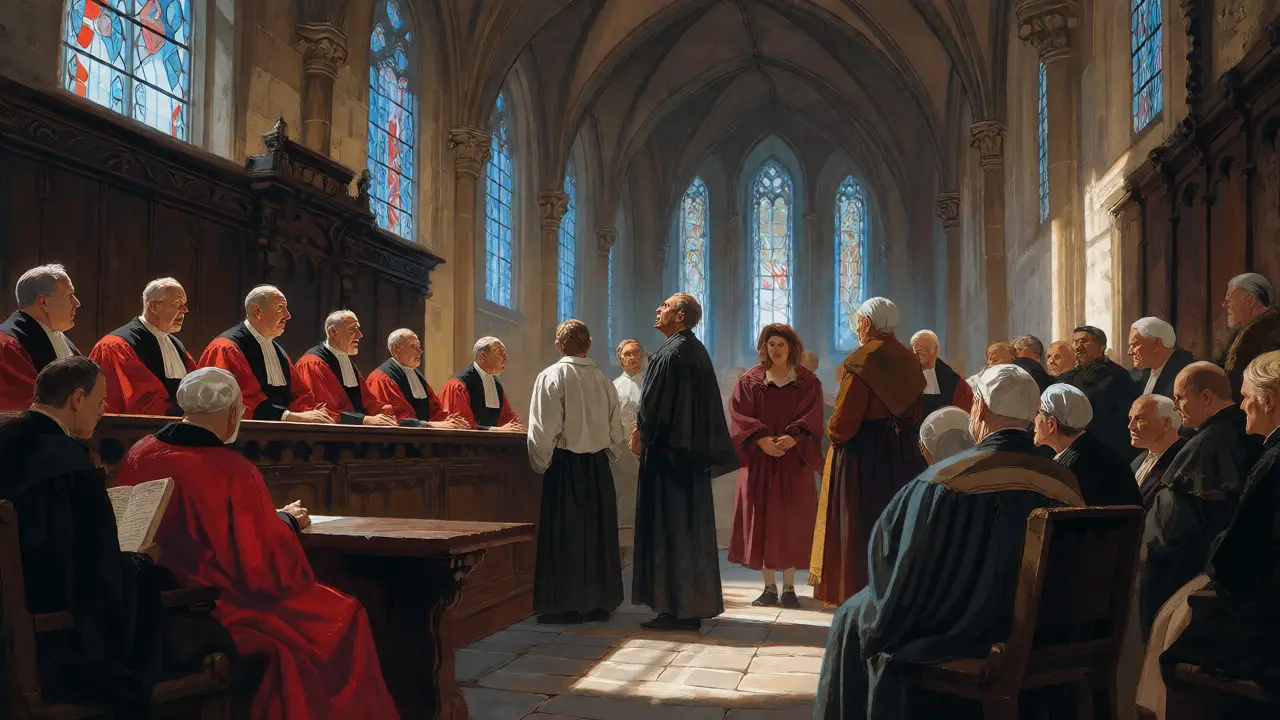
Because consummation was so vital, its absence led to some of the most awkward legal proceedings in history: the impotence trials. If a wife wanted to annul her marriage, she couldn't just say, "He's boring." She had to prove the marriage was never completed. Usually, this meant claiming her husband was physically unable to perform sexually.
These cases weren't handled quietly. A panel of midwives, surgeons, and local women would inspect the husband. They checked for physical defects, scars, or signs of previous marriages. Sometimes, the couple was asked to demonstrate their ability in front of the court. Yes, really. There are records from France and England where couples were ordered to attempt intercourse in the presence of judges. If the husband failed, the marriage was declared null and void. It was as if it never happened.
This system favored men in practice, though. Women faced higher stakes. If a woman was found to be "frigid" or unwilling, she could be punished. But if a man was impotent, he lost his lineage and his honor. The pressure to produce an heir drove many nobles to rush into consummation immediately after the ceremony. Waiting was risky. What if the groom got cold feet? What if the bride had a medical issue? The sooner they proved the marriage was valid, the safer everyone felt.
| Feature | Betrothal (Sponsalia) | Consummated Marriage (Matrimonium) |
|---|---|---|
| Legal Status | Promised union; revocable. | Indissoluble bond; permanent. |
| Property Rights | No automatic dower or inheritance rights. | Wife gains dower rights; children inherit. |
| Social Perception | Couple is engaged; can date others formally. | Couple is husband and wife; exclusive. |
| Ending the Union | Simple mutual agreement or breach of promise. | Requires Annulment or Death. |
| Sexual Requirement | Optional (often avoided). | Mandatory for validity. |
Who Decided What Counted as Sex?
We assume sex means penetration, but medieval definitions were stricter and weirder. For a marriage to be valid, the act had to be capable of producing children. This meant vaginal intercourse was the only thing that counted. Oral sex, anal sex, or manual stimulation didn't count toward consummation. If a couple had a passionate night but skipped the "necessary" part, they were still technically unmarried.
This definition excluded many relationships that we would consider intimate. It also created loopholes. Some couples used the pre-marital period to test compatibility. If the man couldn't perform vaginally, the match was off. This practical approach reduced the number of unhappy, childless marriages among the wealthy. For the poor, who often married later in life and had fewer resources, the focus was less on testing and more on survival. But the law applied to everyone.
The Church also worried about "frigidity" in women. Unlike male impotence, which was seen as a physical defect, female reluctance was often viewed as a moral failing. A woman who refused sex could be accused of denying her husband his marital debt. However, if she could prove she was physically incapable (due to a condition like vaginismus), she could seek an annulment. The burden of proof, however, was heavy. She needed witnesses, doctors, and patience.

The Shift Away from Sexual Proof
If consummation was so important, why don't we require it today? The shift began slowly. By the late Middle Ages, the Council of Trent (1545-1563) reformed marriage laws. The Church decided that consent alone should make a marriage valid. Why? Because requiring sex for validity led to too many secret marriages and scandalous trials. It was messy. It was invasive. And frankly, it allowed men to seduce women under the guise of marriage and then deny the union if things went south.
Trent mandated that marriages must be performed by a priest and witnessed by two people. This created a public record. Suddenly, you didn't need to prove you had sex to prove you were married. You just needed to show up at the church and sign the register. The role of consummation shifted from "maker of the marriage" to "proof of normalcy." It became a ground for annulment rather than a requirement for creation. If you never had sex, your marriage was still valid, but it could be annulled later if you chose to fight it.
This change reflected a broader move away from bodily proofs toward documentary ones. As literacy spread and record-keeping improved, society trusted paper more than flesh. Today, we barely think about consummation. It’s a private matter between partners. But for five hundred years, it was the cornerstone of European family law. It determined who owned land, who ruled kingdoms, and who was legitimate. Every royal succession crisis, every divorce scandal, and every disputed will hinged on whether two people had shared a bed.
Key Takeaways
- Consent wasn't enough: In medieval canon law, verbal vows only created a betrothal. Actual marriage required sexual intercourse.
- Proof of validity: Consummation served as biological evidence that the couple intended to live as husband and wife.
- Impotence trials: Couples could sue for annulment if they couldn't have sex, leading to public medical examinations.
- Strict definitions: Only vaginal intercourse counted. Other sexual acts did not validate the marriage.
- Legal reform: The Council of Trent ended the requirement, shifting focus to public witness and documentation.
Did all medieval marriages require sex to be valid?
Yes, under Catholic Canon Law, which governed most of Western Europe, a marriage was not considered complete until it was consummated. Before the 16th century, a couple who exchanged vows but never had sex were technically only betrothed. They could separate without a formal divorce, and neither party gained full spousal rights like inheritance or dower.
What happened if a husband was impotent?
If a husband could not perform sexually due to physical inability, the wife could petition for an annulment. This process often involved a public examination by midwives or surgeons to verify the impotence. If confirmed, the marriage was declared null and void, meaning it legally never existed. The wife was then free to remarry.
Why did the Church stop requiring consummation?
The Council of Trent in the 16th century changed the law to prevent fraud and simplify administration. Requiring sex for validity led to many secret marriages and difficult-to-prove claims. By mandating that marriages be performed by a priest with witnesses, the Church created a public record. This made consent and documentation the primary markers of a valid marriage, moving away from bodily proof.
Was oral sex considered consummation?
No. Medieval canon law defined consummation strictly as vaginal intercourse capable of procreation. Acts such as oral sex, anal sex, or mutual masturbation did not count toward validating a marriage. Even if a couple engaged in these activities regularly, the marriage remained incomplete in the eyes of the law until vaginal penetration occurred.
How did commoners handle this rule compared to nobility?
Commoners generally followed the same religious laws, but enforcement was looser. Poorer couples often lacked the resources for lengthy legal battles over annulments. For them, community recognition and cohabitation were often more important than strict legal technicalities. Nobility, however, relied heavily on these rules to secure dynasties, making consummation a critical political and financial milestone.