Medieval Marriage Economics Simulator
Select a region to see how local customs affected the financial risk for brides and grooms. The intensity of scrutiny correlated directly with the size of the dowry.
Northern France
High DowryEngland
Moderate DowryItalian City-States
Very High DowryRegional Analysis
Financial Risk Assessment
Simulate the outcome if the "proof" of purity was challenged on the wedding night.
The marriage could be annulled. The bride returns to her family, often with a damaged reputation that limits future marriage prospects.
Loss of full dowry. Social stigma forces exclusion from high-status marriages, potentially leading to lower-tier unions or convent life.
Imagine a woman in 14th-century France. Her worth isn't just about her beauty or her family name; it is literally tied to the state of her hymen. In the medieval period, a woman's body was often treated as a financial asset. If she arrived at her wedding night intact, the contract held. If not, the dowry could be voided, and her social standing crumbled. This wasn't just moral policing; it was hard economics.
The connection between sexual purity and money runs deep into the fabric of medieval society. For centuries, historians focused on the Church's role in regulating sex. But recent scholarship reveals that the real driver was often the transfer of wealth between families. A woman's virginity was a guarantee of lineage certainty. It ensured that any children born from the marriage were biologically related to the husband, securing inheritance rights. This made sexual purity a commodity with a price tag.
The Financial Weight of the Hymen
To understand why this mattered so much, you have to look at how property worked. In many European regions, land and titles passed through male lines. A wife brought a dowry-cash, land, or goods-to support the new household. However, if the husband suspected infidelity before the wedding, he risked raising a child who wasn't his heir. That meant his estate might pass to someone else. So, the promise of virginity acted as an insurance policy for the groom's family.
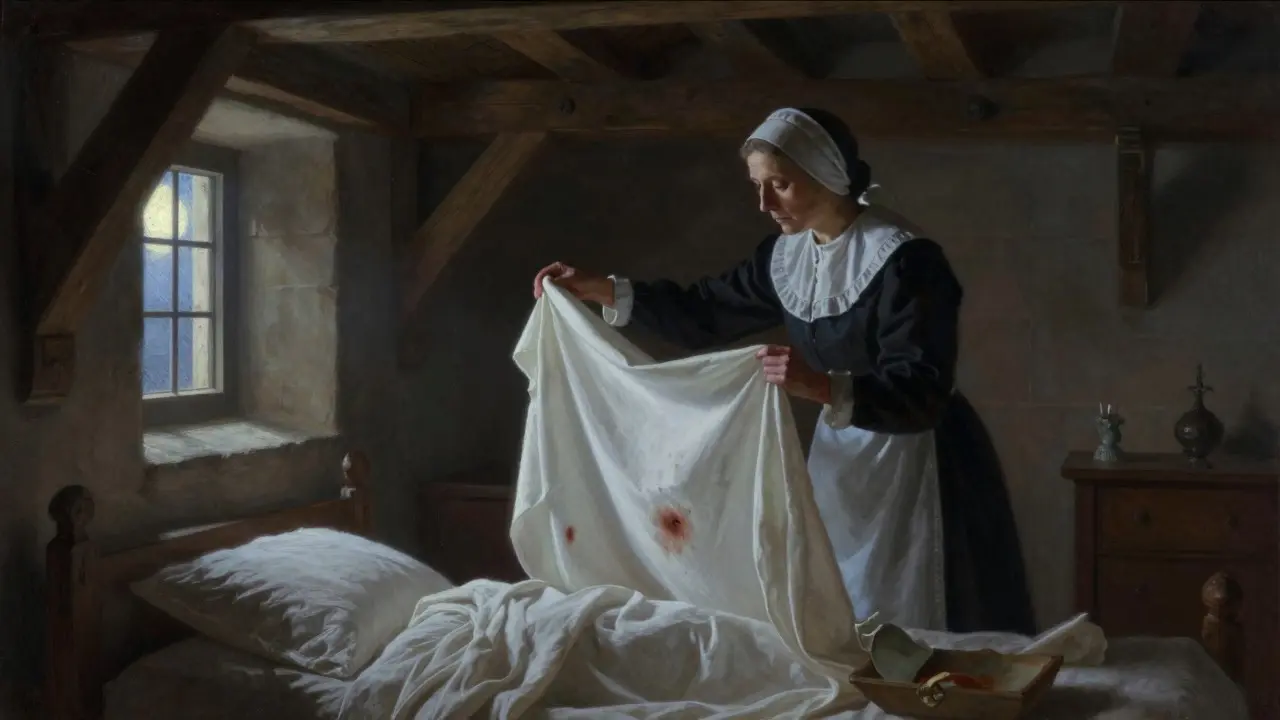
- Verification Rituals: On the wedding night, the husband (or sometimes a midwife) would check for bloodstained sheets. These "proofs" were kept as legal evidence.
- Contractual Clauses: Marriage contracts often included clauses stating that the bride must be a virgin. Failure to prove this could lead to annulment or loss of the dowry.
- Social Stigma: A "broken" woman faced exclusion from high-status marriages, forcing her into lower-tier unions or convent life.
This system created a paradox. While the Church preached chastity as a spiritual virtue, the secular courts cared about the bloodstain because it protected property. The two systems reinforced each other, making the pressure on young women immense.
Regional Variations and Legal Realities
Not every corner of medieval Europe operated the same way. In England, common law was less rigid about proving virginity than in some continental jurisdictions. However, local customs varied wildly. In parts of Italy and Spain, the dowry system was more formalized, and the financial stakes were higher due to complex family business structures.
| Region | Dowry Prevalence | Virginity Verification | Legal Consequence of Infidelity |
|---|---|---|---|
| Northern France | High | Common (bloodstained sheets) | Annulment possible |
| England | Moderate | Less formalized | Fine or separation |
| Italian City-States | Very High | Strict contractual clause | Loss of dowry/property |
| Scandinavia | Low | Rarely documented | Divorce easier |
Notice the difference in Scandinavia. Here, the dowry system was weaker, and women had slightly more autonomy. This suggests that the intensity of the virginity requirement correlates directly with the size of the dowry. Where money moved more, scrutiny was tighter.
The Role of the Church and Secular Law
The Catholic Church played a dual role. Theologically, it emphasized the sanctity of marriage and the sin of premarital sex. Canon law required consent for marriage but didn't always mandate proof of virginity. However, local bishops often enforced stricter standards to maintain social order. Meanwhile, secular kings and lords cared less about souls and more about stable estates. They supported laws that prevented disputes over inheritance.
This overlap created a powerful enforcement mechanism. A woman accused of losing her virginity faced both spiritual condemnation and financial ruin. She might be excommunicated or simply disowned. The fear of this double punishment kept many women compliant, even when they felt the rules were unfair.

Women's Agency Within the System
It’s easy to view medieval women as passive victims of these rules. But reality was more complex. Some women used their reputation for purity to negotiate better marriage terms. A girl known for strict chastity could command a higher dowry or marry into a higher social tier. Others found ways around the system. Midwives, who conducted the checks, could be bribed to report false positives. Stories of "fake" bloodstains appear in court records, showing that the system wasn't foolproof.
Additionally, widows had different rules. A second marriage didn't require virginity, only widowhood. This gave older women a distinct economic advantage. They could remarry without the stigma of being "used," allowing them to secure new financial protections. This nuance is often missed in popular history, which tends to focus only on young brides.
Long-Term Impact on Gender Roles
The legacy of linking sexual purity to economic value didn't disappear after the Middle Ages. It evolved. As the dowry system faded in favor of joint property laws, the emphasis shifted from physical proof to social reputation. Yet, the underlying idea remained: a woman's sexual behavior affected her family's financial stability. This mindset persisted into the early modern period and influenced debates about female education and employment well into the 19th century.
Understanding this historical context helps us see why discussions about gender equality still touch on topics of bodily autonomy and economic independence. The medieval era established a framework where a woman's body was a site of economic negotiation, a concept that resonates far beyond its time.
Did all medieval women have to prove their virginity?
No, it depended on region and social class. Wealthy families in areas with strong dowry traditions, like northern France and Italy, were most likely to enforce this. Poorer peasants often lacked the resources for formal verification, and rural customs varied widely.
What happened if a bride was not a virgin?
Consequences ranged from mild to severe. In some cases, the marriage continued but the dowry was reduced. In others, the marriage was annulled, and the woman returned to her family, often with a damaged reputation that limited future marriage prospects.
How did the Church view premarital sex?
The Church considered premarital sex a sin, but enforcement was inconsistent. Local priests often prioritized community harmony over strict theological policing. However, public scandals could lead to penance or social ostracism, reinforcing the importance of maintaining a reputation for purity.
Were there any benefits for women in this system?
Yes. Maintaining a reputation for purity allowed women to secure better marriages and higher dowries. It also provided a form of social capital that could be leveraged for protection and status within the community. Widows also benefited from not having to re-prove virginity upon remarrying.
How does this compare to modern views on marriage?
Modern marriages are generally based on individual choice and emotional connection rather than economic exchange. While dowries exist in some cultures today, they are rarely tied to strict virginity requirements. The shift reflects broader changes in women's legal rights and economic independence.