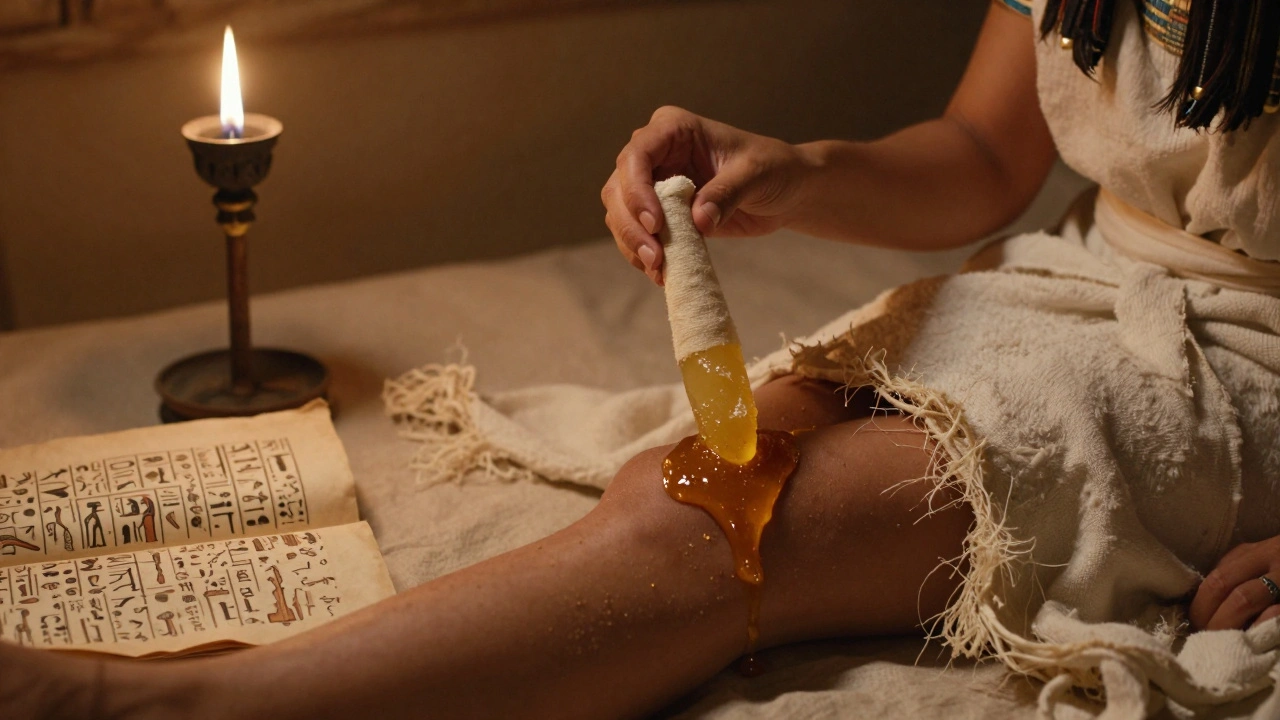
Long before pills, patches, or condoms, people figured out ways to stop pregnancy using what was around them: honey, acacia gum, crocodile dung, and sea sponges. These weren’t guesses or superstitions-they were written down in medical texts, tested, and passed down for centuries. The history of birth control isn’t a modern invention. It’s a story of trial, error, and surprising science buried in ancient scrolls.
What Did They Actually Use?
In ancient Egypt, around 1850 BC, women used pessaries-vaginal inserts made of materials like lint, honey, and acacia leaves. The Kahun Gynecological Papyrus, one of the oldest medical documents ever found, describes how these were shaped like cones and inserted deep into the vagina. Modern tests show that acacia gum, when fermented, produces lactic acid, which kills sperm. That’s not magic. That’s chemistry. And it worked. The Ebers Papyrus from 1550 BC adds another layer: a mixture of honey and sodium carbonate. Sodium carbonate is a natural alkali, still used today in some spermicidal gels. Even weirder? Crocodile dung. Yes, really. It was mixed with honey and inserted as a barrier. We don’t know if it helped, but it shows they were experimenting with texture, pH, and physical obstruction-all principles still used in modern contraception.Silphium: The Ancient Contraceptive Superstar
In ancient Greece and Rome, the most sought-after birth control wasn’t a plant you could grow anywhere. It was silphium, a giant fennel-like herb that only grew in a narrow strip of land near Cyrene, in what’s now Libya. It was so valuable, it was stamped on coins. People took it orally as a resin or juice. The physician Soranus of Ephesus wrote that it could prevent conception or even cause early abortion. Modern studies suggest it likely contained compounds that interfered with implantation or hormone function. But silphium didn’t last. Overharvesting, combined with its inability to be cultivated elsewhere, led to its extinction by the 1st century AD. The Romans scrambled for replacements. Asafoetida, a pungent resin from Ferula plants, became the go-to substitute. It worked somewhat, but too much could poison you. That’s how desperate they were.Barrier Methods: The Original Tampons and Plugs
Long before the modern tampon, women in Greece and Rome used sea sponges soaked in vinegar, honey, or even lead-based solutions. These were inserted into the vagina to block sperm. The same sponges were later reused-washed out and reinserted. That’s not just practical. That’s resourceful. Soranus, again, was ahead of his time. He rejected magical amulets and astrology. Instead, he recommended wool plugs soaked in oils or sticky substances. He even advised women to sit upright after intercourse to let semen drain out. It sounds odd, but the idea of using physical barriers to block sperm? That’s exactly how today’s diaphragms and cervical caps work.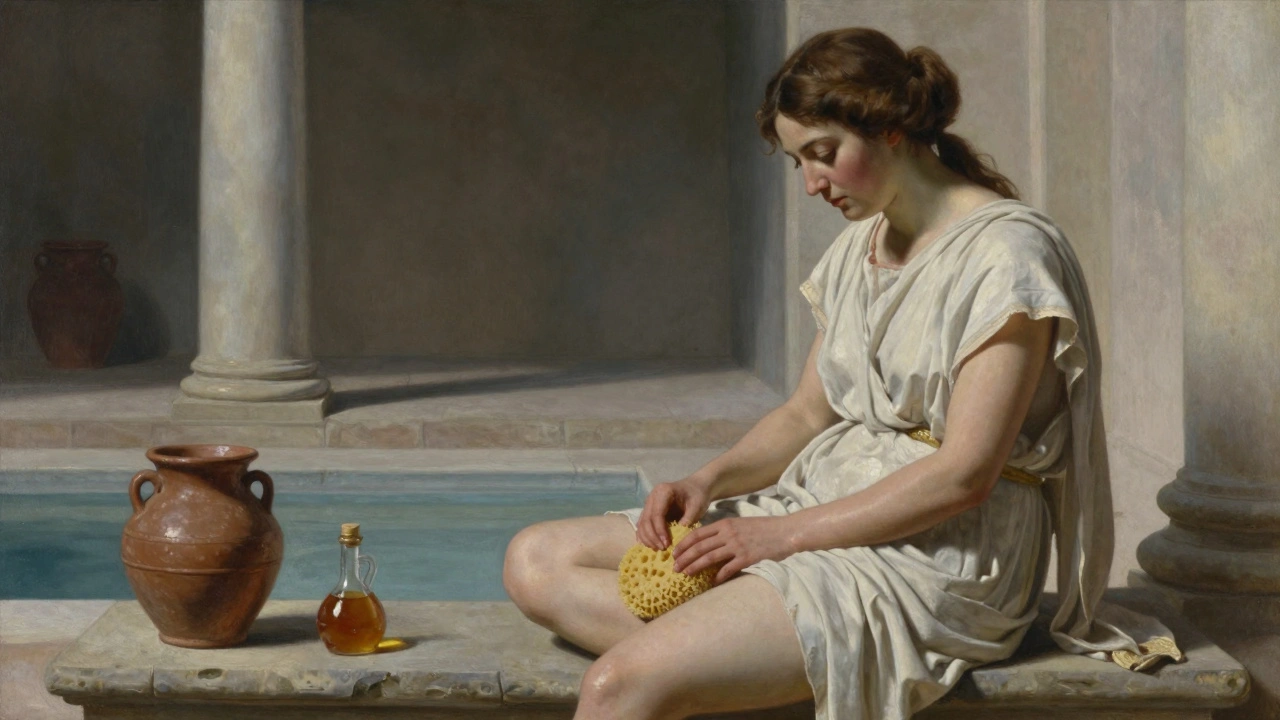
What Actually Worked?
Most of these methods were hit or miss. Wiping after sex? Useless. Jumping backward seven times? No effect. Drinking copper saltwater? Toxic and pointless. But three methods had real potential:- Coitus interruptus (withdrawal): Used across Egypt, Rome, and China. It’s not perfect, but it’s the most effective non-device method before modern science.
- Honey and acacia pessaries: Modern labs confirmed they create spermicidal conditions. Some modern jellies still use similar compounds.
- Sea sponge barriers: They physically blocked sperm. Think of them as early tampons with a purpose.
From Egypt to Persia: A Global Story
This wasn’t just a Mediterranean thing. In Persia, the physician Avicenna wrote in The Canon of Medicine around 1000 AD about 20 different contraceptive methods. One of them? A pessary made of elephant dung-same as the Egyptian crocodile dung method, just swapped out. He believed it was stronger. We don’t know if it was, but the fact that he documented it shows this knowledge traveled. In China, during the Tang Dynasty, a recipe called the "Thousand of Gold Contraceptive Prescription" mixed quicksilver (mercury) with oil and heated it. Taking mercury orally? That’s not birth control-that’s poison. But again, they were trying. In India, women used powdered palm leaves and red chalk as vaginal inserts. No one knows exactly how it worked, but it was documented for centuries.
Why Does This Matter Today?
We like to think modern birth control is new. But the core ideas-blocking sperm, changing pH, delaying ovulation-are ancient. The Egyptian honey-acacia pessary? It’s the same principle as today’s spermicidal foam. The sea sponge? The direct ancestor of the contraceptive sponge sold in pharmacies in the 1900s. Even withdrawal was the most reliable method for thousands of years. What’s remarkable is how much of this was based on observation, not luck. People noticed patterns. They tested materials. They wrote down what worked and what didn’t. They didn’t have microscopes or labs, but they had logic. And they were willing to experiment with what nature provided.The Legacy of Ancient Contraception
Marie Stopes, who helped popularize the cervical cap in the early 1900s, didn’t invent it. She improved it. The idea came from ancient pessaries. The sponge she promoted? It was modeled after the sea sponges used in Rome. Even the term "tampon"-used for both menstrual and contraceptive purposes-has roots in ancient vaginal inserts. This isn’t about nostalgia. It’s about continuity. Women have always wanted control over their bodies. They’ve always found ways to do it, even when the world told them they shouldn’t. The ancient world didn’t have the pill, but they had something just as powerful: knowledge, curiosity, and the courage to try.Did ancient birth control methods actually work?
Some did, surprisingly. Honey and acacia gum pessaries created spermicidal conditions that modern tests confirm. Sea sponges acted as physical barriers, blocking sperm. Withdrawal was the most reliable method overall. But many others-like drinking copper water or jumping after sex-had no effect. Effectiveness varied wildly, but a few methods were grounded in real science.
What was the most effective ancient contraceptive?
Coitus interruptus, or withdrawal, was likely the most effective. It didn’t rely on materials that could degrade or fail. It was behavioral, simple, and had no side effects. Among physical methods, honey-acacia pessaries had the strongest evidence of spermicidal action. Silphium may have been even more effective, but it’s extinct and we can’t test it anymore.
Why did ancient people use crocodile dung?
They didn’t know what we know now about sperm. But they knew texture and consistency mattered. Crocodile dung was thick, sticky, and likely created a physical barrier. It may have also had antimicrobial properties from bacteria in the dung. It wasn’t chosen randomly-it was part of a trial-and-error system based on what felt like it should work.
Is silphium still used today?
No. Silphium went extinct around the 1st century AD after being harvested to extinction. It grew nowhere else, and no one could cultivate it. Asafoetida replaced it, but it’s not the same. Today’s birth control doesn’t use either. But silphium’s legacy lives on as one of the first documented oral contraceptives in history.
How do ancient methods compare to modern ones?
Modern methods are far more reliable. A hormonal IUD is 99% effective. A condom is 98% with perfect use. Ancient methods ranged from 10% to maybe 70% effective at best. But the core ideas-barriers, spermicidal agents, behavioral changes-are the same. Today’s products are just better engineered, tested, and consistent.