Censorship Effectiveness Calculator
How Effective Was Historical Censorship?
Enter parameters to see how censorship affected different content types across early modern Europe (1500-1800).
Between 1500 and 1800, Europe was a place where a single book could land you in prison-or get you burned at the stake. It wasn’t just about politics or religion. It was about erotic expression, words that made authorities tremble, and the quiet rebellion of readers who refused to look away. Censorship wasn’t just a law back then-it was a daily reality, enforced by bishops, inquisitors, and royal officials who saw every printed word as a threat to God, king, or social order.
The Birth of Formal Censorship
The first real censorship system didn’t start with kings or parliaments. It began in 1486, when Berthold von Henneberg, the Archbishop of Mainz, set up a commission to approve every book before it was printed. That was new. Before that, books were rare, handwritten, and mostly kept inside monasteries. But the printing press changed everything. By 1520, over 10,000 pamphlets were flooding Europe, many of them Protestant critiques of the Catholic Church. Authorities panicked. They couldn’t control the message anymore-so they tried to control the medium.The Pope responded in 1487 with a bull demanding all printed texts get approval before publication. That became the blueprint. By 1551, the Holy Roman Empire made it law: no printing without official permission. Publishers had to list their names and locations. If you printed something banned, you could lose your shop, your freedom, or your life.
Blasphemy and the Index
The Catholic Church didn’t just ban heretics-it banned entire books. In 1559, Pope Paul IV released the first official Index librorum prohibitorum, or Index of Prohibited Books. It didn’t just target Luther and Calvin. It banned King Henry VIII, because he broke with Rome. It banned medical texts by Leonhart Fuchs because they included notes that questioned Church teachings. Even fiction was suspect. Stories about saints, love, or magic were often cut-or burned-if they didn’t align with official doctrine.The Index was updated every few years. By 1564, after the Council of Trent, it listed over 4,000 authors and 10,000 titles. It wasn’t just a list. It was a weapon. Inquisitors in Spain, Italy, and Portugal used it to raid homes, confiscate books, and interrogate owners. A single copy of a banned book could lead to a public burning-or worse.
Erotic Expression: The Forbidden Pleasure
While theologians worried about heresy, they were even more terrified of sex. Erotic literature didn’t just challenge morality-it challenged control. Writers like Pietro Aretino, whose sonnets described sexual acts with brutal honesty, became underground legends. His books were banned across Catholic Europe, yet they circulated in secret. Printers in Venice, Antwerp, and Paris made copies. Readers passed them hand to hand. Women, men, clergy, and nobles all read them. The more they were banned, the more they spread.Why? Because sex was one of the few things authorities couldn’t fully suppress. You could burn a book, but you couldn’t burn a memory. You could silence a writer, but you couldn’t silence desire. Erotic texts weren’t just about pleasure-they were acts of defiance. They said: you don’t own my body, my mind, or my imagination.
Expurgation: The Art of Cutting Words
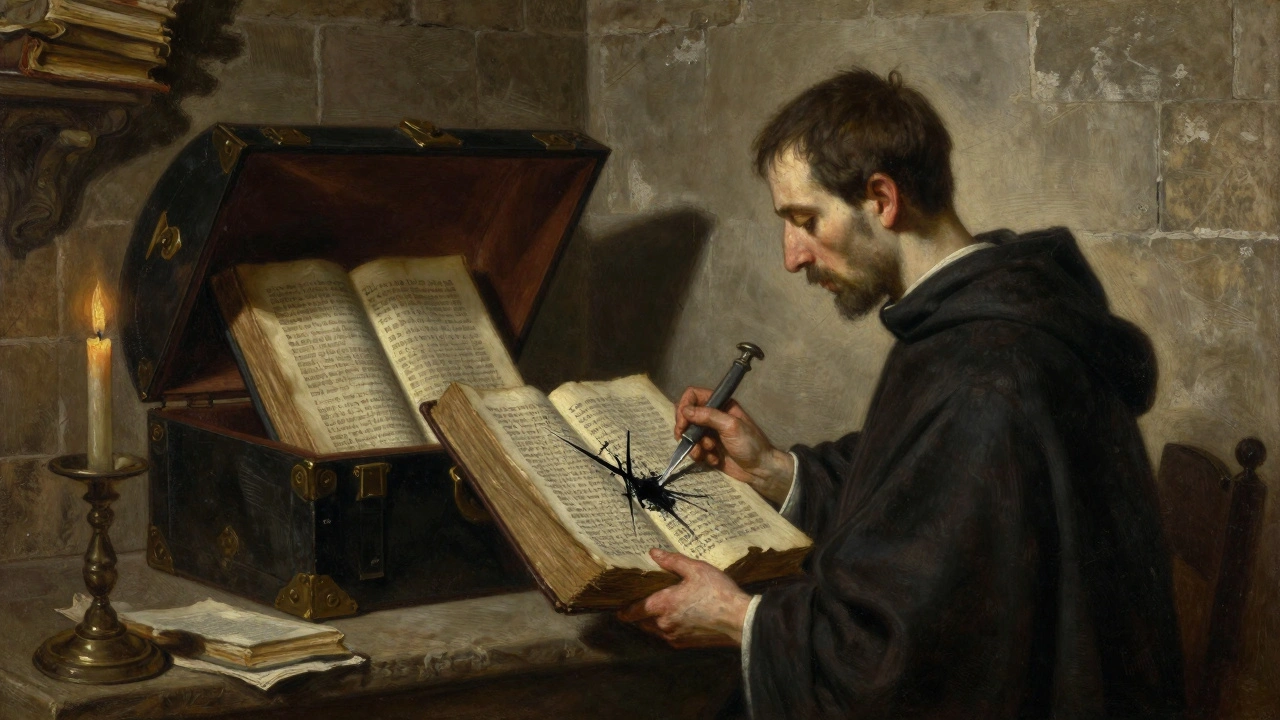
Sometimes, censors didn’t want to destroy books-they wanted to fix them. That’s where expurgation came in. Instead of burning a text, they’d physically cut out the bad parts. Pages were scraped with knives. Words were crossed out in ink. Authors’ names were erased. In 1559, after Conrad Gesner’s works were banned, owners were ordered to scratch out his name so the book could still be kept-just not credited to him.This wasn’t just about censorship. It was a messy, messy job. Book owners, priests, and local inquisitors had to decide what to cut. Sometimes they cut too much. Sometimes they cut too little. And sometimes, they cut nothing at all. The 1601 edition from Saumur, France, even included a commentary that argued many banned passages were harmless. That’s not resistance-it’s quiet rebellion.
Regional Differences: Who Controlled What?
Censorship wasn’t the same everywhere. In Spain, the Inquisition ran a tight ship. Between 1540 and 1700, they reviewed over 34,000 titles. In France, royal censors had to approve every new book before it could be printed. The 1571 ordinance made royal privilege mandatory-no exception. Even the first French newspaper, La Gazette, got its start only because King Louis XIII gave it permission.But not everywhere was so strict. The Dutch Republic became Europe’s publishing haven. By 1700, nearly 40% of books printed there were banned elsewhere. Amsterdam was the underground hub. Books from England, France, and Italy flowed through its presses. Protestant England had its own system, run by the Privy Council and bishops. Between 1634 and 1640, they reviewed over 600 books-about one every four days. But when licensing expired in 1695, the system collapsed. No one replaced it. The floodgates opened.
How People Beat the System
Censors thought they were in control. But readers and printers were smarter. They used fake imprints-listing a printer in Geneva when the book was actually printed in Lyon. They used pseudonyms. They wrote in code. A phrase like “the philosopher’s stone” might mean something entirely different. Readers learned to read between the lines.Printers formed networks. A banned book printed in Amsterdam could be smuggled into France, hidden in barrels of salt or under sacks of grain. Book owners kept banned texts in locked chests or behind false panels in their libraries. Some even kept two copies-one clean for show, one expurgated for the censors.
And then there were the universities. Professors reviewed books for their departments. A medical text might pass because it was useful. A political tract might be ignored because no one cared. Censorship wasn’t perfect. It was inconsistent. It depended on who was in charge, how much they cared, and whether they were bribed.
The Backfire Effect
The more you ban something, the more people want it. That’s not new. In 1677, an edict was issued warning that a false edition of the Index was circulating-meaning people were printing fake lists of banned books to confuse censors. It worked. If you didn’t know what was banned, you couldn’t avoid it.Galileo’s trial in 1633 wasn’t just about science. It was about authority. The Church feared that if people started questioning the Earth’s place in the universe, they’d start questioning everything else-God, kings, marriage, sex. And they were right. The censorship of Galileo didn’t stop science. It fueled it. His books were smuggled, copied, and studied in secret. His ideas lived on.
Same with erotic texts. Banning Aretino didn’t kill his work. It made him a symbol. His books became collector’s items. His name became a whisper in salons, a joke among scholars, a secret between lovers. Censorship didn’t suppress desire-it amplified it.
The Long Shadow
The Index of Prohibited Books wasn’t abolished until 1966. That’s over 400 years of state and church control over what people could read. But its legacy isn’t just in books. It’s in the way we think about freedom. The struggle over erotic expression, blasphemy, and truth in early modern Europe didn’t end with the Enlightenment. It shaped modern ideas of free speech, intellectual privacy, and the right to read what you want.Today, we don’t have the Index. But we still have censorship-just in new forms. Algorithms that hide content. Platforms that ban words. Governments that block websites. The tools changed. The fear didn’t. The same questions remain: Who gets to decide what we can see? What happens when we’re told not to look?
Early modern Europe didn’t win the fight for free expression. But it started it. And every person who read a banned book, crossed out a word, or passed a secret text-those were the real revolutionaries.
What was the Index of Prohibited Books?
The Index of Prohibited Books, or Index librorum prohibitorum, was an official list of books banned by the Catholic Church from 1559 until 1966. It included works deemed heretical, blasphemous, or morally corrupting, ranging from Protestant theological texts to erotic literature and scientific writings. The Index was enforced by local inquisitors and required book owners to surrender or destroy prohibited titles. It was updated regularly and applied across Catholic Europe, influencing even Protestant regions that adopted similar restrictions on sexually explicit or anti-religious material.
Why was erotic literature so heavily censored?
Erotic literature was seen as a direct threat to moral and religious order. Authorities believed sexual content led to sin, undermined marriage, and corrupted youth. But deeper than that, it challenged control. Unlike theological debates, which could be argued with doctrine, desire couldn’t be reasoned with. Works like those by Pietro Aretino were banned not just for their content, but because they proved people would seek out forbidden pleasure no matter the risk. Their popularity showed that censorship couldn’t suppress human nature-only drive it underground.
How did expurgation work in practice?
Expurgation meant physically altering banned books by removing or covering prohibited passages. Censors used knives to scrape out text, ink to cross out words, or paste to cover offending sections. Book owners, priests, and local officials were often responsible for making these changes. For example, after the 1559 Index banned Conrad Gesner’s medical works, owners had to erase his name from the title page. This created a gray zone: books could still be owned, but only if they were "cleansed." It turned reading into a hands-on act of compliance-and sometimes, quiet resistance.
Why was the Dutch Republic so important in the history of censorship?
The Dutch Republic became Europe’s center for printing banned books because it had weak central control and strong commercial incentives. Between 1600 and 1700, about 40% of books printed there were illegal elsewhere. Publishers in Amsterdam, Leiden, and Rotterdam printed works from France, England, and Italy that were banned in their home countries. These included Protestant texts, scientific treatises, and erotic literature. The Dutch didn’t always support free speech-but they knew a profitable market when they saw one. Their presses kept ideas alive across the continent.
Did censorship actually stop people from reading banned books?
No. Censorship often had the opposite effect. Banned books became more desirable. Underground networks formed to smuggle, copy, and distribute them. Readers developed codes to talk about forbidden topics. Printers used fake imprints to hide origins. Even when books were burned, copies survived in private libraries. The more authorities tried to control information, the more creative people became at evading them. Censorship didn’t silence ideas-it made them more powerful.
How did censorship change during the Enlightenment?
The Enlightenment brought new challenges to censorship. Thinkers like Voltaire and Diderot used satire, pseudonyms, and coded language to bypass censors. The Encyclopédie was printed in secret, with pages shipped across borders to avoid detection. In 1695, England ended its licensing system, removing legal control over printing. France kept strict rules until the Revolution in 1789, when royal censorship was abolished. But even then, new forms emerged-Napoleon reinstated controls, and modern states later replaced religious censorship with state security justifications. The tools changed, but the tension between power and expression didn’t.