Ancient Family Simulator & Comparison Tool
Choose a civilization and scenario to see how the family unit, names, and property were handled.
Compare key aspects of family life across the three cultures using the interactive sliders below.
| Aspect | Etruria | Greece | Rome |
|---|---|---|---|
| Lineage Tracing | Bilateral (both parents) | Patrilineal (father only) | Patrilineal (father only) |
| Woman's Name After Marriage | Retains paternal surname | Often takes husband's name or title | Takes husband's nomen |
| Property Control | Shared/Wife retains dowry rights | Husband controls all property | Father/Husband controls property |
| Public Visibility | High (banquets, festivals) | Low (confined to oikos) | Moderate (increased in later periods) |
| Widow's Rights | Manages estate if no male heir | Guardian appointed | Guardian appointed initially, later reforms |
When we think of the ancient world, images of Roman emperors or Greek philosophers often dominate. But just north of Rome, in the region known as Etruria, a sophisticated civilization that flourished in central Italy from the 8th to the 3rd century BCE, a different social order was taking shape. One of the most striking aspects of Etruscan society was its approach to family, gender roles, and inheritance. Unlike their Roman neighbors, Etruscans practiced a system where women held significant legal and social power, particularly within the household. Understanding how Etruscan marriage functioned reveals a complex web of rights, duties, and cultural values that challenged modern assumptions about ancient patriarchy.
The Structure of Etruscan Family Units
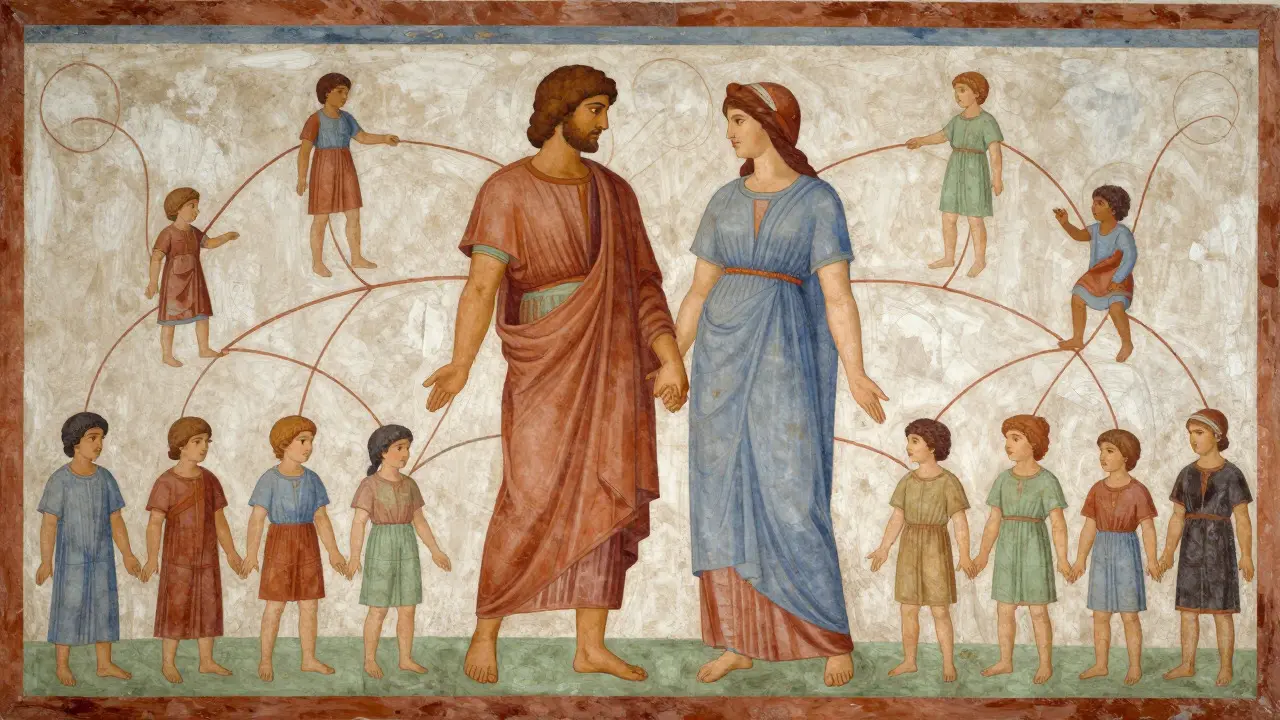
To understand Etruscan social dynamics, you have to look at the Family Unit, which served as the basic building block of Etruscan society. In many ancient cultures, the family was strictly male-dominated. However, in Etruria, the concept of domus (household) included both parents as co-heads. This wasn't just a cultural preference; it was legally recognized. The Etruscan state structure mirrored this domestic arrangement, with political authority often shared or influenced by both male and female lineages.
This dual-headed family structure had profound implications for property and status. When an Etruscan woman married, she did not simply become the property of her husband's family, as was common in contemporary Greece or early Rome. Instead, she retained her own identity and legal standing. Her name, derived from her father's lineage, remained with her throughout her life. This naming convention is crucial because it highlights that lineage in Etruria was traced through both parents, creating a more flexible and interconnected social network.
Naming Conventions and Lineage Tracing
How did Etruscans keep track of who belonged where? They used a specific naming system that differed significantly from the Roman tripartite name (praenomen, nomen, cognomen). An Etruscan individual typically had two names: a personal name and a family name. For example, a man might be called "Aule Vel" (Vel being the family name), while his wife might be "Tinia Vel" if she came from the same clan, or more commonly, she would retain her paternal surname even after marriage.
This practice meant that children could trace their ancestry back through both their mother and father. This bilateral lineage system allowed for greater social mobility and alliance-building. If a powerful Etruscan family wanted to secure a trade agreement or a political alliance, they could marry into another prominent house without completely erasing the bride's original status. The child born from such a union would carry connections to both families, effectively doubling their social capital. This stands in stark contrast to the strict patrilineal systems found elsewhere in the Mediterranean, where a woman's identity was often subsumed under her husband's name upon marriage.
Inheritance Laws and Property Rights
One of the most debated aspects of Etruscan society is how property passed down generations. Did sons inherit everything, or did daughters have a claim? Evidence from tomb paintings and literary sources suggests that Etruscan inheritance laws were more equitable than those of neighboring cultures. While men generally held public office and managed external affairs, women had substantial control over domestic assets, including jewelry, land, and movable goods.
Etruscan Inheritance often followed a pattern where daughters received dowries that were protected by law. These dowries were not merely gifts but legal deposits that returned to the wife if the marriage ended. More importantly, widows had the right to manage the estate of their deceased husbands, especially if there were no adult male heirs. This provision ensured that wealth stayed within the extended family rather than passing to distant male relatives outside the immediate household. It also gave women a degree of economic independence that was rare in the ancient world. A widow could remarry, and her new husband would manage the joint estate, but her original assets remained distinct and protected.
Sexual Norms and Gender Roles
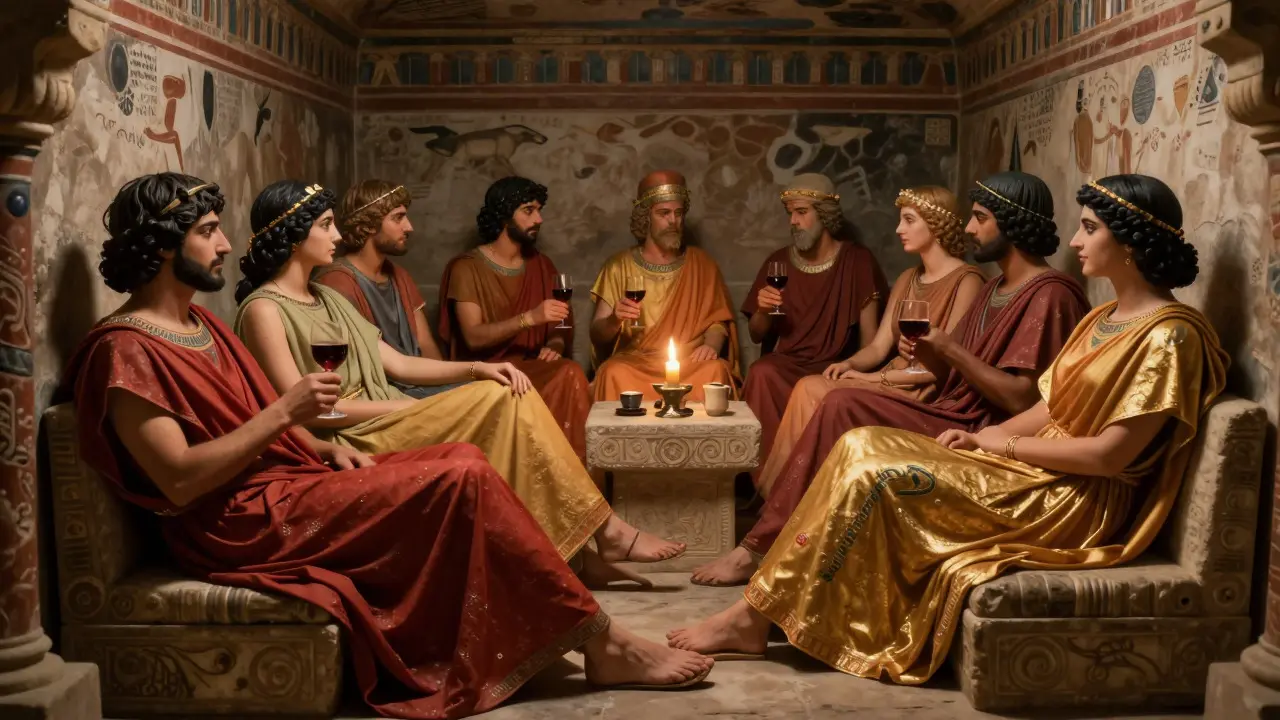
What did daily life look like for Etruscan men and women? Artifacts from tombs in Tarquinia and Cerveteri depict scenes of banqueting where men and women recline together on couches, drinking wine and listening to music. This imagery has led scholars to debate the extent of Etruscan sexual freedom. Were these scenes realistic depictions of everyday life, or idealized representations of elite leisure?
Most historians agree that Etruscan women enjoyed greater social visibility than their Greek or Roman counterparts. They participated in public festivals, attended banquets, and engaged in physical activities like chariot racing. This visibility suggests that sexual norms were less rigidly controlled by male guardianship. Adultery, for instance, was viewed differently. In Rome, adultery was primarily a crime against the husband's honor. In Etruria, since women had independent legal status, infidelity might have been treated as a breach of contract between two families rather than a violation of a man's property rights. This shift in perspective reflects a broader cultural value placed on partnership over possession.
Comparison with Neighboring Cultures
To fully appreciate the uniqueness of Etruscan social structures, it helps to compare them with those of Greece and Rome. The table below outlines key differences in marriage, lineage, and gender roles across these three civilizations.
| Aspect | Etruria | Greece | Rome |
|---|---|---|---|
| Lineage Tracing | Bilateral (both parents) | Patrilineal (father only) | Patrilineal (father only) |
| Woman's Name After Marriage | Retains paternal surname | Often takes husband's name or title | Takes husband's nomen |
| Property Control | Shared/Wife retains dowry rights | Husband controls all property | Father/Husband controls property |
| Public Visibility | High (banquets, festivals) | Low (confined to oikos) | Moderate (increased in later periods) |
| Widow's Rights | Manages estate if no male heir | Guardian appointed | Guardian appointed initially, later reforms |
This comparison highlights how Etruscan society offered a more balanced distribution of power within the household. While not a matriarchy, it was certainly a gynocentric influence in a predominantly patriarchal ancient world. The ability of Etruscan women to maintain their names and manage assets created a stable foundation for social cohesion, allowing families to navigate political changes without losing internal stability.
Legacy and Decline
As Rome expanded and eventually absorbed Etruria, many of these distinct Etruscan practices began to fade. Roman law, with its strict emphasis on patria potestas (father's power), gradually imposed its norms on the conquered populations. However, traces of Etruscan influence can still be seen in early Roman customs, such as the use of the toga praetexta for freeborn boys and girls alike, suggesting a lingering respect for the equality of birth regardless of gender. The decline of Etruscan culture was not just military but also cultural, as the unique social fabric of Etruria was woven into the larger tapestry of the Roman Empire.
Today, archaeologists continue to uncover evidence that challenges our preconceptions about ancient gender roles. Tomb paintings, inscriptions, and artifacts provide a window into a society that valued partnership and mutual respect in ways that were ahead of its time. By studying Etruscan marriage, lineage, and sexual norms, we gain a deeper understanding of how diverse human societies have organized themselves throughout history.
Frequently Asked Questions
Did Etruscan women have the same legal rights as men?
Not exactly the same, but significantly more equal than in other ancient cultures. Etruscan women could own property, manage estates, and retain their names after marriage. They did not hold high political office, but their domestic and economic power was substantial and legally protected.
How did Etruscan naming conventions differ from Roman ones?
Etruscans typically used a personal name and a family name. Crucially, women kept their father's family name after marriage, whereas Roman women took their husband's nomen. This allowed Etruscans to trace lineage through both maternal and paternal lines.
What happened to Etruscan customs after Rome conquered the region?
Over time, Roman law and social norms became dominant. The strict patriarchal structure of Rome replaced the more balanced Etruscan system. However, some Etruscan influences persisted in early Roman culture, particularly regarding the treatment of women in the household and certain religious rituals.
Were Etruscan sexual norms more liberal than Greek or Roman standards?
Yes, generally speaking. Etruscan art depicts women participating in public banquets and social events alongside men, suggesting less restriction on female movement and social interaction. Adultery was likely viewed as a private matter between families rather than a public crime against a husband's honor.
How do we know about Etruscan marriage laws?
Since few written legal codes survive, much of what we know comes from archaeological evidence, such as tomb paintings showing family scenes, inscriptions on gravestones indicating relationships, and references by Greek and Roman writers who observed Etruscan customs firsthand.