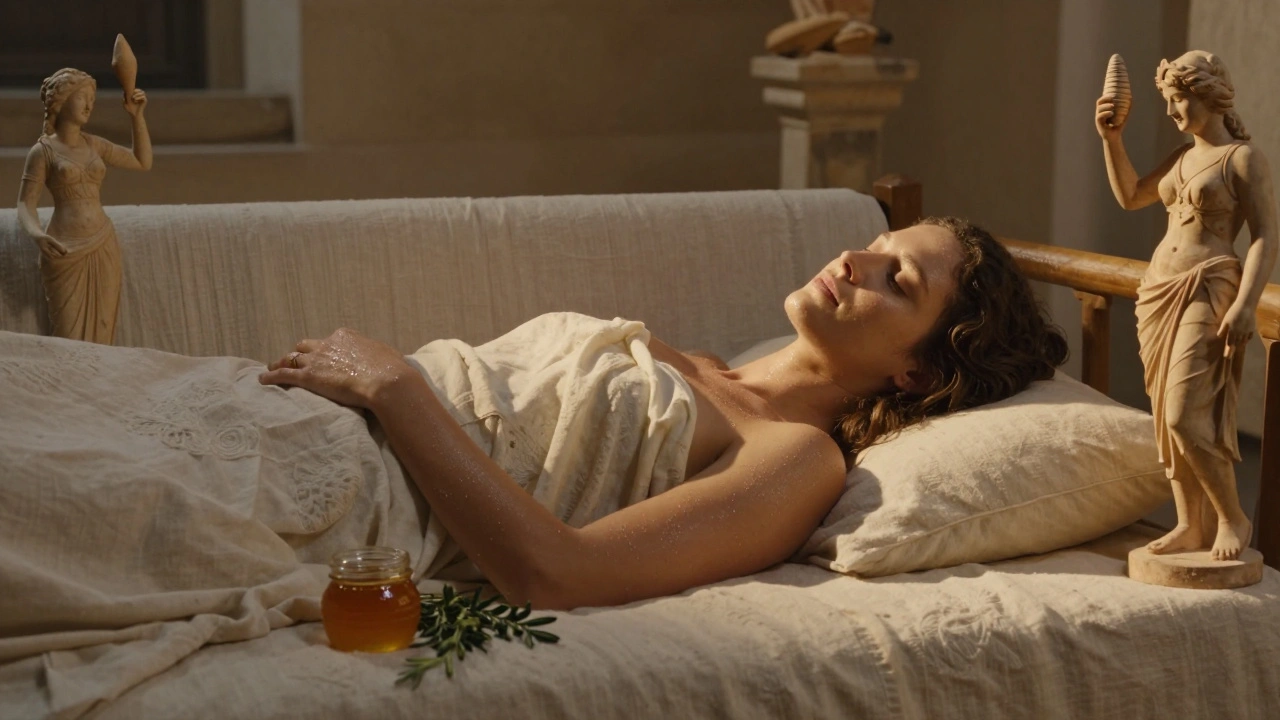
Greek Pleasure & Orgasm Comparison Tool
Explore Ancient Greek Perspectives
This tool compares common modern misconceptions about ancient Greek views on female pleasure with historical facts from medical texts and myths. Learn how Greek physicians actually understood female sexuality—far different from today's assumptions.
Modern Misconception
Ancient Greek doctors treated "hysteria" by using vibrators to give women orgasms.
Historical Fact
There's no evidence ancient Greeks used vibrators or manual stimulation to treat "hysteria." Treatments like salt-and-vinegar rubs or marriage recommendations were about restoring bodily balance, not sexual release. The concept of "hysteria" as a medical diagnosis developed centuries later.
When you think about ancient Greeks, you probably picture philosophers debating truth, athletes competing in the Olympics, or gods meddling in human lives. But what about sex? Specifically, how did they understand female pleasure? Not the way we do today-with a clear climax, a measurable peak, a single moment labeled "orgasm." The Greeks didn’t think that way. Their medical texts, written over 2,400 years ago, describe pleasure as something that stretches across the whole act of intercourse, not something that bursts at the end.
What the Hippocratic Texts Actually Said
The most detailed account comes from a text called Nature of the Child, part of the Hippocratic Corpus. It doesn’t use words like "orgasm" or "climax." Instead, it says this: when a woman is having sex, if she’s eager for it, she feels pleasure from the start-and that pleasure lasts until the man finishes. But if she’s not eager? Her pleasure ends right when he does. And here’s the part that surprises most people today: the text says if she’s eager, she "ejaculates" before the man. Not in the modern sense of fluid shooting out. More like a release of internal warmth, a wetness that signals deep pleasure. The ancient Greeks didn’t see this as abnormal. They saw it as natural.This wasn’t just a random guess. The Hippocratic doctors believed women had a "wet" temperament, while men were "dry." Wet meant emotional, passionate, responsive. Dry meant controlled, rational, stable. So when they talked about women being more "eager," they weren’t just judging morality-they were describing physiology. A woman’s body, in their view, was built to respond deeply, continuously, and physically to sexual contact. Her pleasure wasn’t a goal to reach. It was a state to be in.
Myth vs. Medicine
Now, let’s look at myth. The story of Tiresias is one of the most famous. In Ovid’s Metamorphoses, Tiresias lived as both man and woman. When Zeus and Hera argued about who experienced more pleasure in sex, they asked Tiresias to settle it. He said women feel nine times more pleasure than men. That’s not a medical claim. It’s myth. A poetic exaggeration. But it tells us something important: even in stories, ancient Greeks didn’t dismiss female pleasure as insignificant. They imagined it as powerful, even overwhelming.Compare that to Roman texts, like Achilles Tatius’s Leucippe and Clitophon. There, women are described as "maddened with pleasure," opening their mouths wide, losing control. That sounds a lot more like what we’d call an orgasm. So why the difference? The Greeks saw pleasure as a process. The Romans, later on, started seeing it as a peak. That shift matters. It shows how ideas evolved, even within antiquity.

The Hysteria Myth That Won’t Die
You’ve probably heard the story: ancient Greek doctors treated "hysteria" in women by giving them manual orgasms. It sounds wild. It sounds like something out of a bad comedy. But here’s the truth: there’s no evidence this ever happened.This myth got popular thanks to a 1999 book that claimed ancient physicians used vibrators to cure "female nervous disorders." But when scholars like Helen King dug into the original texts, they found nothing like it. The treatments described-rubbing the shins with salt and vinegar, applying warm oils, even recommending marriage-were never about inducing sexual release. They were about restoring balance. The Greeks didn’t think women were "hysterical" because they were sexually frustrated. They thought women were out of balance because their uterus was "wandering" or their body was too dry or too wet. Pleasure wasn’t the cure. Harmony was.
Modern writers kept repeating the vibrator story because it fit a narrative: that ancient men were afraid of female sexuality and tried to control it. But the truth is messier. The Greeks didn’t see female pleasure as dangerous. They saw it as natural, necessary, and deeply tied to health.
What Did Women Actually Experience?
We can’t know for sure. No woman from 400 BCE left a diary. No papyrus survives with a personal account of her feelings during sex. But we have clues. Terracotta figurines show women holding phallic objects. A short poem by Herodas mentions "lace and straps"-possibly describing a device used between women. These aren’t just artifacts. They’re evidence that women weren’t just passive in their sexuality. They were exploring, experimenting, using tools to feel pleasure on their own terms.And here’s something most people miss: the Hippocratic texts treat women’s desire as equal to men’s. They don’t say women are "less sexual." They say women are more emotionally connected to sex. That’s not a weakness. It’s a different kind of strength. The problem, according to the texts, wasn’t that women wanted too much. It was that they couldn’t control it. And that control? That was called sophrosyne-moderation, self-possession. Men were expected to have it. Women, in their view, were naturally less able to. Not because they were inferior, but because their bodies were different.
Modern Misreadings
Today, we still get this wrong. We look at ancient texts and try to force them into modern boxes: orgasm = climax. Desire = libido. Pleasure = physical release. But the Greeks didn’t have those categories. They didn’t separate mind from body. They didn’t isolate sex from health. They didn’t divide pleasure into stages.When scholars today say "the Greeks didn’t believe in female orgasm," they’re using our language to judge their world. That’s not fair. The Greeks didn’t need a single moment called "orgasm" because they already had a word for the whole experience: aphrodision-the act of being touched by Aphrodite. It wasn’t a peak. It was a wave.
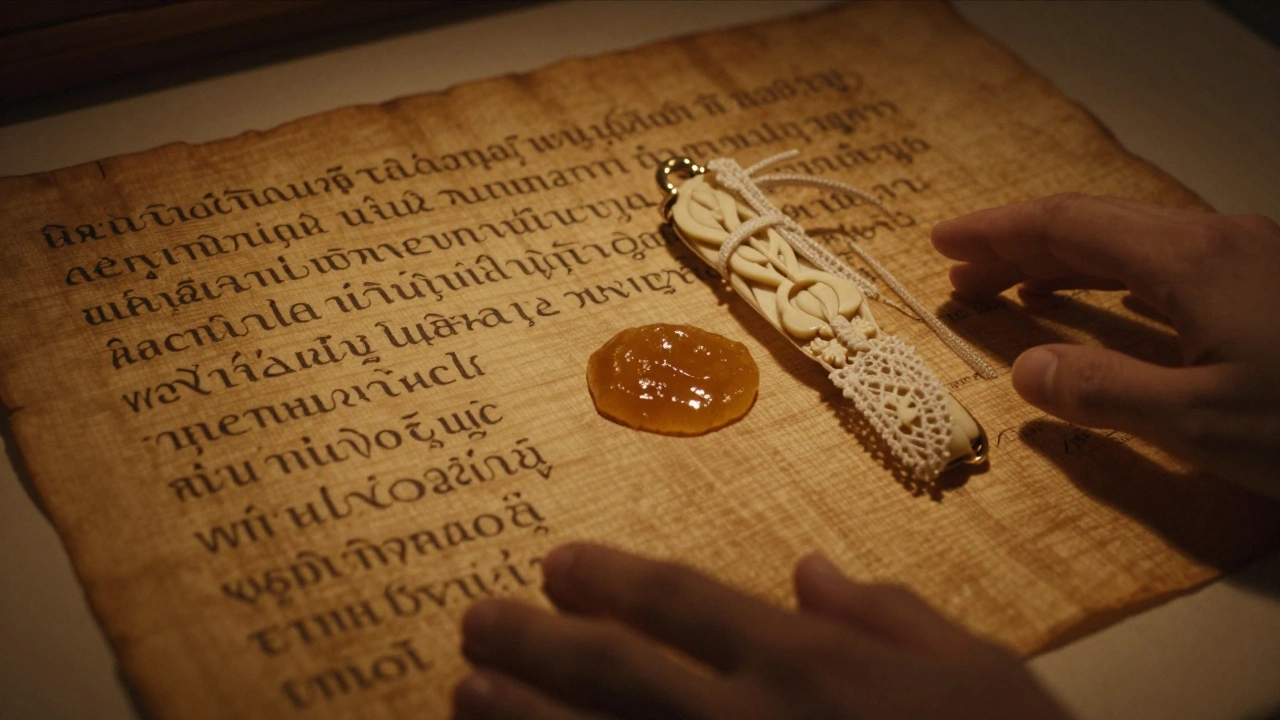
Even recent research, like the 2024 book Female Pleasure in Ancient Greece: New Perspectives, shows how much we’ve missed. Papyrus fragments from Oxyrhynchus, only recently translated, hint at women using herbal remedies to heighten sensation. One fragment mentions a paste made from honey and crushed myrtle leaves-applied before intercourse. Not to cure disease. To make pleasure last longer.
Why This Matters Now
Understanding how the Greeks thought about female pleasure isn’t just history. It’s a mirror. We still struggle with the idea that women’s pleasure isn’t about reaching a finish line. We still treat sex like a performance-with a goal, a score, a climax. The Greeks didn’t. They saw it as a shared rhythm, a bodily conversation that lasted as long as both people were engaged.And maybe that’s the most radical thing about their view: they didn’t think pleasure needed to be measured. They didn’t need a "Big O" to validate it. They just knew it was there-when the woman was eager, when her body warmed, when the whole thing felt right.
That’s not just ancient history. It’s a quiet challenge to how we think about sex today.
Did ancient Greeks believe women could have orgasms?
Yes, but not in the way we do. The Hippocratic texts describe female pleasure as a continuous sensation that lasts throughout intercourse, not as a single climax. They even mention women "ejaculating" if they were eager, which likely refers to bodily wetness and warmth, not a modern definition of orgasm. Their framework didn’t separate pleasure into stages-it saw it as an ongoing, embodied experience.
Was female orgasm used to treat "hysteria" in ancient Greece?
No. The idea that Greek doctors used manual stimulation or vibrators to treat "hysteria" is a modern myth. Helen King and other scholars have shown that the treatments cited in older books-like rubbing the shins with salt and vinegar-were never meant to induce sexual release. They were general remedies for imbalance. The term "hysteria" as a medical diagnosis didn’t exist in ancient Greece. That concept developed centuries later.
How did Greek medical texts describe female desire?
They saw female desire as natural and equal to male desire, but tied to a "wet" temperament-meaning women were more emotionally and physically responsive. Unlike men, who were expected to practice "sophrosyne" (self-control), women were seen as less able to restrain their urges. This wasn’t a moral judgment of excess, but a physiological observation: their bodies were thought to respond more intensely to touch and warmth.
What role did myth play in understanding female pleasure?
Myth didn’t explain medical facts, but it shaped cultural beliefs. The story of Tiresias, who claimed women felt nine times more pleasure than men, shows that ancient Greeks recognized female pleasure as powerful-even superior. These weren’t scientific claims, but they reflected a cultural openness to the idea that women’s sexual experience was profound, not secondary.
Are there any artifacts that prove ancient Greek women used tools for pleasure?
Yes. Terracotta figurines from the 5th century BCE show women holding phallic-shaped objects. A poem by Herodas mentions "lace and straps," likely describing strap-on devices used in same-sex encounters. These artifacts suggest women weren’t just passive recipients of male pleasure-they explored their own sensations, possibly using tools to enhance or control their experience.