
Workplace Accommodation Request Calculator
This tool calculates potential workplace accommodations based on Philadelphia's 2027 law and ISO 45010 standards. Enter your job type and symptoms to see what accommodations may be available to you.
What's your job type?
Which symptoms do you experience?
What accommodations might be available?
Your Results
You may be eligible for the following accommodations:
- Additional bathroom breaks
- Flexible scheduling options
- Access to quiet spaces for rest
What to expect:
Philadelphia law requires employers to provide reasonable accommodations without undue hardship. 56% of adjustments cost nothing to implement.
Business benefits:
For women over 45 after implementing menopause support
When accommodations are requested
Tip: Frame requests as workplace safety needs rather than personal needs to avoid stigma. Remember, 59% of women feel too uncomfortable to ask for help.
For decades, menstruation was treated like a secret in the workplace. Women and people who menstruate were expected to power through cramps, fatigue, and hot flashes without mention-because asking for help meant risking judgment, being seen as weak, or worse, being passed over for promotions. But that’s changing. In January 2026, Philadelphia became the first major U.S. city to pass a law requiring employers to provide reasonable accommodations for employees experiencing menstruation, perimenopause, or menopause. Starting January 1, 2027, workers can legally request things like extra bathroom breaks, flexible hours, access to quiet rooms, or even lighter uniforms if symptoms interfere with their job. And it’s not just Philadelphia. A global standard, ISO 45010, is set to release in 2026, giving companies a clear blueprint to make workplaces safer and more inclusive for everyone who experiences hormonal shifts.
Why This Matters Now
About 1.8 billion people around the world menstruate. That’s nearly a quarter of the global workforce. Yet, according to a 2025 study from the University of Pennsylvania’s LDI, 61% of employees say their company has no formal policy to support them during these times. Even worse, 59% of women reported feeling too uncomfortable to ask for help. The result? People show up to work in pain, skip meals to avoid bathroom trips, or take unpaid time off because they don’t know what else to do. This isn’t just about comfort-it’s about retention and productivity. Companies like Unilever saw a 27% increase in retention among women over 45 after launching a menopause support program in 2024. Meanwhile, 43% of women who requested menopause-related accommodations reported negative career impacts, like being denied promotions or being labeled as "unreliable." That’s not just unfair-it’s expensive. When experienced workers leave because their needs aren’t met, companies lose institutional knowledge and pay more to replace them.What’s Actually in These Policies?
Philadelphia’s ordinance, Bill No. 250849, doesn’t just say "be nice." It lists specific accommodations employers must consider when requested:- Additional bathroom breaks without penalty
- Flexible scheduling or remote work options
- Access to private, quiet spaces for rest or medication
- Adjustments to uniform requirements (e.g., lighter fabrics, looser fits)
- Temperature controls in work areas to manage hot flashes
- Temporary reassignment of physically demanding tasks during flare-ups
Global Context: What Other Countries Are Doing
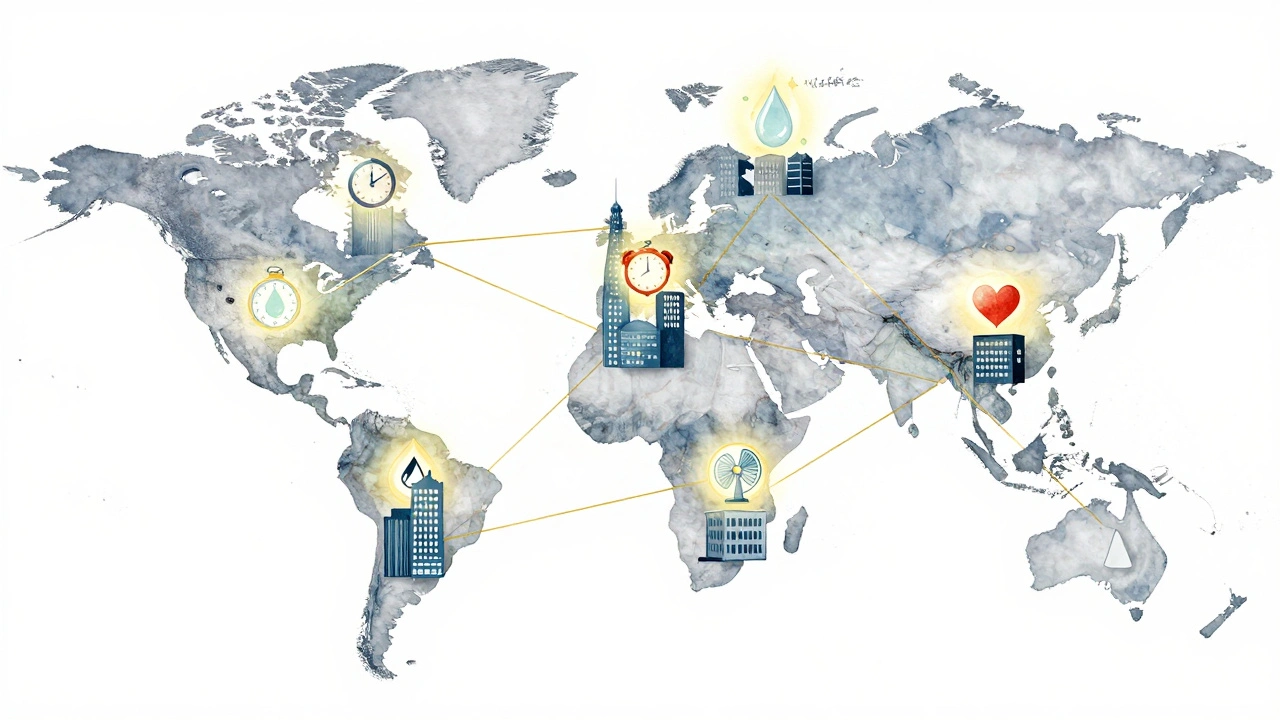
The U.S. is catching up, but it’s not leading. Japan has had menstrual leave since 1947, though enforcement is patchy. South Korea gives workers up to three paid days off per year for severe period pain. Spain passed a law in 2023 granting paid menstrual leave. In the UK and EU, new gender equality directives are expected to require similar protections by 2027. What sets Philadelphia apart is how it integrates these needs into occupational safety standards-something the upcoming ISO 45010 standard also does. Instead of treating this as a "women’s issue," it frames it as a workplace safety issue. That’s key. When you label it as safety, not sympathy, it’s harder for managers to ignore.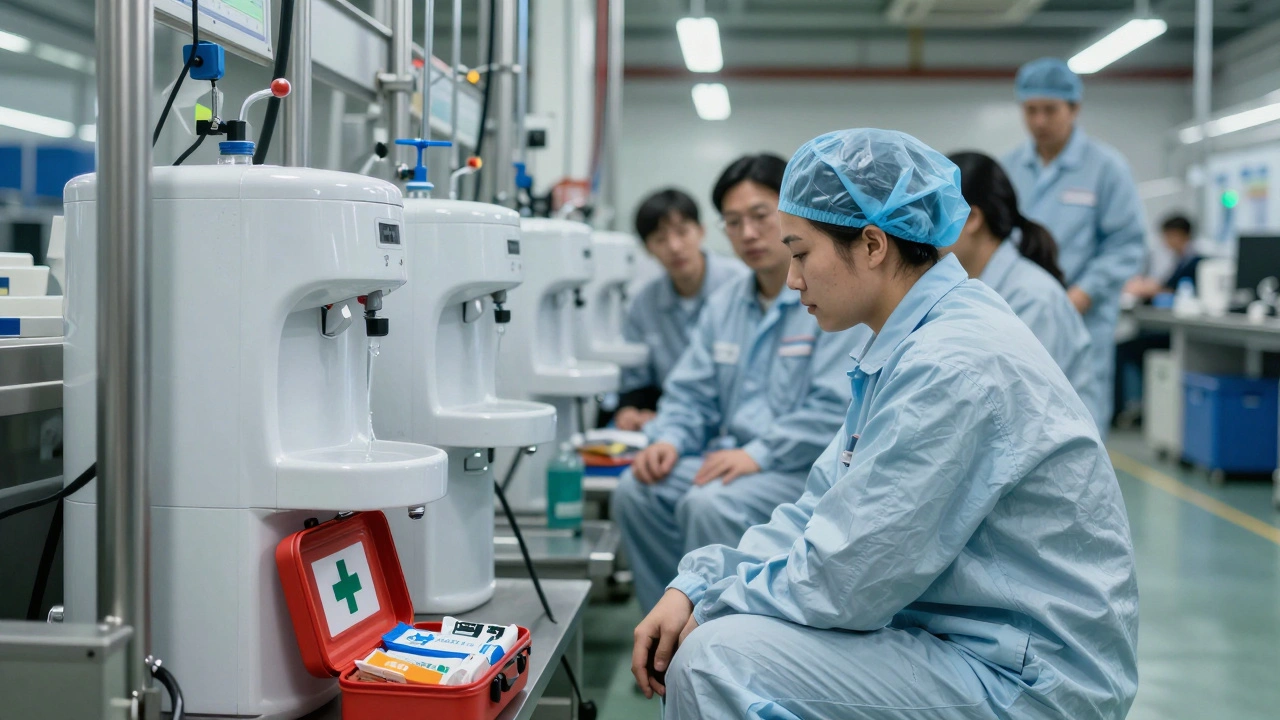
Who’s Being Left Behind?
The biggest gap isn’t in policy-it’s in implementation. While tech companies and healthcare organizations are moving quickly, manufacturing, retail, and service industries are lagging. A cashier on a 10-hour shift can’t just take a break to lie down. A factory worker in a steel plant can’t adjust the temperature. A delivery driver doesn’t have access to a private room. That’s why the ISO 45010 standard is so important. It doesn’t just say "give time off." It tells companies how to redesign work environments: better ventilation, access to cold water, storage for pain relief meds, training for managers to talk about this without embarrassment. It’s not about special treatment-it’s about removing barriers that keep people from doing their jobs safely. Elizabeth Kukura, a law professor at Drexel, put it bluntly: "Service workers, retail workers, contingent workers-they’re often the ones with the strictest bathroom policies, even the ability to take a sip of water or a pill to ease symptoms. These changes would help them the most."How Companies Are Making It Work
Companies that have adopted these policies report three big wins: higher retention, fewer sick days, and stronger team morale. At one mid-sized software firm in Austin, managers started holding monthly check-ins with all employees-not to ask if they’re okay, but to ask if they need anything to do their best work. One employee, who had been quietly suffering through heavy flow days, said, "I didn’t know I could ask for a shorter shift. Now I do. And I’ve stayed here three years longer than I thought I would." Successful programs share common traits:- Leadership talks about it openly-no whispering, no avoiding the topic
- Managers are trained to respond with empathy, not skepticism
- Accommodations are framed as normal, not exceptional
- Employees know how to request help without fear of backlash
What’s Still Missing
The biggest problem with current U.S. laws is that they’re reactive. You have to ask. You have to explain. You have to prove you’re suffering. That’s exhausting. The ISO 45010 standard pushes for proactive design-like building rest areas into office layouts, stocking pain relief meds in first-aid kits, or designing uniforms that work for all body types and cycles. Another gap? Awareness. Many male managers still don’t understand what perimenopause feels like. One woman shared on Reddit: "My boss told me, ‘Periods aren’t an excuse to miss work.’" That’s not ignorance-it’s stigma. And stigma kills inclusion. There’s also a lack of data. Most companies don’t track how many employees request these accommodations, or why. Without data, it’s easy to pretend the problem doesn’t exist.The Future Is Already Here
The market for workplace wellness solutions targeting women’s health is projected to hit $4.2 billion by 2027. Only 9% of Fortune 500 companies have formal policies now-but that’s up from 3% in 2024. The shift is accelerating, driven by younger workers who expect workplaces to respect their whole lives, not just their output. And it’s not just about women. Trans men, nonbinary people, and others who menstruate are also affected. Inclusive policies don’t assume gender. They assume humanity. As the ISO standard rolls out and more cities follow Philadelphia’s lead, we’re moving toward a future where no one has to choose between their health and their job. Where a hot flash doesn’t mean a performance review. Where a cramp doesn’t mean you’re unreliable. Where asking for help isn’t a sign of weakness-it’s a sign of a workplace that works for everyone.It’s not about giving special treatment. It’s about giving basic dignity.