Men's Mental Health Risk Assessment Tool
This tool assesses risk factors related to the masculinity crisis based on current research. It's not a diagnosis but helps identify areas needing support. Your responses remain private.
This assessment is based on current research about masculinity crisis and mental health
Your results show:
- 988 Suicide & Crisis Lifeline (call or text 988)
- Local mental health resources
- The article's recommended community programs
More men in America are dying by suicide than ever before. They’re disappearing from classrooms, workplaces, and family dinners. And they’re not just lonely-they’re lost. Not because they’re weak, but because the old rules for being a man don’t work anymore. The provider role? Hard to fulfill when wages haven’t risen in 20 years. Emotional strength? Now seen as a flaw if you don’t cry. Manhood? Still defined by financial success, even as jobs vanish and housing costs explode. This isn’t a myth. It’s the lived reality for millions of American men in 2025.
The Provider Trap
Eighty-six percent of men still believe being a man means being the primary breadwinner. That number hasn’t changed in a decade, even as the economy has. The jobs that once supported families-factories, trucking, construction-are shrinking. Meanwhile, women are entering the workforce in record numbers and earning more in many households. But instead of redefining success, many men are internalizing failure. When you’re told your worth is tied to your paycheck, and your paycheck keeps dropping, you start to believe you’re worthless. A 2025 Equimundo report found that men facing financial strain are 16.3 times more likely to think about suicide than those who are economically secure. That’s not just stress. That’s systemic betrayal. Men aren’t failing because they’re lazy. They’re failing because the system stopped working for them and never gave them a new script to follow.The Loneliness Epidemic
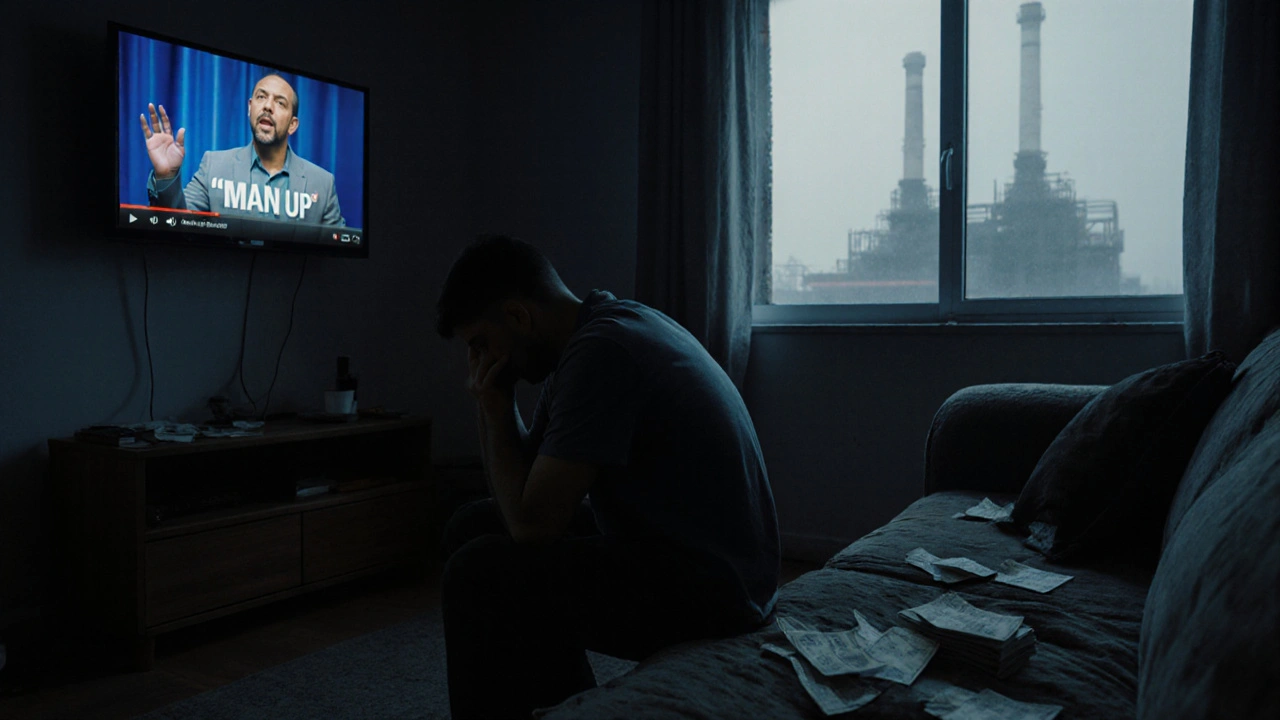
Men are more isolated than at any point in modern history. Fifteen percent have no close friends at all. That’s five times higher than in 1990. In a country where community used to mean church groups, bowling leagues, or workplace camaraderie, men now sit alone in their apartments, scrolling through social media or watching YouTube videos that tell them to ‘man up’ instead of reaching out. The numbers are brutal: 53% of men and women say, ‘No one really knows me.’ But for men, that feeling is deadly. Those who feel unseen are 2.2 times more likely to have considered suicide in the last two weeks. It’s not that men don’t want connection. It’s that they’ve been trained to avoid vulnerability. Ask a man how he’s doing, and he’ll say ‘fine.’ He’ll smile. He’ll go home and drink. Or worse-he’ll turn to the internet, where echo chambers promise power, control, and belonging in exchange for hatred and rage.The Man Box and the Rise of the Manosphere
The ‘Man Box’-a term for the rigid set of rules that tell men to be tough, dominant, and emotionless-is tightening, not loosening. A 2025 study found that beliefs like ‘a man should always have the final say’ or ‘real men don’t ask for help’ are growing in popularity, especially among younger men. Those who buy into these ideas are 6.3 times more likely to have suicidal thoughts. Online, the manosphere has filled the void. Reddit threads, YouTube channels, and Discord servers preach that women are the problem, feminism is a conspiracy, and the only solution is dominance. Men influenced by these spaces are 2.2 times more likely to support authoritarian leaders. Gun ownership has shifted too: 38% of male gun owners now own an AR-15, up from 29% in 2017. This isn’t about self-defense. It’s about identity. When you feel powerless in real life, a rifle becomes a symbol of control.
War, Trauma, and the Unspoken Wounds
War doesn’t just happen overseas. It lives in the homes of veterans who can’t sleep, who can’t talk, who don’t know how to be fathers or husbands after seeing things no one should. The VA reports that over 17 veterans die by suicide every day. Most never seek help. Why? Because asking for therapy feels like admitting weakness. Because the military taught them to endure, not to heal. But it’s not just combat veterans. Men who grew up in abusive homes, who watched their fathers break under pressure, who were told ‘boys don’t cry’-they carry the same trauma. It doesn’t show up as PTSD. It shows up as anger, addiction, or silence. And it’s passed down. Boys who grow up without healthy male role models are far more likely to repeat the cycle. Eighty-five percent of incarcerated men lacked a responsible father figure. That’s not coincidence. That’s consequence.Young Men Are Falling Behind
In schools, boys are falling behind. Since 2015, male enrollment in college has dropped by 12%. Boys are more likely to be suspended, diagnosed with behavioral disorders, and labeled ‘disengaged.’ A 2025 survey of 1,017 boys aged 11 to 17 found that over half felt ‘invisible’ in school. Teachers report that boys shut down when asked to express emotions. They’re not lazy. They’re confused. No one taught them how to talk about feelings. No one showed them it’s okay to need help. Meanwhile, girls are outperforming boys in graduation rates, college applications, and mental health service use. The gap isn’t about intelligence. It’s about support. Girls are encouraged to talk. Boys are told to tough it out. And when they can’t, they disappear.