Gender Power Gap Calculator
How Gender Inequality Works
According to Social Dominance Theory, societies naturally form hierarchies where men dominate women. This isn't about individual bias—it's built into systems. The more status a role has, the more likely it's held by a man. This calculator measures your organization or community's power gap using SDT principles.
Input Your Data
Your Results
Enter data above to see your power gap score.
Think about the last time you saw a CEO, a politician, or a military commander. Chances are, you pictured a man. Now think about the last time you saw a nurse, a teacher, or a caregiver. Again, you probably pictured a woman. This isn’t coincidence. It’s the result of deep, old systems that don’t just reflect gender differences-they enforce them. Gender inequality isn’t about individual bias. It’s built into the architecture of society. From boardrooms to bedrooms, from laws to language, structures are designed to keep men on top and women on the bottom. And those structures aren’t going away just because we wish they would.
The Iron Law of Androcracy
In 1999, psychologists Jim Sidanius and Felicia Pratto laid out a theory that changed how we understand power. Social Dominance Theory (SDT) doesn’t just say men have more power than women. It explains why. According to SDT, human societies naturally organize into hierarchies based on three things: age, gender, and arbitrary social categories like race or religion. Gender is one of the strongest. The theory calls this the "iron law of androcracy"-the rule that men dominate women across nearly every society, in every era, in every continent. This isn’t about biology. It’s about systems. Men don’t rule because they’re stronger or smarter. They rule because institutions-governments, corporations, schools, even families-are built to favor them. When roles get more powerful, the odds that a man fills them go up. That’s Putnam’s law of increasing disproportion. The higher the status, the more likely it is to be held by a man. Look at the U.S. Congress: 77% of members are male. Look at Fortune 500 CEOs: 95% are men. These aren’t accidents. They’re outcomes.How Hierarchies Stay Alive
Hierarchies don’t stay in place because people are cruel. They stay because they’re efficient-at maintaining themselves. SDT shows three ways this happens:- Institutional discrimination: Rules that look neutral but always benefit one group. Think of promotion systems that reward long hours, which assume you don’t have caregiving duties. Or hiring practices that favor candidates from elite universities, which are harder for women and minorities to access.
- Aggregated individual discrimination: Small, everyday choices that add up. A manager who picks the guy for the big client because he "seems more confident." A teacher who calls on boys more often. A parent who tells a daughter to be careful, but tells a son to be bold.
- Behavioral asymmetry: The unspoken rules that make inequality feel normal. Women who speak up are called "bossy." Men who speak up are called "leaders." Women who negotiate salary are seen as aggressive. Men who do the same are seen as assertive. The same behavior, different labels-because the system expects men to lead and women to follow.
These aren’t isolated incidents. They’re the gears of the machine. And they’re everywhere.
Men Are Also Trapped
Most people think patriarchy is about men having power over women. That’s true-but incomplete. Patriarchy also traps men. It forces them into roles that demand emotional suppression, constant competition, and never-ending proof of strength. The system doesn’t just benefit the top 1%. It crushes the rest. Research shows that as economic inequality grows, so does the pressure on men to be the sole providers. In the U.S., men are four times more likely to die by suicide than women. They’re more likely to be in prison, more likely to be killed in war, more likely to work dangerous jobs with no safety nets. Why? Because the system tells them: "Be strong. Don’t cry. Provide. Win. Or else." And here’s the twist: the same hierarchy that gives men power over women also gives some men power over other men. The real winners? The few men at the very top. Everyone else? They’re fighting for scraps. The system doesn’t care if you’re a man or a woman-it only cares if you’re on top. And for most men, you’re not.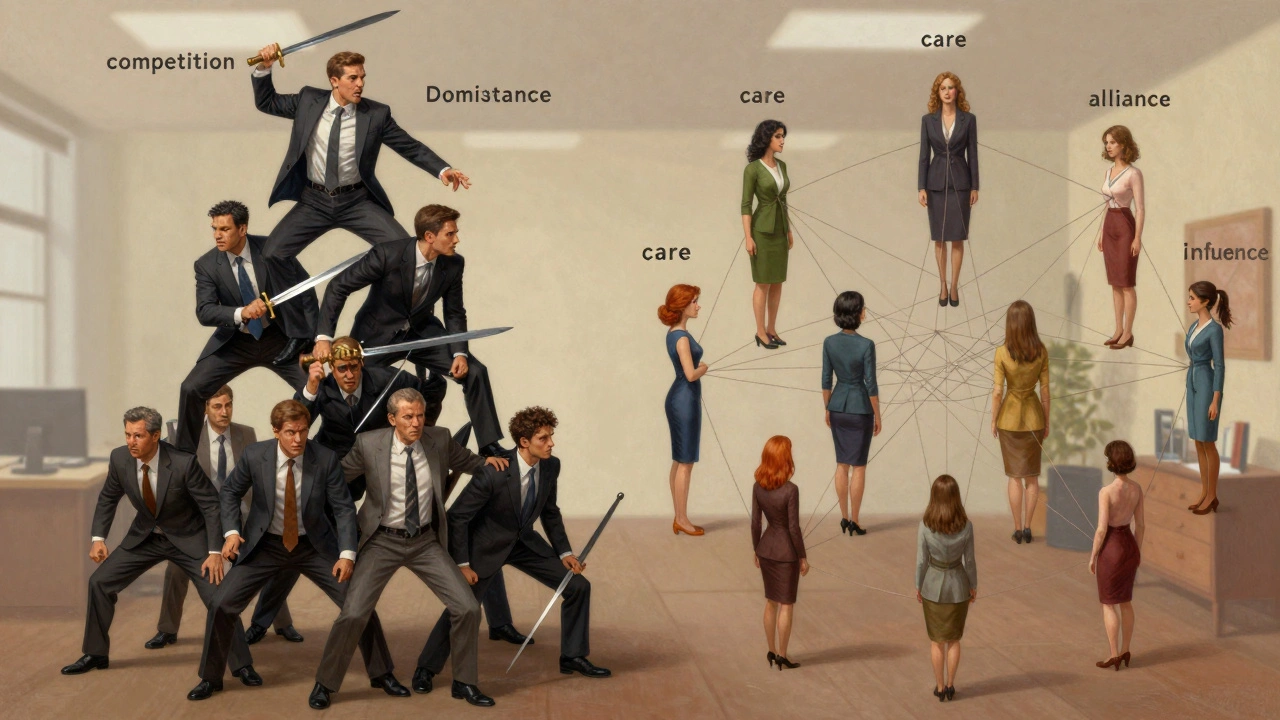
Female Hierarchies? Not What You Think
There’s a myth that women form their own hierarchies. That’s not quite right. In social species, dominance hierarchies are about competition for mating rights-and that competition is always same-sex. Men compete with men. Women compete with women. But here’s the key difference: male dominance is usually about winning fights, asserting control, and eliminating rivals. Female dominance? It’s often about alliances, cooperation, and influence. Studies on small groups show something surprising. At first, men set clear ranks fast-loud voices, interruptions, physical presence. Women? They’re more fluid. They build networks. They share power. But over time, men’s hierarchies become unstable. Women’s become more structured. Why? Because women are forced to adapt to a system that doesn’t reward direct dominance. So they build influence differently. Not weaker. Just different. Some researchers argue that female hierarchies aren’t true dominance systems at all. They say female rank is based on reproductive value-motherhood, caregiving, social bonds-not contests. And there’s evidence. In primates, female rank often comes from maternal lineage, not aggression. In human societies, women’s influence often flows through kinship, not titles. That doesn’t mean women are powerless. It means the system doesn’t let them play by the same rules.How Economics Reinforces Gender
Economic systems don’t just reflect gender roles-they amplify them. The rise of "winner-take-all" economies has made inequality worse for everyone, but it’s hit women and lower-class men hardest. Why? Because these systems reward the traits we associate with men: aggression, competition, risk-taking. Look at tech and finance: two of the fastest-growing industries. Who gets the big paychecks? Mostly men. Who does the caregiving work that keeps society running? Mostly women. And it’s unpaid or underpaid. Childcare, elder care, housework-these aren’t "non-economic" tasks. They’re the foundation of the economy. But because they’re tied to femininity, they’re treated as optional. This isn’t accidental. It’s designed. The more we value competition over care, the more we push women out of power and into the shadows. And we call it "natural."
Why This Doesn’t Change
We’ve had decades of awareness campaigns, diversity training, equal pay laws. And yet, the numbers barely budge. Why? Because we’re trying to fix symptoms, not the disease. You can’t change gender inequality by just hiring more women. You have to change the system that rewards dominance, punishes care, and treats hierarchy as inevitable. You have to challenge the idea that power should be concentrated. You have to stop assuming that men are natural leaders and women are natural supporters. The truth? There’s nothing natural about a world where 90% of billionaires are men. There’s nothing natural about a world where women do 76% of unpaid care work. There’s nothing natural about a system that tells boys to be tough and girls to be sweet. These are choices. Made by people. Reinforced by institutions. Maintained by silence.What’s Next?
Change doesn’t come from slogans. It comes from rewiring the systems that keep power in the same hands. That means:- Redesigning workplaces to value care as much as competition
- Investing in public childcare and elder care so women aren’t forced to choose between family and career
- Reforming education to stop teaching boys to dominate and girls to defer
- Shifting economic policy to reduce extreme inequality, which fuels the need for hierarchy
- Listening to women and marginalized men-not to fix them, but to rebuild the system with them
Gender inequality isn’t a problem of bad people. It’s a problem of broken systems. And systems can be fixed.
Is gender inequality just about men oppressing women?
No. While men do hold more power than women in most societies, gender inequality isn’t just about men controlling women. It’s about a system that rewards hierarchy itself. That system benefits a small group of powerful men while pressuring most men to compete in harmful ways. Women are oppressed, but so are lower-status men. The real issue is the structure-not just who’s on top, but why the structure exists at all.
Can women create their own dominance hierarchies like men do?
Women do form social hierarchies, but they’re often built differently. Male hierarchies tend to rely on competition, intimidation, and visible dominance. Female hierarchies usually rely on alliances, influence, and caregiving networks. Research shows that in same-sex groups, women’s ranks are less stable at first but become more structured over time. This doesn’t mean women are less capable of leadership. It means they adapt to systems that don’t reward traditional dominance.
Why do men have higher Social Dominance Orientation (SDO) scores?
Studies across 40+ countries show that men, on average, score higher on the Social Dominance Orientation scale. This means they’re more likely to support systems that create inequality. Why? Because patriarchal societies train men to see hierarchy as natural, even desirable. Men are socialized to be protectors, providers, and leaders-and those roles require them to uphold the system. Higher SDO isn’t about biology. It’s about conditioning.
Doesn’t gender equality help men too?
Yes. Gender equality doesn’t just lift women-it frees men. When society stops demanding that men be emotionally stoic, financially dominant, and endlessly competitive, men are less likely to die by suicide, less likely to be trapped in dead-end jobs, and more likely to form deeper relationships. Equality isn’t a zero-sum game. It’s a system upgrade for everyone.
Why do gender roles persist even in progressive countries?
Because change is slow. Even in countries with strong gender equality laws, deep cultural norms linger. Who does the housework? Who gets promoted? Who gets to speak first? These habits are passed down through families, media, education, and workplace routines. Laws can change quickly. Culture takes generations. Real progress means changing not just policies, but the invisible rules everyone follows without thinking.
Gender inequality isn’t going to vanish with a protest or a hashtag. It will vanish when we stop pretending it’s about individual choices-and start fixing the structures that make those choices inevitable.