Menstrual Health Myth Checker
Check Ancient Medical Beliefs
Enter a historical belief or symptom description to see if it matches ancient Greek/Roman medical views or modern science.
Modern Medical Understanding
This matches current scientific knowledge about menstruation.
Ancient Medical Myth
This reflects historical Greek/Roman medical misconceptions.
Today, we think of menstruation as a normal, natural part of life for people with uteruses. But in ancient Greece and Rome, it wasn’t seen that way at all. To them, menstruation wasn’t a routine bodily function-it was a pathological emergency that had to be controlled, corrected, or even forced into happening. If a woman didn’t bleed, she was at risk of dying. If she bled too much, she was also in danger. Her body wasn’t working right-it was broken, and doctors were there to fix it.
Why Did They Think Menstruation Was Dangerous?
The whole system came from something called humoral theory. This was the medical model used by Hippocrates and his followers in the 5th and 4th centuries BCE, and later adopted by Roman doctors. According to this theory, the body was made up of four fluids: blood, phlegm, yellow bile, and black bile. Health meant balance. Illness meant imbalance.
Here’s where it got strange. Greek doctors believed women’s bodies were fundamentally different from men’s-not just in anatomy, but in texture. Women’s flesh was described as "spongy" and "loose." Because of this, they absorbed more fluid from food and drink than men did. That extra fluid had to go somewhere. So they said: menstruation is the body’s way of dumping out the excess blood before it rots inside her. If she didn’t bleed, the blood would build up, swell her organs, poison her mind, and kill her.
This wasn’t a theory based on observation. It was a theory based on fear. And it shaped everything.
Menstrual Blood Had Powers-And Dangers
It wasn’t just about control. Ancient Romans believed menstrual blood had supernatural properties. Pliny the Elder, a Roman naturalist, wrote in his Natural History that touching a menstruating woman could cure gout, fevers, and even skin cancer. He also claimed that if menstrual blood dripped on a magician’s doorstep, it could break their spells. That’s not a joke. That’s a recorded belief.
At the same time, menstrual blood was considered dangerously polluting. Women were kept away from temples, altars, and religious rituals. Inscriptions at healing sanctuaries like Epidaurus warned people not to enter if they were menstruating. It wasn’t just about hygiene-it was about spiritual contamination. A woman’s body, in its natural state, was seen as a threat to sacred spaces and public order.
How Did Doctors "Treat" Menstrual Problems?
If a woman stopped bleeding-called amenorrhea-doctors didn’t ask if she was pregnant, stressed, or undernourished. They assumed her body was full of rotting blood. Their solution? Force it out.
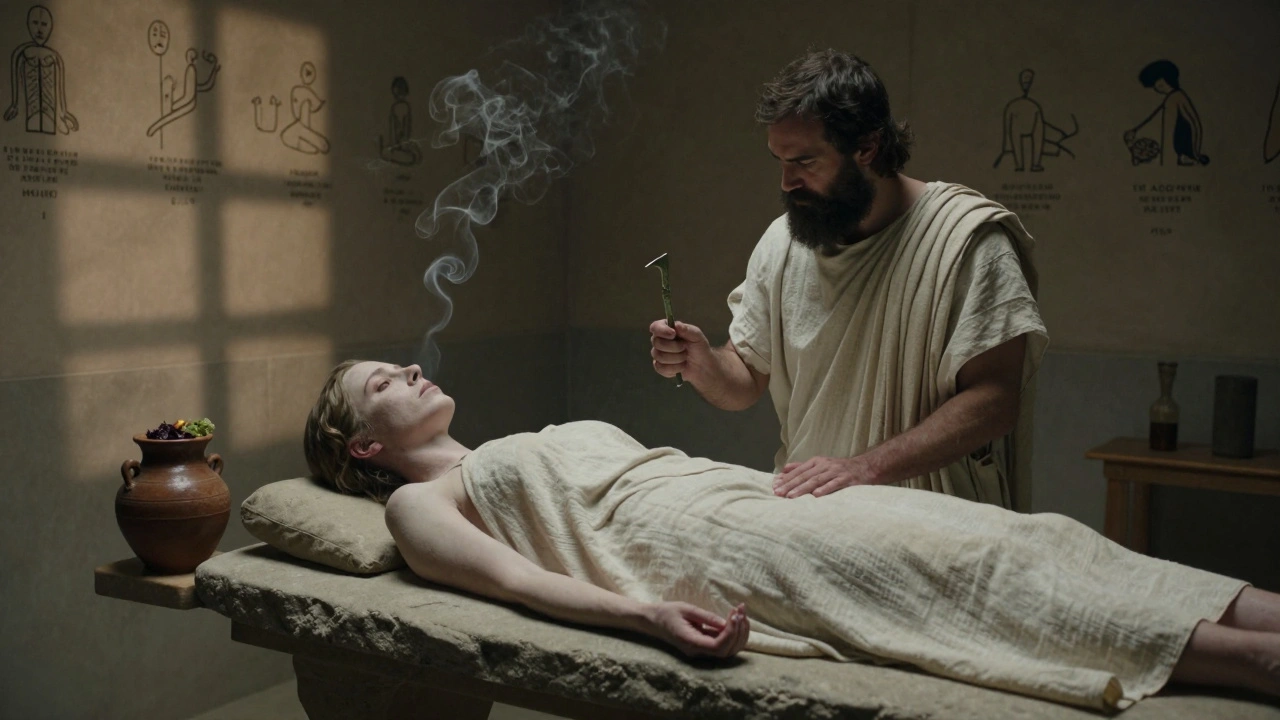
One common treatment was bloodletting. Doctors would cut her veins to drain blood, thinking it would mimic menstruation. Another was fumigation: burning herbs like rue, wormwood, or mint under her nose or near her vagina, hoping the smoke would "pull" the blood down. Some used vapor baths, sitting over steam from herbal mixtures to open her pores and trigger bleeding.
For heavy bleeding, they did the opposite. They tied tight bands around her armpits and groin to cut off circulation. Then they shoved pessaries-small objects soaked in alum, pitch, or roasted egg yolk-into her vagina. These weren’t for comfort. They were meant to block the flow.
And then there were the herbal potions. Chamomile for cramps. Mint for "warming" the womb. Laxatives to purge her system. All of it based on the idea that her body was a leaky vessel that needed constant patching.

Soranus of Ephesus: The One Who Questioned the Madness
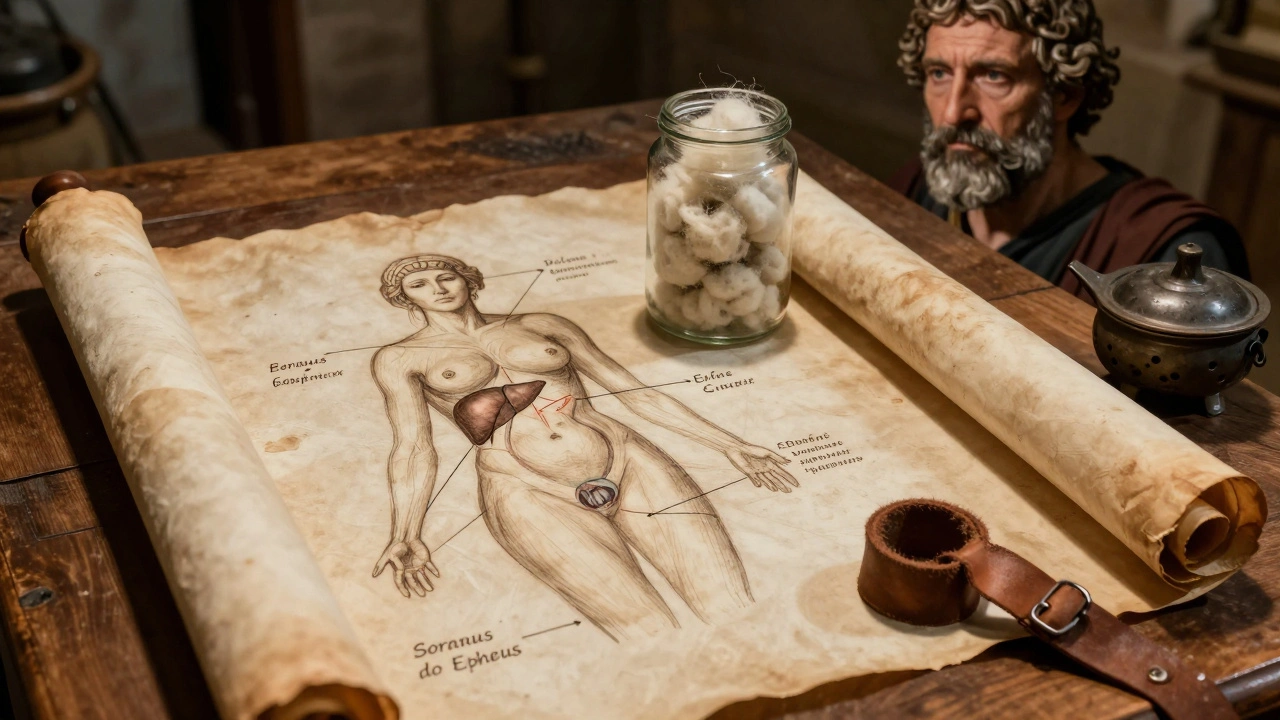
Not every Roman doctor accepted this. Soranus of Ephesus, writing in the 1st or 2nd century CE, was the most detailed gynecologist of the ancient world. His four-volume book on women’s health was the standard for centuries.
Soranus rejected some of the worst treatments. He laughed at doctors who hung women upside down from ladders to treat uterine prolapse. He called the use of "magic stones" wrapped in animal skin nonsense. He warned against excessive bloodletting, saying it weakened patients instead of healing them.
But even he wasn’t modern. He still believed menstruation was a purge. He thought amenorrhea could be caused by a "hot temperament"-a vague term that likely meant stress or emotional imbalance. And when he saw girls who stopped menstruating because they weren’t eating enough? His advice? Eat less. Starve yourself to reshape your body. That’s not just wrong-it’s terrifyingly close to how eating disorders were later pathologized in the 19th century.
Menopause? That Was a Disease Too
When a woman stopped menstruating, doctors didn’t celebrate. They panicked. Galen, one of the most influential Roman physicians, said menopause caused black bile to build up. That, he claimed, led to breast cancer. He thought menstruation was the only thing keeping women from dying of depression and tumors.
He also believed cervical cancer only happened to married women, widows, and prostitutes. Virgins and nuns? They were safe. Why? Because they didn’t have sex. Today, we know that’s because of HPV. Back then, they assumed it was because sex "overworked" the uterus. They didn’t understand viruses. They understood moral panic.
The Tampon Myth: What They Didn’t Use
There’s a popular story that ancient women used tampons made of wool or papyrus. It sounds plausible. It’s been repeated in textbooks. But it’s false.
The only mention of inserting materials into the vagina in Hippocratic texts is for medical treatments-like applying herbs or poultices to treat infections or inflammation. There’s zero evidence they used anything for menstrual absorption. The idea of a tampon in antiquity? That’s a 20th-century marketing invention, likely pushed by Tampax to make modern products seem "natural" and "historical."
The Legacy of Pathologizing Menstruation
For over a thousand years, this thinking didn’t disappear. Medieval doctors inherited it. Renaissance physicians revived it. Even into the 1800s, doctors told women their periods made them hysterical, weak, or mentally unstable. They were told to rest, avoid work, and stay out of school.
The belief that menstruation was a sign of disorder shaped how women were treated-not just medically, but socially. It justified excluding them from public life, from education, from power. If your body was broken, you couldn’t be trusted to lead, to think, to vote.
Modern medicine has mostly moved beyond humoral theory. We know now that menstruation is a healthy, necessary cycle. But the shadow of those ancient ideas still lingers. When women are told to hide their periods, to apologize for cramps, to medicate their natural biology-those are echoes of the same fear that once told a Roman woman: your body is rotting. Bleed, or die.
How Did This Affect Women’s Lives?
Imagine living like this: every month, your body was treated like a threat. Your blood was poison. Your silence was dangerous. Your pain was proof of imbalance. Doctors didn’t ask you how you felt. They told you what your body was doing wrong. And they had the power to force you into treatments that could leave you weaker, sicker, or even dead.
Women had no say in this. Their voices were ignored. Even when they described their own symptoms, doctors interpreted them through their own theories. A woman saying "I feel dizzy" became "excess blood in the head." A woman saying "I don’t want to eat" became "a hot temperament needing correction."
It wasn’t just about medicine. It was about control. The more they pathologized menstruation, the more they claimed authority over women’s bodies. And that authority lasted far longer than the humors ever did.
Was menstruation always seen as pathological in ancient times?
Yes, in Greek and Roman medicine, menstruation was almost universally viewed as a pathological process-not a natural one. The dominant medical theory, humoralism, held that women’s bodies naturally accumulated excess fluids, and menstruation was the body’s only way to purge them. Without it, illness or death was expected. Even when doctors like Soranus tried to refine treatments, they still operated within this framework. There was no concept of menstruation as a healthy, normal cycle until modern physiology emerged centuries later.
Did ancient doctors understand the menstrual cycle the way we do today?
No. Ancient doctors had no concept of hormones, ovulation, or the endocrine system. They didn’t know the uterus was part of a cyclical, self-regulating system. Instead, they saw menstruation as a one-time purge, triggered by the body’s need to eliminate excess blood. They believed it happened at a fixed time each month, often linking it to lunar cycles, not biology. Their understanding was based on observation of symptoms, not underlying mechanisms-and they often misinterpreted what they saw.
Why did Roman doctors believe menstrual blood could cure diseases?
This belief came from the idea that menstrual blood was the purest form of female bodily fluid-a concentrated version of the excess that needed to be expelled. Because it was so powerful, it was thought to have restorative properties. Pliny recorded that it could cure gout, fevers, and skin conditions. These were not scientific claims but magical or symbolic interpretations. The same logic that saw menstrual blood as dangerous also made it seem potent. It was both polluting and healing, depending on context.
Did any ancient cultures treat menstruation as normal?
There’s little evidence that any major ancient medical system viewed menstruation as normal. While some non-Western cultures had ritual or spiritual views-like viewing it as sacred or powerful-Greek and Roman medicine was the most influential in shaping Western thought. Their pathological model dominated medical practice for over a millennium. Even when other societies had different rituals, the medical framework that shaped hospitals, universities, and doctors’ training came from Greece and Rome.
How did this view affect women’s rights and roles in society?
By framing menstruation as a sign of bodily weakness and instability, ancient medicine gave doctors and male authorities a reason to limit women’s roles. Women were excluded from public life, education, and leadership because their bodies were seen as unreliable. If your body was constantly "out of balance," you couldn’t be trusted to govern, teach, or make decisions. This wasn’t just medical opinion-it became social law. The idea that women were naturally irrational or unfit for certain roles was built on this foundation.