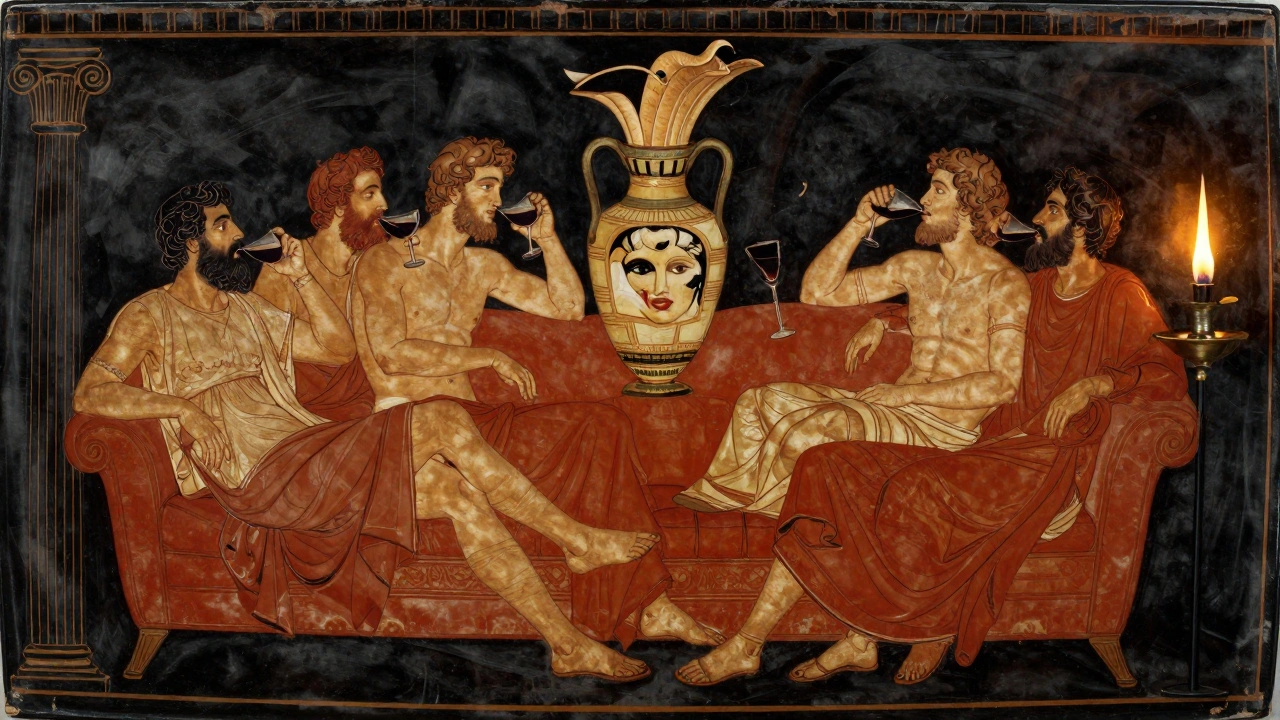
When you think of ancient Greece, you might picture marble statues, philosophers arguing in the agora, or Olympic athletes. But one of the most revealing windows into how the Greeks saw sex comes from something far more everyday: pottery. Specifically, the painted vases that lined the shelves of homes, filled the floors of symposia, and were traded across the Mediterranean. These weren’t just containers for wine or oil-they were visual storytelling tools, and many of them showed sex. Not just any sex. Specific kinds of sex. Repeated, exaggerated, and sometimes disturbingly intimate scenes that tell us more about Athenian society than any law code or speech ever could.
What the Vases Showed-and Didn’t Show
Athenian potters between 600 and 300 BCE painted thousands of scenes of sexual encounters. Some were tender, some were crude, and many were violent. Heterosexual scenes often showed men overpowering women, sometimes with weapons nearby, sometimes with chains. But there’s a glaring absence: wives. You won’t find married women in these scenes. Not in the context of drinking parties, not in the role of active partners. Instead, the women shown are prostitutes, concubines, or mythological figures like Aphrodite or Leda. Their bodies are exposed, their expressions often passive or forced. Meanwhile, men are always in control-standing, thrusting, dominating.
But the most frequent and deliberate sexual imagery? Male-male relationships. Specifically, between adult men and adolescent boys. These weren’t random scenes. They were everywhere-on drinking cups, on storage jars, on panels meant to be admired during symposia. And they weren’t just about lust. They were about power, mentorship, and social status. The older man, the erastes, was expected to guide the youth, the eromenos, in philosophy, politics, and military life. But the art made it clear: desire was part of that bond. And it was displayed openly.
The Herm: A Symbol of Desire
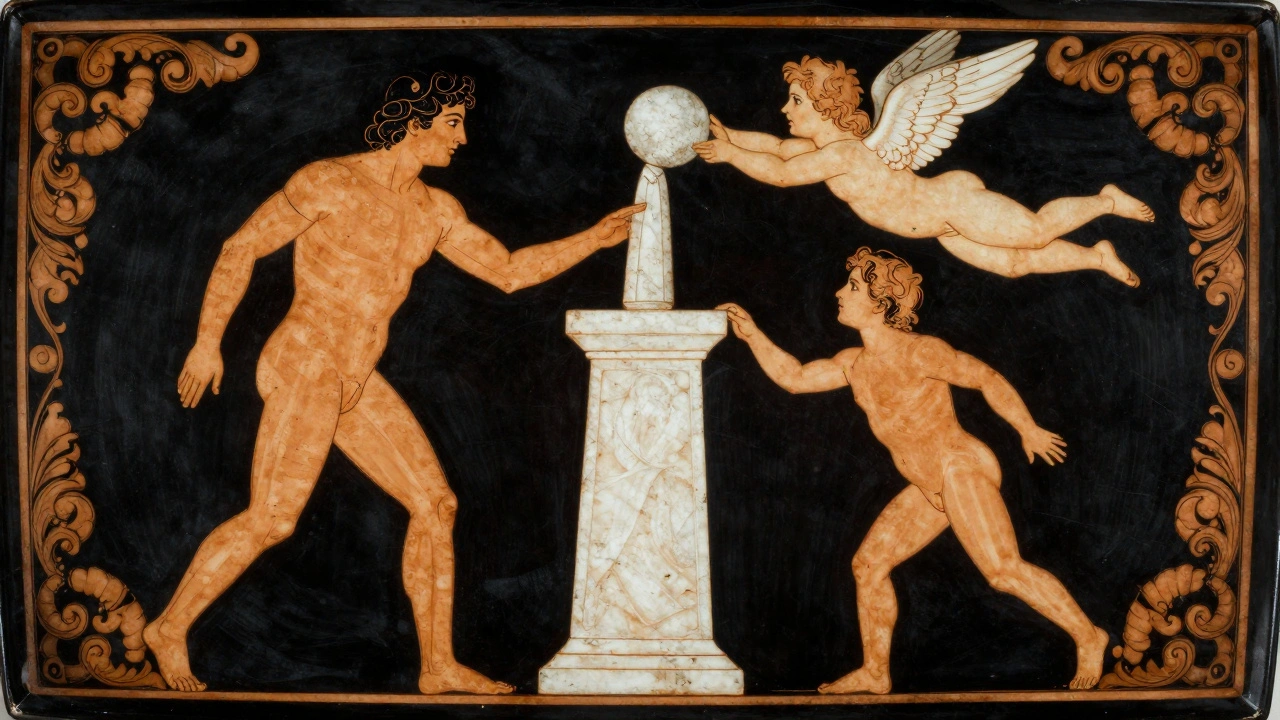
One of the strangest and most telling motifs shows up again and again: the herm. These were stone pillars with a carved head of a man-usually bearded-and a prominent, erect phallus. They stood at doorways, crossroads, and gardens. On vases, painters placed these herms right next to adult men and young boys. Sometimes the man is touching the herm’s phallus. Sometimes the boy is. Sometimes both are looking at it together.
This wasn’t just decoration. It was a visual joke with a serious point. The herm, with its beard and phallus, looked like the idealized erastes. By placing it beside a real man and a real boy, the painter was saying: This is what desire looks like. This is what you’re all thinking about. It was a way to laugh at the obvious, while making sure everyone understood the underlying truth. Humor made the taboo acceptable. And in the symposium, where wine flowed and inhibitions dropped, that was the whole point.
Some vases even show winged Eros-the god of love-fondling a boy’s genitals or holding a herm like a toy. Eros wasn’t just a symbol of romance. He was a representation of the boy himself, caught between being desired and being the one who desired. The art blurred the line between the lover and the loved, making it clear: youth wasn’t just admired. It was commodified.
Who Was Looking? And Why?
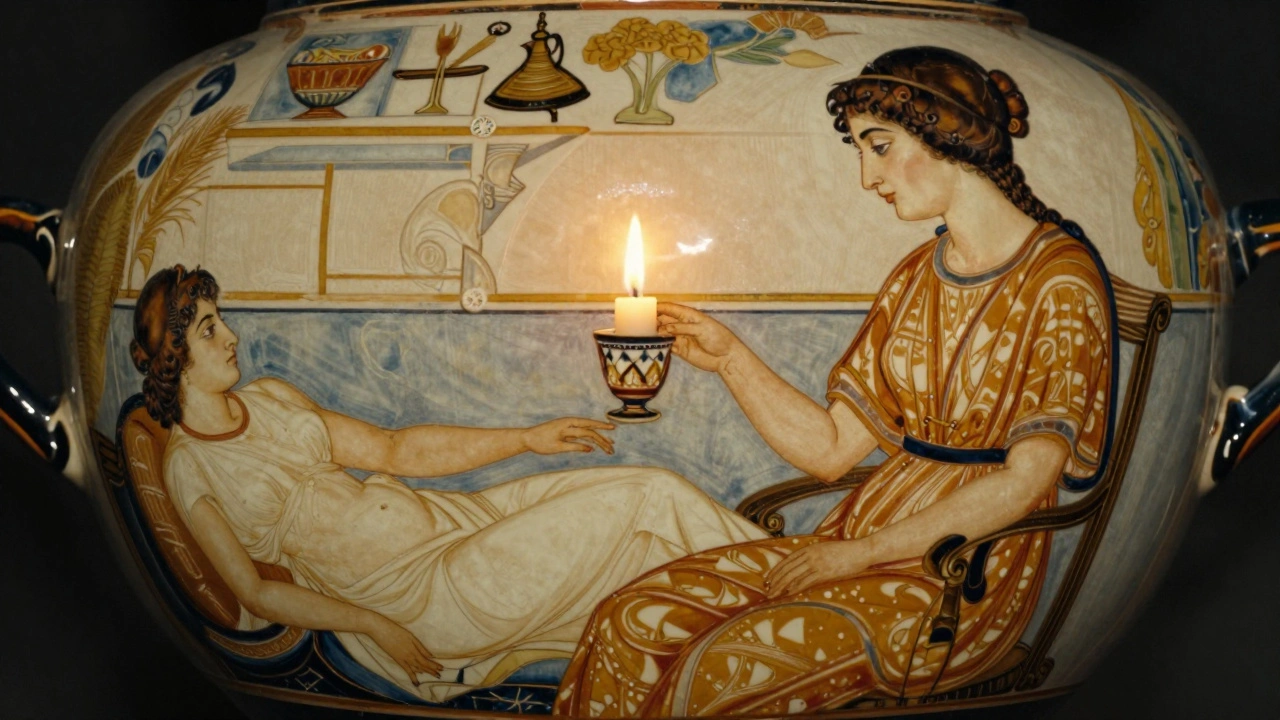
Most people assume these vases were made for men-symposiasts drinking, laughing, and ogling. And yes, that’s true. But here’s where it gets more complicated: women bought them too. Not just as decorative objects, but as gifts, as dowries, as household items. Evidence from tomb paintings and inscriptions shows that women were active participants in the pottery market. Some vases with erotic scenes were clearly made for female audiences. The imagery changed. Less violence. More intimacy. More emotional connection between partners.
One example: a cup from around 450 BCE shows a man and woman lying side by side, touching each other gently. No force. No audience. Just quiet closeness. That scene wouldn’t have fit in a symposium. But it might have hung in a woman’s bedroom. Artists knew their audience. They didn’t just paint what they saw. They painted what they thought people wanted to see.
And then there were the Etruscans. These people from Italy were crazy for Athenian pottery. They paid high prices for vases with complex myths and explicit sex scenes. Why? Because they thought Greek culture was exotic, sophisticated, and daring. So Athenian potters gave them what they expected: more nudity, more pederasty, more phalluses. The vases exported to Etruria often had even more extreme scenes than those found in Athens. That tells us something important: the art wasn’t just reflecting Athenian norms. It was shaping foreign perceptions of them.
Sex, Power, and Social Hierarchy
The vases don’t show a society where sex was free or equal. They show a society where sex was layered with control. Age mattered. Status mattered. Gender mattered. A free Athenian man could pursue a youth without shame. But he couldn’t be pursued by one. A woman, even if she was beautiful and wealthy, couldn’t initiate sex with a man in public. And slaves? They were invisible in these scenes-not as participants, but as props.
The most common sexual scene on vases? A man penetrating a woman from behind. It’s not romantic. It’s not playful. It’s mechanical. And it’s repeated over and over. Meanwhile, scenes of male-male sex often show the youth lying on his back, arms out, accepting. The older man is always standing, in control, looking directly at the viewer. The message is clear: sex was a performance of dominance.
But here’s the twist: in real life, pederastic relationships were regulated. There were social rules. The boy couldn’t be too young. The relationship had to end before he grew a beard. It wasn’t just about sex-it was about training. The vases, though, stripped away the rules. They showed only the desire. That’s why they’re so powerful. They reveal what people *wanted* to believe, not what they were *supposed* to do.
Why This Matters Today
We don’t have diaries from ancient Athenians. We don’t have personal letters or therapy sessions. What we have are pots. And those pots tell us what was normal, what was funny, what was taboo, and what was desired. The fact that these scenes were so common means sex wasn’t hidden. It was part of daily life. But it wasn’t free. It was structured. It was hierarchical. It was tied to power.
Modern readers often struggle with this. We project our ideas of consent, equality, and romance onto the past. But the Greeks didn’t think that way. Their sexuality was about status, not identity. A man could love a boy and still marry a woman. That wasn’t contradictory. It was expected. The vases don’t judge. They just show. And that’s what makes them so valuable.
These images weren’t just decoration. They were mirrors. And when you look into them, you see not just ancient Greeks-but how deeply culture shapes desire, how art fuels fantasy, and how power always has a face.
Were Greek vase paintings meant to be erotic or just decorative?
They were both. Many vases were functional objects used in daily life-holding wine, oil, or perfume. But their decoration wasn’t random. Erotic scenes were carefully chosen to appeal to the viewer’s desires, especially during symposia, where drinking and sexual talk went hand in hand. The art stimulated conversation, laughter, and fantasy. So while not every vase was meant to be pornographic, the erotic imagery was absolutely intentional and designed to provoke a reaction.
Did Greek women have any role in the creation or consumption of erotic vases?
Yes. While men were the primary users of symposium vases, women were active buyers and users of pottery in domestic settings. Archaeological evidence shows that some vases with erotic imagery were found in women’s tombs and homes. The imagery on these vases was often softer-focusing on tenderness, courtship, or private moments-suggesting artists tailored scenes to female audiences. Women may have commissioned these pieces, gifted them, or simply influenced what was produced by their purchasing power.
Why are there so many scenes of male-male sex on Greek vases?
Pederasty-the relationship between an adult man and an adolescent boy-was a socially recognized part of Athenian male life, especially among the elite. It wasn’t just about sex; it was about mentorship, education, and social bonding. Vase painters highlighted these scenes because they resonated with the male audience at symposia. The imagery reinforced cultural norms and provided a shared visual language of desire. The fact that these scenes appear on so many types of vases shows they were central to how men understood their own sexuality.
Do the vase paintings reflect real-life practices or just fantasy?
They reflect both. The structure of relationships-like age differences, social roles, and public displays of affection-matches what we know from texts like Plato’s dialogues and legal codes. But the exaggeration, humor, and violence in the scenes suggest artistic license. Painters amplified what was socially acceptable to make it more engaging. So while the core dynamics were real, the details were often stylized for emotional impact, entertainment, or shock value.
How did foreign buyers like the Etruscans influence the imagery on Greek vases?
Etruscan buyers wanted vases that felt authentically "Greek"-especially scenes that showcased Greek values like philosophy, heroism, and sexuality. To meet demand, Athenian potters produced more explicit and exaggerated erotic scenes than were common domestically. This means some of the most extreme imagery we see today may have been created not to reflect Athenian life, but to satisfy foreign stereotypes. The vases became a kind of cultural export, shaping how others saw Greek sexuality, even if they distorted it.