In the mid-1800s, doctors didn’t just treat sickness-they judged desire. If you felt pleasure outside of marriage, if you loved someone of the same sex, if you wanted sex more than your doctor thought you should, you weren’t just immoral-you were ill. Two men, William Acton and Havelock Ellis, shaped how medicine saw human desire. One locked it in a cage of moral panic. The other cracked the door open. Their clash wasn’t just academic. It changed how we understand sex, gender, and what’s normal.
William Acton: The Victorian Doctor Who Said Women Don’t Want Sex
William Acton’s name still pops up in medical history books, not because he was right, but because he was so widely believed. In 1857, he published Prostitution, Considered in Its Moral, Social and Sanitary Aspects and The Functions and Disorders of the Reproductive Organs. These weren’t fringe ideas. They were the law of the land in Victorian medicine.
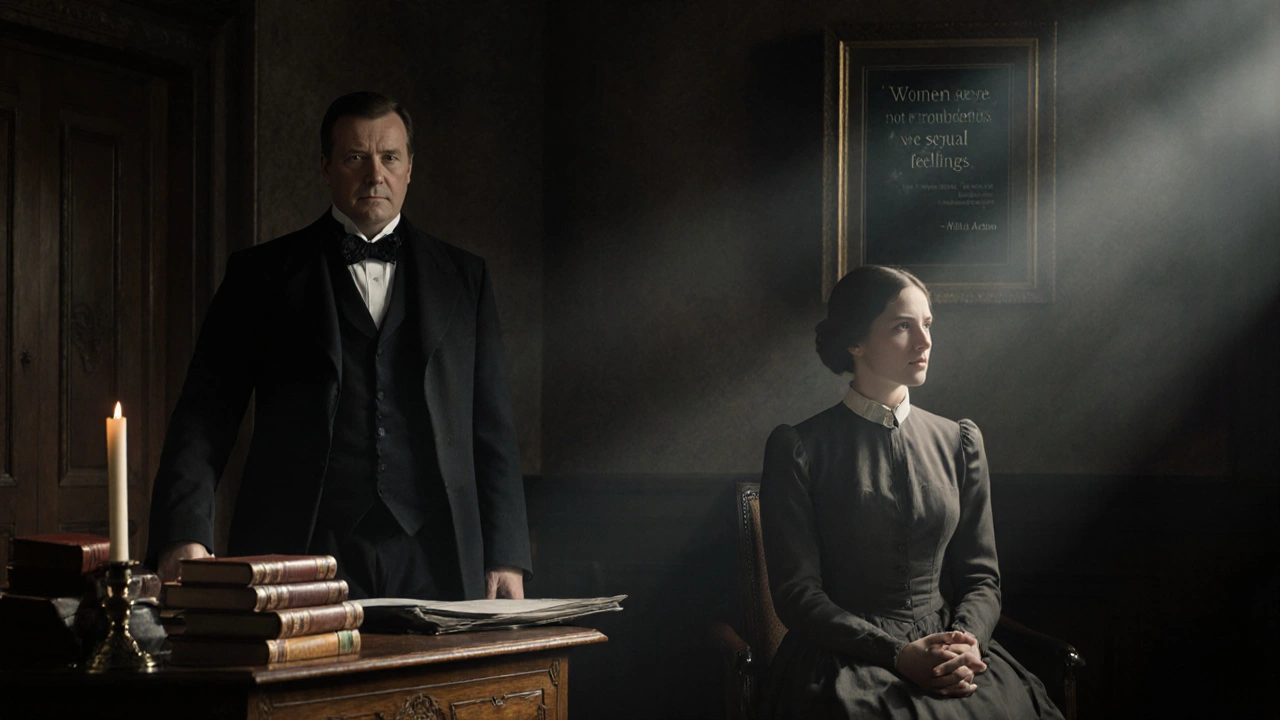
Acton’s most infamous line? “The majority of women (happily for them) are not very much troubled with sexual feelings of any kind.” He wasn’t just describing women-he was prescribing silence. If a woman wanted sex, doctors thought something was wrong. Hysteria, nervous exhaustion, even madness were common diagnoses for women who spoke up about desire. Acton didn’t just ignore female pleasure-he declared it nonexistent.
For men, Acton’s advice was equally controlling. He believed semen was a vital fluid, like blood or bone marrow. Losing too much of it-through masturbation, sex, or even wet dreams-meant draining your health. He called this “productive sexual continence.” The idea? Save your seed, save your life. Men were told to limit sex to just a few times a month. Too much, and you’d weaken your mind, your muscles, your soul.
Acton’s work wasn’t based on patient interviews or data. It was based on moral panic dressed up as science. He wrote about prostitutes, but not to help them. He wrote to warn men away from them, framing prostitution as a disease vector and a moral trap. His views were echoed in churches, schools, and homes. For decades, he was the voice of medical authority on sex.
Havelock Ellis: The Rebel Who Turned Confessions Into Science
Then came Havelock Ellis. Born in 1859, he didn’t just disagree with Acton-he rewrote the rules. By 1896, Ellis began publishing Studies in the Psychology of Sex, a ten-volume series that would become the foundation of modern sexology.
Ellis didn’t just write from his desk. He listened. He collected letters. He interviewed patients. He asked people to describe their desires, their fears, their experiences. He called it “the patient’s discourse.” That was radical. For the first time, sex wasn’t just a doctor’s opinion-it was a collection of real human stories.
Ellis argued that homosexuality wasn’t a sin or a disease. He called it a natural variation, found across cultures and even in animals. He wrote about Michelangelo, Walt Whitman, and Verlaine-not as moral failures, but as men whose love was part of their genius. He didn’t excuse it. He explained it.
He also challenged the myth of female passivity. Yes, he sometimes described women’s desire as “mysterious,” but he insisted it existed. He even suggested couples try cunnilingus-a shockingly frank idea for the early 1900s. He didn’t have all the answers, but he asked the right questions.
His work was banned from public sale. Only doctors and lawyers could buy it. That didn’t stop it from spreading. By the 1920s, his third edition of Sexual Inversion was quietly reshaping how medicine thought about gender and sexuality. He didn’t just challenge Acton-he buried him under evidence.

Two Worlds of Desire: Science vs. Morality
Acton and Ellis weren’t just different doctors. They represented two entirely different ways of seeing the body.
Acton saw desire as a threat. It had to be controlled. Men needed to conserve their strength. Women needed to suppress their urges. Sex was dangerous unless it served reproduction. His world was one of limits, warnings, and fear.
Ellis saw desire as a fact. It varied. It changed. It was human. He didn’t say all desires were good-but he said they were real. He didn’t pathologize homosexuality. He studied it. He didn’t shame women for wanting pleasure-he documented it. His work was still flawed. He often framed women’s sexuality as passive. He used terms like “invert” and “eonist” that sound offensive today. But his method was revolutionary: listen to the person, not the dogma.
Where Acton relied on moral certainty, Ellis relied on observation. Where Acton wrote for control, Ellis wrote for understanding. And where Acton’s ideas faded into history, Ellis’s became the starting point for Kinsey, Masters and Johnson, and even today’s sex therapists.
The Legacy: What We Still Carry From the Victorians
Today, you won’t hear a doctor say women don’t want sex. You won’t hear someone warn that masturbation will ruin your liver. But the ghosts of Acton and Ellis still linger.
When we assume that men are naturally more sexual than women, that’s Acton’s echo. When we still treat non-heterosexual desire as something to “explain” rather than accept, that’s Ellis’s unfinished work. He opened the door, but society still hesitates to walk through.
Modern sex research still uses the case study method Ellis pioneered. The idea that people’s own stories matter more than a doctor’s assumptions? That’s his gift. But we’ve also learned what he missed. He didn’t hear from Black, working-class, or non-European voices. His patients were mostly white, middle-class, and educated. We now know desire is shaped by race, class, and power-not just biology.
Ellis’s archives at the Wellcome Collection in London now see 40% more researchers than they did a decade ago. Scholars are going back to his original case notes-not to idolize him, but to recover the voices he recorded. Who were the people who wrote him letters? What did they really feel? What did they fear?
Acton’s work is rarely cited today-except as a cautionary tale. His books are relics. Ellis’s are still taught in medical schools, psychology programs, and gender studies courses. He’s not perfect. But he was the first to say: Let’s talk about it. Let’s listen. Let’s stop pretending.

Why This Matters Now
When politicians ban books about gender, when schools silence conversations about sex, when doctors still assume what patients “should” feel-we’re still fighting the same battle Ellis started.
Acton gave us shame. Ellis gave us curiosity. The difference isn’t just historical. It’s alive.
Today, a teenager searching online for answers about their attraction isn’t reading Acton. They’re reading the legacy of Ellis: the idea that their feelings are real, valid, and worth understanding. That’s not luck. That’s the quiet, hard-won victory of one man who dared to listen.
The medical world stopped treating desire as a crime. It didn’t happen overnight. But it started when someone stopped preaching and started asking: What do you feel?
Did Havelock Ellis believe women were as sexual as men?
Ellis insisted that women had sexual desires, contrary to the common Victorian belief that they didn’t. But he often described their desire as more passive, mysterious, or complex compared to men’s. He didn’t fully escape the gender stereotypes of his time, even as he challenged them. His work acknowledged female sexuality more than any doctor before him, but he still framed it through a lens shaped by 19th-century ideas about femininity.
Why was William Acton so influential in his time?
Acton’s books were among the first to be widely read by doctors and the public as medical authority on sex. His ideas aligned with Victorian moral values, making them easy to accept. He gave a scientific-sounding justification for controlling sex-especially women’s-and his views became standard teaching in medical schools. His influence lasted until Ellis’s research began to replace moral claims with documented evidence.
Was Havelock Ellis the first to study homosexuality scientifically?
He wasn’t the absolute first, but he was the first to build a large-scale, systematic study of homosexuality across cultures and history. He collected hundreds of personal accounts, referenced global examples-from ancient Greece to Native American tribes-and argued it was a natural variation, not a disease. His work laid the groundwork for later researchers like Alfred Kinsey.
Did Havelock Ellis support LGBTQ+ rights as we understand them today?
Not exactly. Ellis didn’t fight for legal rights or public acceptance. He didn’t organize protests or lobby lawmakers. But he did argue that homosexuality wasn’t immoral or criminal-it was natural. He opposed laws that punished same-sex relationships. In his time, that was revolutionary. His work gave later activists the scientific language to demand equality.
Why is Havelock Ellis still studied today?
Because he shifted medicine from judgment to observation. He proved that human desire can’t be understood from a textbook alone-it needs real stories. Modern sex therapy, gender studies, and even public health policies trace their roots to his methods. He’s studied not because he got everything right, but because he asked the right questions-and showed how to find the answers.
What Comes Next
If you want to understand today’s debates about sex, gender, and identity, start with these two men. Acton shows you what happens when medicine becomes a tool of control. Ellis shows you what happens when it becomes a tool of understanding.
Read his original case studies. Look at the letters he collected. See how people described their lives in a time when speaking up could cost them everything. That’s not history. That’s the foundation of how we talk about desire now.
The fight isn’t over. But the tools we use? They were forged in the quiet work of a man who listened.