Evolutionary Signal Effectiveness Calculator
How Environmental Factors Affect Mating Signals
Based on research from the article, animals use multiple signal types (visual, auditory, chemical) to increase mating success. This calculator demonstrates how environmental conditions impact signal effectiveness.
When you think of courtship, you might picture roses, dinner dates, or a carefully crafted text. But across the animal kingdom, romance is far stranger-and far older. Long before humans wrote love poems, frogs were calling in the dark, spiders tapped out rhythms on leaves, and birds built intricate temples just to impress a mate. These aren’t just cute behaviors. They’re evolutionary weapons, honed over millions of years to win reproduction at all costs.
Chemical Whispers: The First Love Letters
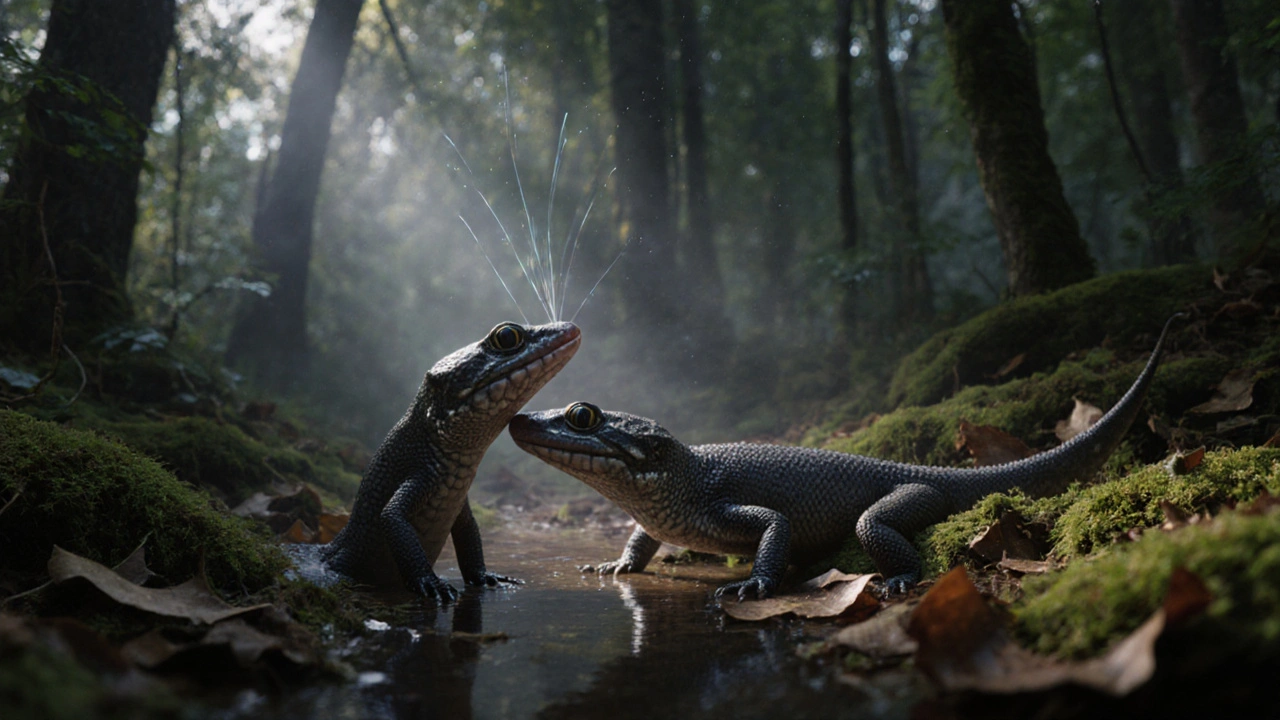
Long before sight or sound mattered, life communicated through scent. In the damp forests of North America, male salamanders of the Plethodontidae family glide up to females and press their chin against her skin, releasing a cocktail of pheromones. These aren’t just nice smells-they’re chemical commands. Studies show these signals cut female mating delays by 40 to 60 percent and make them far more likely to accept a partner. No words needed. Just chemistry.This isn’t unique to salamanders. Fish, insects, and even some mammals rely on pheromones to signal readiness, health, or genetic compatibility. In mice, a single scent can tell a female if a male is related to her or carries immune genes that would strengthen their offspring. Evolution didn’t need fancy brains for this. Just good genes and a strong nose.
Visual Spectacles: When Beauty Becomes a Weapon
Then came color. And movement. And sheer extravagance.The peacock’s tail isn’t just for show-it’s a physics experiment. At 25 to 27 hertz, the male shakes his feathers just fast enough to create shimmering, iridescent flashes that catch the light like a disco ball. Females don’t just look at the size of the tail-they watch how it moves. Research using high-speed cameras captured this rhythm in detail, proving the flicker isn’t random. It’s calibrated.
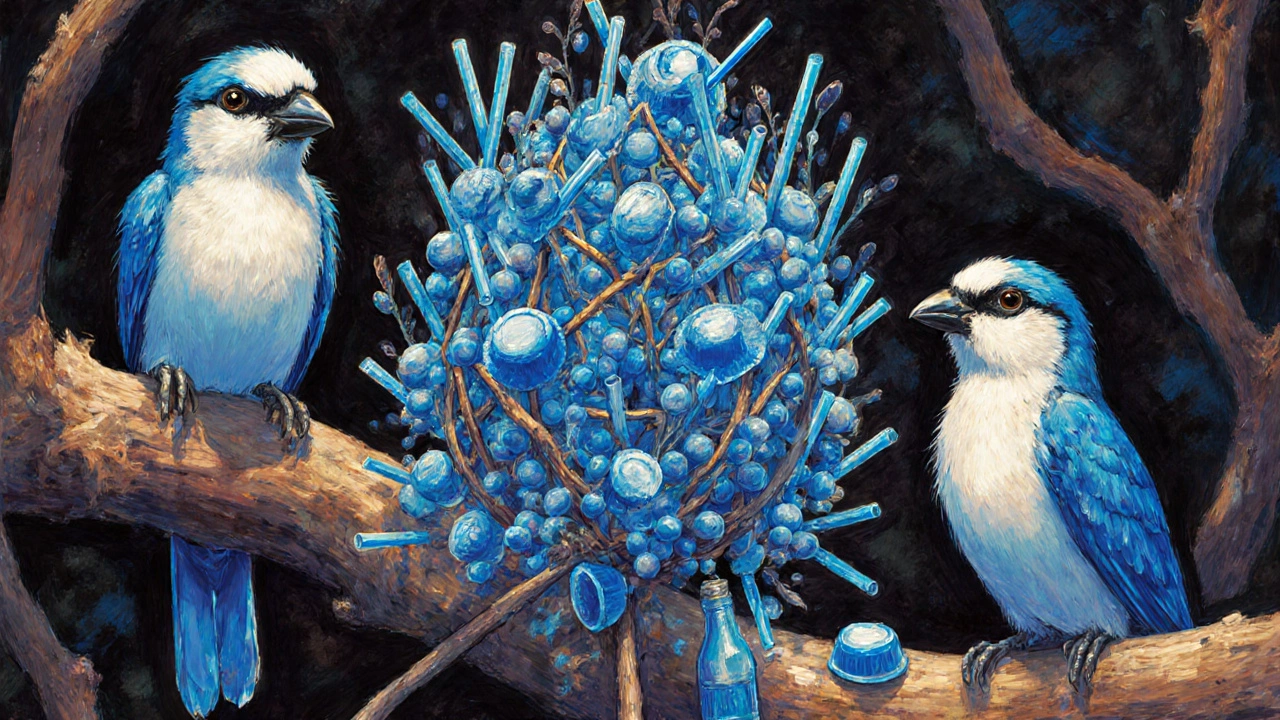
Even more extreme are satin bowerbirds. Males don’t just display feathers-they build. They collect blue objects-bottle caps, berries, plastic straws-and arrange them in precise, geometric patterns around a stick hut called a bower. They spend hours each day rearranging, guarding, and improving it. This isn’t art for art’s sake. It’s a fitness test. Females visit dozens of bowers before choosing. Only the most meticulous, most persistent males win.
And it’s not just birds. Male cuttlefish change skin color and texture in milliseconds, flashing stripes and spots to signal dominance or submission. Some even mimic females to sneak past rivals. In the ocean, beauty is a survival tactic.
Songs in the Dark: Sound as a Sexual Signal
In the quiet of night, sound becomes the star. Male Estrildid finches sing complex melodies-each note, each pause, each trill tuned by evolution. But here’s the twist: their songs don’t match their dances or their plumage. One species might have a bright red chest and a simple chirp. Another might be dull gray but sing like a virtuoso. That’s because, in these birds, song, color, and movement evolved independently. No correlation. No teamwork. Just separate paths to the same goal: getting laid.But in birds-of-paradise, it’s different. Their songs and colors evolve together. A male with a deep blue chest also sings a richer, more complex call. The same goes for movement and sound. When researchers analyzed 39 species over 15 million years, they found a strong link between auditory and visual traits-but not between two visual traits. Why? Because different senses don’t compete. They amplify. A flash of color means nothing if the bird’s song is weak. But together? They’re unstoppable.
The Power of Many Signals: Why Animals Don’t Just Stick to One
Why do so many animals use multiple signals at once? Why not just sing, or just dance, or just smell?Because nature is noisy. And unreliable.
In a rainforest, wind drowns out songs. Thick foliage blocks visual displays. Rain washes away pheromones. So animals layer their signals. Túngara frogs, for example, combine a low-frequency “whine” with a splashy “chuck” sound. Alone, each signal works in about half the environments. Together? They work in 83 percent of cases-even when there’s heavy background noise.
Canaries do something similar. Males sing a special trill and bob their heads in a precise dance. Females only respond when both happen together. It’s not that one signal is better. It’s that both together create certainty. If a male’s song is perfect but his dance is sloppy, she walks away. If his dance is flawless but his voice is off? Still no deal. The system demands consistency.
But this comes at a cost. Bowerbirds burn 22 to 27 percent more energy just maintaining their displays than males who don’t bother. That’s like a human running a marathon every day just to get a date. Evolution doesn’t care about fairness. It only cares about results.
Neural Wiring: The Brain Behind the Show
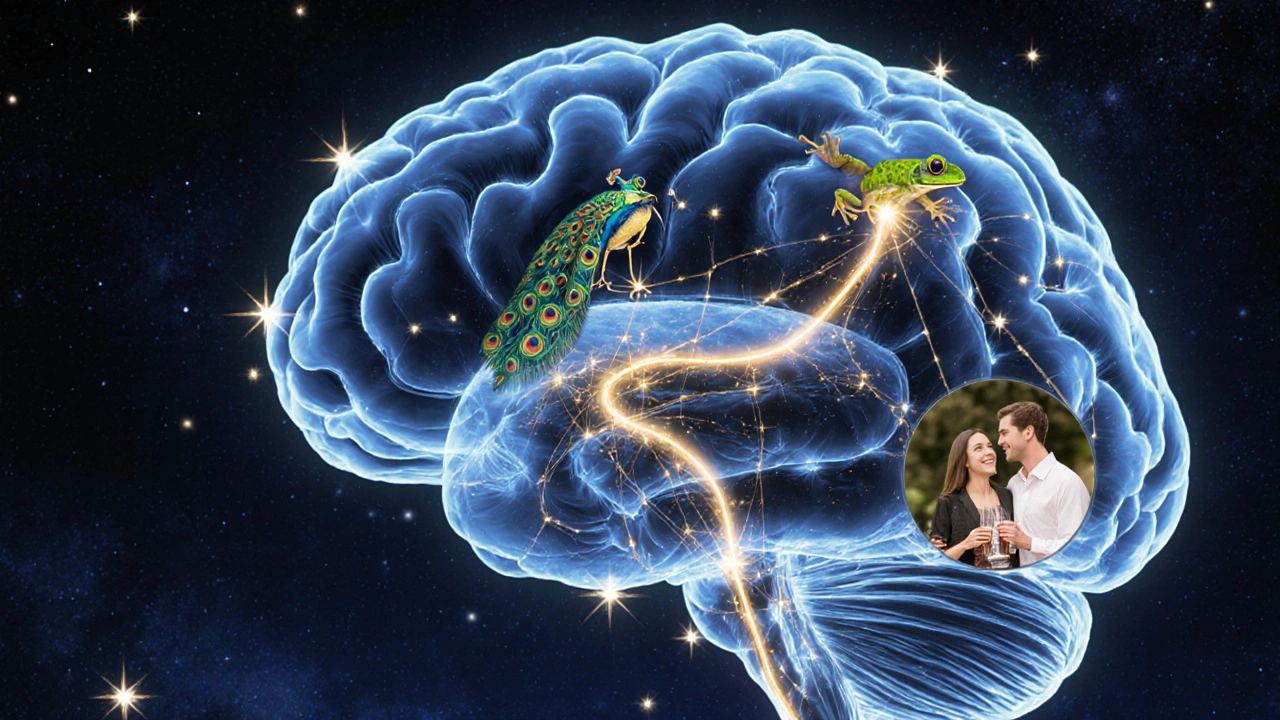
All this behavior-singing, dancing, building, scent-marking-isn’t magic. It’s biology. Deep in the brain, across species from frogs to humans, lies a small region called the periaqueductal gray (PAG). It’s only 12 to 15 millimeters long. But it controls everything: the timing of a bird’s song, the twitch of a frog’s call, the rhythm of a salamander’s approach.What’s wild is that this structure hasn’t changed much in 320 million years. The same neural circuit that makes a lizard bob its head also makes a human smile nervously during a first date. Evolution didn’t rebuild the system. It just added layers. Human flirting? It’s still rooted in the same ancient pathways.
Recent studies using brain imaging show that when a female bird hears her preferred song, her PAG lights up. The same happens in humans when they hear a romantic voice or see a familiar face. The brain doesn’t distinguish between a bird’s trill and a lover’s laugh. It just recognizes a signal that means “this one is worth it.”
Genes, Mating, and the Hidden Rules of Attraction
Behind every dance, every song, every scent is a genetic blueprint. In fruit flies, just three to five genes control nearly 80 percent of variation in courtship song. In birds, 17 specific genes have been linked to bower-building behavior. These aren’t random mutations. They’re targeted changes-selected because they made a male more attractive.And here’s the kicker: preference often evolves alongside the signal. A female who prefers a certain color ends up with sons who have that color-and daughters who also prefer it. This tight genetic link-called genetic coupling-can create reproductive barriers so strong that two populations become separate species, even if they live side by side.
That’s exactly what happens in frog hybrid zones. Two similar frog species live near each other. Their calls are slightly different. Females only mate with males who sing the right tune. Ninety percent of the time, they get it right. No confusion. No wasted effort. Just pure, genetic precision.
Human Romance: Are We Just Fancy Birds?
So where do humans fit in? We don’t have tails or bowerbirds, but we do have poetry, music, art, humor, and elaborate rituals. Geoffrey Miller argued in The Mating Mind that these aren’t just cultural luxuries-they’re evolutionary courtship displays. Language didn’t evolve just to share information. It evolved to impress. Creativity isn’t just useful. It’s sexy.Think about it. Who gets more dates: the person who tells a funny story or the one who just talks about their job? Who wins admiration: the painter, the musician, the writer-or the accountant who balances spreadsheets perfectly? We don’t advertise strength or speed. We advertise imagination.
And it’s not just men. Women, too, display traits linked to creativity, emotional intelligence, and social skill. In monogamous species, both sexes evolve elaborate signals. That’s true for 78 percent of bird species that pair up. And humans? We’re one of them. Our courtship is mutual. Complex. And deeply rooted in biology.
Threats to the Rituals: When Nature Gets Disrupted
But here’s the problem: we’re breaking the system.Artificial light confuses fireflies. Their mating flashes are timed to darkness. Streetlights? They drown them out. Noise pollution from traffic and construction masks bird songs. In high-noise areas, mating success drops by 43 to 57 percent. Climate change shifts breeding seasons. In 19 percent of amphibian species, chemical signals now arrive too early or too late. Females don’t respond. Males don’t mate. Reproductive success plummets by 31 to 38 percent.
And it’s not just the environment. Human activity fragments habitats. Animals can’t find mates. Can’t build bowers. Can’t sing without being drowned out. We’re not just losing species. We’re losing the rituals that kept them alive for millions of years.
The Future of Love: Science, Tech, and Survival
Scientists are now using machine learning to decode animal courtship. Convolutional neural networks can identify specific dance moves in birds-of-paradise with 89 percent accuracy. High-speed cameras record every twitch of a peacock’s tail. Genomic tools pinpoint the exact genes behind bower-building.But technology isn’t just for study. It’s becoming a tool for rescue. Conservationists are using audio recorders to monitor bird songs in degraded forests. If a species’ song disappears, they know it’s in trouble. They can intervene-plant native trees, reduce noise, restore habitats-before it’s too late.
Understanding sexual signals isn’t just about curiosity. It’s about survival. The same mechanisms that made peacocks beautiful and frogs loud are the ones that keep biodiversity alive. When we protect courtship, we protect evolution itself.