Ancient Greek Social Status Identifier
Select a scenario below to reveal the likely social status of the woman described. This tool highlights the vast differences in autonomy, legal rights, and daily life between these two groups.
Scenario A
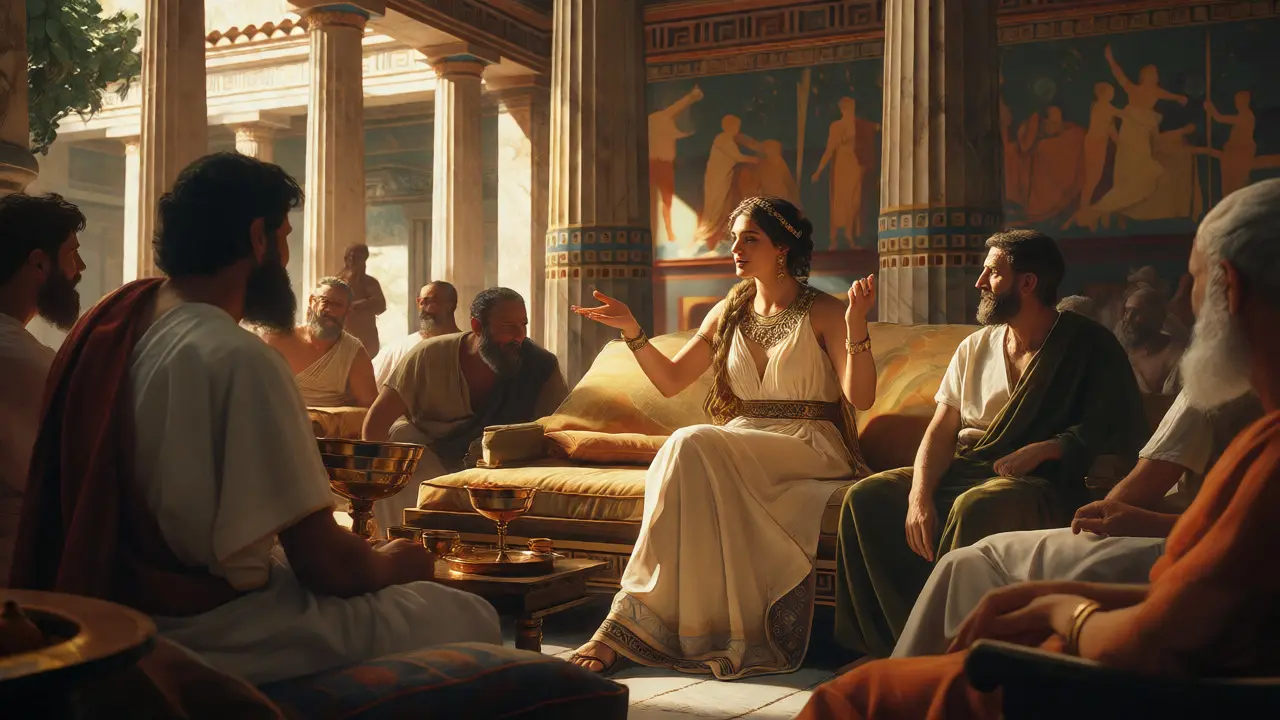
She owns her own home, pays taxes independently, and hosts philosophical debates attended by prominent statesmen like Pericles.
Scenario B
She works in an oikos (brothel), has no control over which clients she sees, and is considered property rather than a citizen.
Scenario C
She was trained in music and rhetoric, charges high fees for companionship, and can sue in court if mistreated.
Scenario D
She stands near the port of Piraeus, serves hundreds of low-paying clients annually, and cannot sign contracts.
You probably picture ancient Greek women as silent figures locked away in the gynaeceum, the women’s quarters of the home, weaving wool and staying out of sight. But step into a symposium or walk through the bustling port of Piraeus, and you’ll meet two very different groups of women who shaped the social fabric of Athens: the hetairai (high-class courtesans) and the pornai (common prostitutes). The difference between them wasn’t just about price tags; it was about power, education, legal standing, and how much control they had over their own bodies.
This distinction matters because it shatters the myth that all non-citizen women in Greece were helpless victims. While both groups existed outside the rigid bounds of respectable citizenship, their lives looked nothing alike. One group could debate philosophy with Pericles and amass fortunes; the other worked in brothels owned by pimps called mastropos, often trapped in debt bondage. Understanding this divide helps us see ancient society not as a monolith of male dominance, but as a complex hierarchy where sex work created unique spaces for female agency-even if that agency came at a heavy cost.
The Hetairai: Education, Influence, and Elite Companionship
Think of the hetairai not as simple escorts, but as the closest thing ancient Athens had to independent career women. They were usually foreigners or freed slaves, which meant they didn’t have the legal restrictions placed on citizen wives. This loophole allowed them to move freely, manage money, and attend events where respectable women couldn’t go. Their value wasn’t just physical; it was intellectual and artistic. A top-tier hetaira might be trained in music, dance, rhetoric, and conversation. She was hired for her ability to entertain men at parties, yes, but also to challenge them intellectually.
Aspasia of Miletus is the most famous example. She lived with Pericles, the leading statesman of Athens, and reportedly hosted salons where philosophers like Socrates debated. Did she love him? Did he love her? Historians argue about it, but the point remains: she wielded political influence. Citizen wives stayed home; Aspasia helped shape policy. Hetairai paid taxes specifically levied on them, proving the state recognized their economic importance. They wore expensive jewelry, dined on fine foods, and could retire comfortably if they saved well. Their autonomy was real, though always precarious-dependent on the favor of powerful patrons rather than legal rights.
The Pornai: Survival, Slavery, and the Brothel System
Now shift your gaze from the marble villas to the darker corners of the city. The pornai operated in a completely different reality. Most were slaves, purchased or captured, and forced into sexual labor. They worked in oikoi (brothels) or stood on street corners near ports. Unlike the hetairai, pornai had almost no control over when, where, or with whom they had sex. Their bodies were property. If a pimp decided to sell one woman to another owner, she went. If she refused a client, she faced punishment.
Economic pressure drove many free poor women into this role too, but even then, they lacked the social capital of the elite courtesans. Archaeological finds, such as thousands of small clay tokens found in Corinth, suggest these women served hundreds of clients a year. The pay was meager compared to the wealth generated for owners. There was little room for personal choice. A pornai didn’t choose her partners based on compatibility or intellect; she took whoever walked through the door. Her status was legally low, often equated with dirt or disease in moralizing texts, yet her labor was essential to the economy. Without them, the social rituals of male bonding in taverns and baths would have collapsed.

Legal Status and Social Stigma
The law treated these two groups differently, reflecting their distinct roles in society. Citizen women (politai) were under the guardianship (kyrios) of a father or husband. They couldn’t conduct business worth more than a bushel of barley without male permission. Hetairai, being non-citizens, bypassed this. They could sign contracts, own property, and sue in court. This legal freedom gave them a shield against total exploitation. If a patron mistreated a hetaira, she had recourse, however limited.
Pornai, especially those who were slaves, had none of this. They were chattel. However, some became apothetai-freedwomen who continued working independently. Even then, stigma stuck. Respectable citizens avoided marrying former pornai. Yet, paradoxically, men who visited pornai privately often respected them more than they admitted publicly. The hypocrisy was thick: men needed sexual outlets outside marriage, so they created a class of women to provide it, then despised them for doing exactly what the men demanded. Hetairai escaped some of this scorn because their companionship mimicked the intimacy of marriage, minus the domestic duties.
| Feature | Hetairai | Pornai |
|---|---|---|
| Social Class | High-end, educated, often foreign elites | Low-end, slaves, poor free women |
| Autonomy | High: chose clients, managed finances | Low: controlled by masters/pimps |
| Primary Skill | Conversation, arts, companionship | Sexual service only |
| Living Situation | Private homes, rented apartments | Brothels, streets, shared quarters |
| Public Perception | Admired, feared, influential | Stigmatized, invisible, exploited |
The Economic Engine of Desire
Sexual labor was big business in Athens. It wasn’t just a vice; it was an industry. The state taxed hetairai heavily, treating them as professional businesses. In the 4th century BCE, a high-profile hetaira like Phryne could charge sums equivalent to a skilled craftsman’s annual wage for a single night. That kind of income allowed them to buy land, fund temples, and support families back home. They were economic actors, not just passive objects.
For the pornai, the economics were brutal. Owners kept the profits. A slave prostitute might generate significant revenue, but her upkeep was minimal. The system relied on high turnover and low costs. Ports like Piraeus thrived on this trade, catering to sailors and merchants who wanted quick, cheap services. The sheer volume of transactions suggests that sexual access was normalized across classes. Rich men visited hetairai for prestige; poor men visited pornai for necessity. Both groups fueled a market that supported pimps, tax collectors, and the broader urban economy. Ignoring this sector means ignoring a massive chunk of ancient GDP.

Agency Within Constraints
Can we call any of this “freedom”? Not in the modern sense. No woman in ancient Greece voted or held office. But within their constraints, hetairai carved out niches of agency. They formed networks, mentored younger women, and leveraged relationships for protection. Some retired into wealthy marriages or religious life. Others used their influence to sway political outcomes. It wasn’t equality, but it was leverage.
Pornai exercised smaller acts of resistance. They might hide earnings, form bonds with fellow workers, or manipulate customers. But their options were narrow. The key takeaway is that “sexual labor” wasn’t a single category. It ranged from the highly autonomous, wealthy companion to the enslaved worker with zero rights. Treating them as identical erases the nuance of ancient social structures. When we read old texts, we must ask: Who is speaking? A philosopher praising a hetaira’s wit sees something different than a comedian mocking a brothel keeper. Context changes everything.
Legacy and Modern Misconceptions
Today, people often confuse hetairai with temple prostitutes, a concept largely debunked by historians. There’s little evidence that sacred prostitution involved ritual sex in the way popular culture imagines. Instead, hetairai were secular professionals. Their legacy survives in art, vase paintings showing lively symposia, and literature describing their sharp tongues. They remind us that history isn’t just about kings and wars; it’s about the people who navigated the margins to survive and thrive.
Understanding this dichotomy helps us appreciate the complexity of gender roles. Women weren’t just mothers or wives. They were entrepreneurs, artists, and survivors. The gap between hetairai and pornai shows how class and legal status determined fate more than gender alone. A rich foreign woman had more freedom than a poor citizen man in some contexts. That’s a radical thought for a society we often paint in broad, simplistic strokes.
Were hetairai considered prostitutes?
Technically, yes, but the term "prostitute" carries modern connotations that don't fit. Hetairai were high-class companions who offered sexual services alongside intellectual and artistic entertainment. They were distinct from common prostitutes (pornai) due to their education, autonomy, and social influence.
Could hetairai marry citizens?
Generally, no. Marriages between citizens and non-citizens did not confer legitimate citizenship on children. However, some powerful men, like Pericles, cohabited with hetairai like Aspasia. These unions were socially accepted but legally distinct from formal citizen marriages.
What was the daily life of a pornai?
Life varied by location and ownership. Many worked in brothels (oikoi) under strict supervision, serving multiple clients daily. They had little privacy, few possessions, and no legal rights. Their days revolved around waiting for customers, performing sexual acts, and enduring harsh treatment from pimps.
Did ancient Greeks view sex work as immoral?
Views were mixed. Publicly, respectable citizens often looked down on sex workers, associating them with lack of self-control. Privately, male demand was high and accepted as a natural outlet. The stigma fell mostly on the women, while men faced little social penalty for visiting either hetairai or pornai.
How did hetairai gain their wealth?
They charged high fees for companionship and sexual services. Top-tier hetairai could earn substantial sums, allowing them to invest in property, lend money, and live luxuriously. Some accumulated enough wealth to retire comfortably or support extended family networks.