Ancient Egyptian Gender Fluidity Explorer
Select a figure or concept from Ancient Egyptian history to understand how they challenged or redefined traditional gender binaries.
- Atum (The Creator)
- Hatshepsut (The Queen-King)
- Bes (The Protector)
- Khnum (The Shaper)
- Ma'at (Cosmic Balance)
Select an Entity
IntroductionChoose a figure from the left to begin your exploration of gender fluidity in ancient times.
--
--
When you think of ancient Egypt, images of rigid hierarchies, strict social roles, and the unyielding power of the Pharaoh usually come to mind. But beneath that surface lies a far more complex spiritual world where boundaries between male and female were often blurred, merged, or intentionally reversed. gender fluidity was not just an abstract concept; it was a central mechanism for understanding creation, cosmic balance, and royal legitimacy in one of history's most enduring civilizations.
To understand this, we have to look past modern binary thinking. In the ancient Egyptian worldview, the universe began from a singular source, and duality was essential for existence to continue. This isn't just poetic license-it is documented in temple reliefs, papyri, and archaeological findings spanning thousands of years. Let’s unpack how the gods themselves embodied these shifting identities and how the Pharaohs used them to legitimize their rule.
The Cosmic Origin: Atum and the First Creation
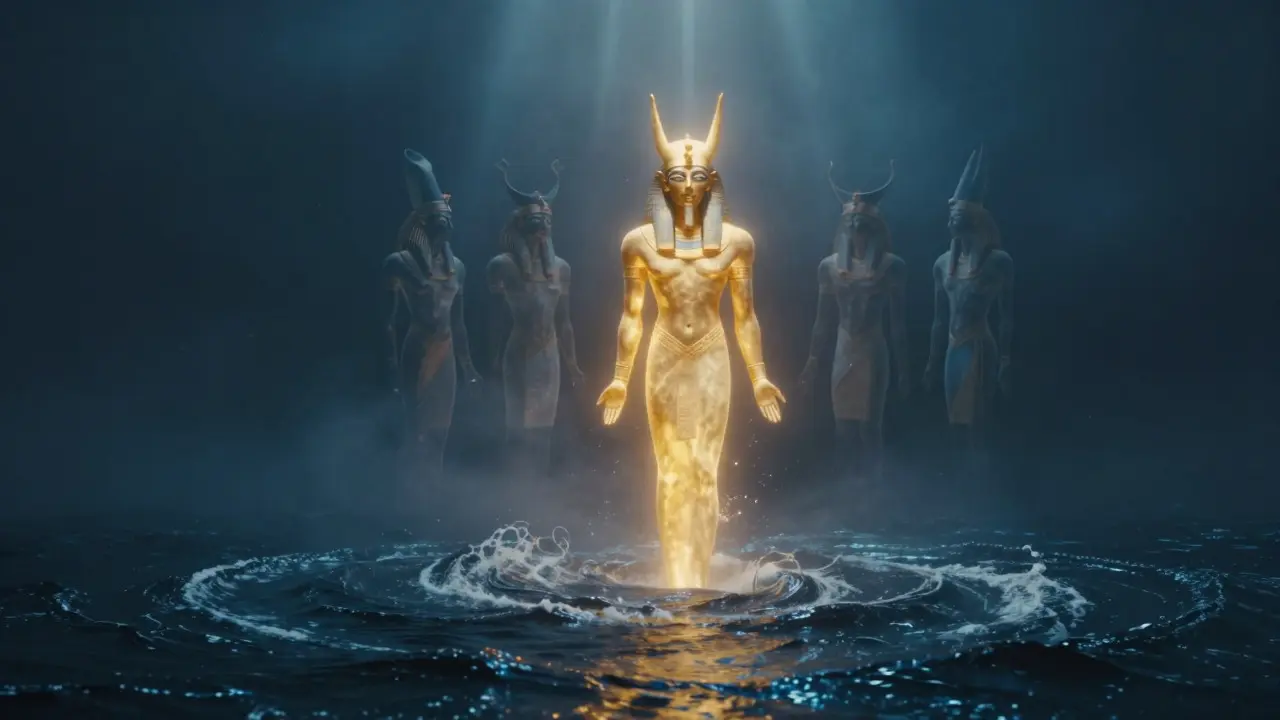
The story begins with Atum, the self-created god who emerged from the primordial waters of Nun. Atum is often depicted as a man wearing the double crown of Upper and Lower Egypt, but his mythology reveals a profound androgyny. According to the Heliopolitan creation myth, Atum created his children by masturbating (producing Shu) and spitting (producing Tefnut). Some texts describe him as having both male and female aspects because he contained all potential life within himself before differentiation occurred.
This initial state of unity is crucial. Before there was "male" and "female," there was simply *being*. The act of creation required the separation of these dualities, but the source remained whole. This sets the theological foundation: gender is a functional tool for cosmic order (*Ma'at*), not an immutable biological fact. If the first god could be both creator and vessel, then later deities could easily shift forms to serve different divine purposes.
Hathor, Isis, and the Female Kingship
Nowhere is this fluidity more visible than in the goddesses who held supreme power. Hathor, the cow goddess associated with music, dance, and motherhood, was also a fierce warrior. She transformed into Sekhmet, the lion-headed destroyer, when her benevolence turned to wrath. This wasn't just a change of costume; it was a shift in energetic polarity. Hathor represented the nurturing, receptive aspect of the divine, while Sekhmet represented the aggressive, active force. Both were facets of the same cosmic energy.
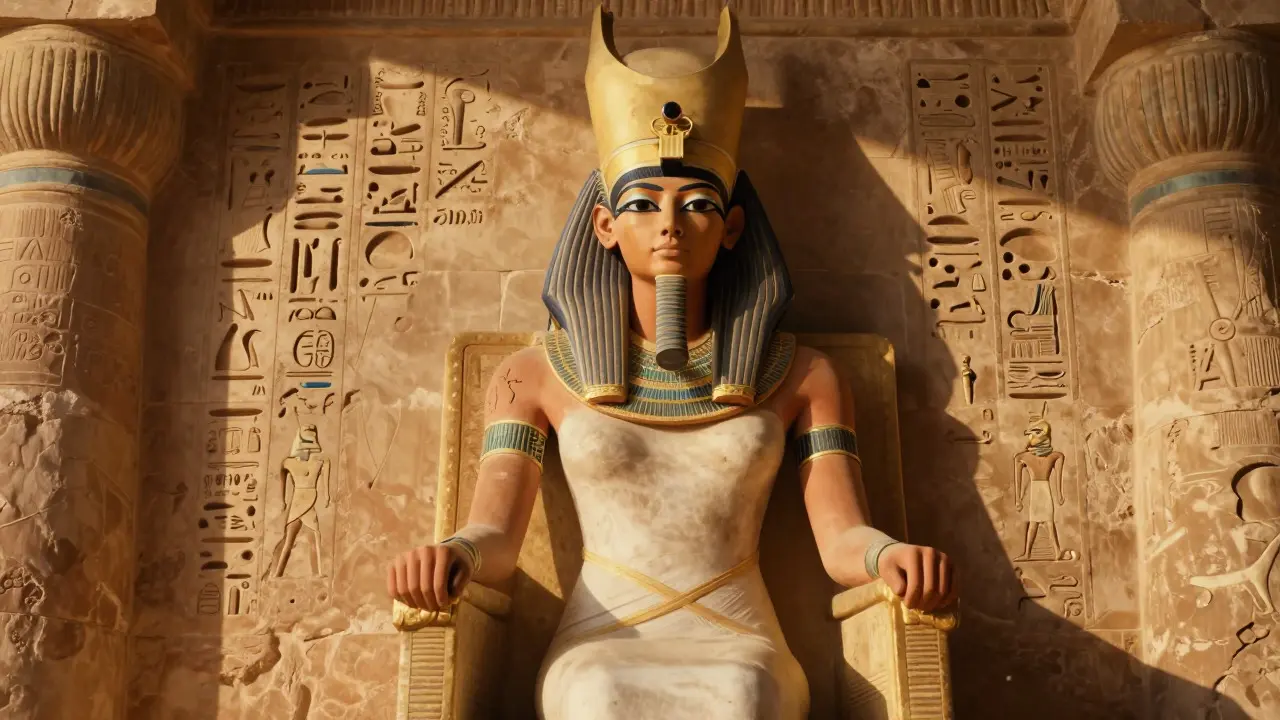
But the most striking example of gender role reversal involves the Pharaohs themselves. While the King was the masculine embodiment of Horus, the Queen was the feminine embodiment of Hathor or Isis. However, during certain rituals, this dynamic flipped. In the Opet Festival, the Pharaoh would symbolically merge with Amun-Ra, taking on attributes that transcended simple masculinity. More dramatically, some queens like Hatshepsut didn't just support the king; they *became* the king. Hatshepsut ruled as a male Pharaoh, wearing the false beard, the nemes headdress, and being referred to in masculine grammatical forms in official inscriptions. Yet, she never denied her female identity entirely-she claimed her right to rule through her father Thutmose I and her husband Thutmose II, positioning herself as the legitimate heir in a system that valued lineage over sex.
The Androgynous Gods: Bes and Khnum
If Hathor represents the fluidity of divine power, other deities represent the literal merging of genders. Bes, a dwarf deity with a lion's head, large ears, and a protruding belly, is one of the most recognizable figures in Egyptian art. Bes was a protector of households, travelers, and especially women in childbirth. He was neither strictly male nor female in function; he served as a guardian against evil spirits and a bringer of fertility. His physical appearance defied classical Greek ideals of beauty, embracing a grotesque, hybrid form that suggested a liminal space between categories.
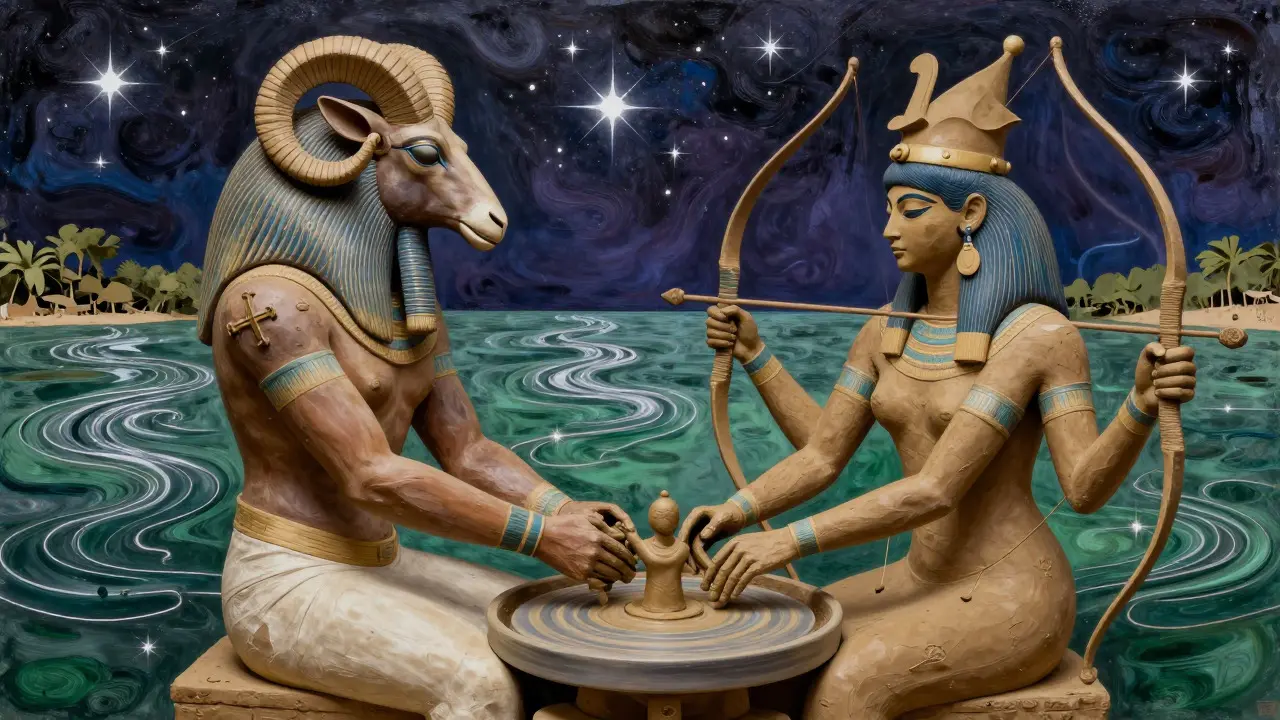
Then there is Khnum, the ram-headed god who shaped humans on a potter's wheel at the Nile's source. Khnum was considered the father of kings, yet he was also closely associated with the goddess Neith, sometimes depicted as a pair who jointly created humanity. In some temples at Esna, Khnum and Neith are shown together as the primary creative duo, blurring the line between paternal and maternal roles in the origin of life. This partnership suggests that creation required both masculine and feminine forces acting in concert, rather than one dominating the other.
Royal Identity and the Ma'at Balance
Why did this matter for politics? Because the Pharaoh was the guarantor of Ma'at, the concept of truth, balance, order, law, morality, and justice. To maintain Ma'at, the Pharaoh had to embody the ideal human form, which included the capacity to channel both masculine and feminine divine energies. A ruler who was too rigidly masculine might fail to nurture the land; one who was too passive might fail to defend it.
This is why royal iconography is so rich with symbolic ambiguity. The Pharaoh wears the white crown of Upper Egypt (associated with the vulture goddess Nekhbet) and the red crown of Lower Egypt (associated with the cobra goddess Wadjet). By wearing both, the King literally holds the two halves of the nation, and by extension, the two halves of the divine, in one body. It is a political statement dressed in religious clothing: the King is complete only when he integrates both poles.
| Entity | Primary Role | Gender Expression | Symbolic Function |
|---|---|---|---|
| Atum | Self-created Creator God | Androgynous / Unified | Source of all duality |
| Hatshepsut | Pharaoh (Queen) | Masculinized Iconography | Legitimacy through lineage |
| Bes | Household Protector | Hybrid / Liminal | Fertility and protection |
| Khnum | Creator of Humans | Dualistic (with Neith) | Joint creative power |
Common Misconceptions vs. Historical Reality
A lot of people assume that ancient Egyptians were either strictly patriarchal or completely free-spirited. The truth is nuanced. They had clear social norms, yes. Men generally worked outside the home, and women managed domestic affairs. But "clear" doesn't mean "rigid." Women owned property, initiated divorce, and served as priests. Men could wear makeup, jewelry, and wigs without losing social standing. These practices weren't seen as "feminine" invasions of male space; they were markers of status and piety.
The key difference from today is that gender expression was tied to *function*, not identity. You wore the wig because it protected your head from the sun and signified you were a person of importance, not because you wanted to express a specific gender identity. Similarly, a queen ruling as a king did so because the office required the authority of the male divine avatar, not necessarily because she rejected her womanhood. This functional flexibility allowed for remarkable stability in a society that otherwise relied heavily on hierarchy.
Legacy in the Ancient Near East
Egypt wasn't an island. Its ideas traveled. The concept of the androgynous creator influenced neighboring cultures in Mesopotamia and Canaan. For instance, the Sumerian god Enki had similar associations with wisdom and creation, though less explicitly androgynous. However, the Egyptian model of the Pharaoh as a living bridge between the human and divine worlds, capable of shifting between masculine and feminine roles, remains unique in its consistency over three millennia. When we study the Ancient Near East, a region encompassing Egypt, Mesopotamia, and the Levant, we see that while Egypt stood out for its explicit theological androgyny, the broader region shared a respect for dualities in nature and divinity.
Understanding this helps us reframe how we view ancient societies. We tend to project our modern anxieties about gender onto the past, assuming everyone thought exactly like we do. But the Egyptians saw gender as a spectrum of divine forces. They didn't need our labels; they had their own sophisticated language for describing the interplay of opposites. And in doing so, they built a civilization that lasted longer than almost any other in history, sustained by a belief that balance-not rigidity-was the key to survival.
Did ancient Egyptians recognize non-binary genders?
While they didn't use the term "non-binary," their theology acknowledged states of being that transcended the male-female binary. Deities like Atum and Bes existed in liminal spaces, and the Pharaoh's role required integrating both masculine and feminine divine attributes. Socially, individuals could cross typical gender expectations if it served a religious or economic purpose, such as a woman owning land or a man serving as a priestess in certain contexts.
How did Hatshepsut justify her rule as a female Pharaoh?
Hatshepsut justified her rule by emphasizing her direct lineage from Thutmose I and her adoption by him as his son. She adopted the full regalia of kingship, including the false beard and nemes headdress, and was depicted in masculine poses in many statues. However, in later private scenes, she is shown in feminine dress, suggesting a strategic use of gender presentation to secure political legitimacy while retaining personal identity.
What is the significance of the god Bes in gender studies?
Bes is significant because he defies standard aesthetic and gender categorizations. As a dwarf with animal features, he represents the "other
Popular Posts

1950s Shift: How the AMA’s Sex Education Series Changed American Schools
Nov, 30 2025 / History & Culture
Hetairai vs. Pornai: Status, Autonomy, and Sexual Labor in Ancient Greece
Sep, 11 2026 / History & Culture
Egyptian Love Poetry and Sexual Desire: Courtship and Passion in the New Kingdom
Aug, 17 2026 / History & Culture