
Lifetime Menstrual Cost & Tax Impact Calculator
Your Usage Profile
Estimated Financial Impact
Total Product Cost (No Tax)
$0
Total Paid in Sales Tax
$0
Grand Total Spent
$0
Did You Know?
- The average U.S. person spends between $3,360 and $18,000 on period products in a lifetime.
- As of early 2026, 32 U.S. states have made menstrual products tax-free.
- Tax removal has been shown to lower consumer prices by up to 12.4% due to market competition.
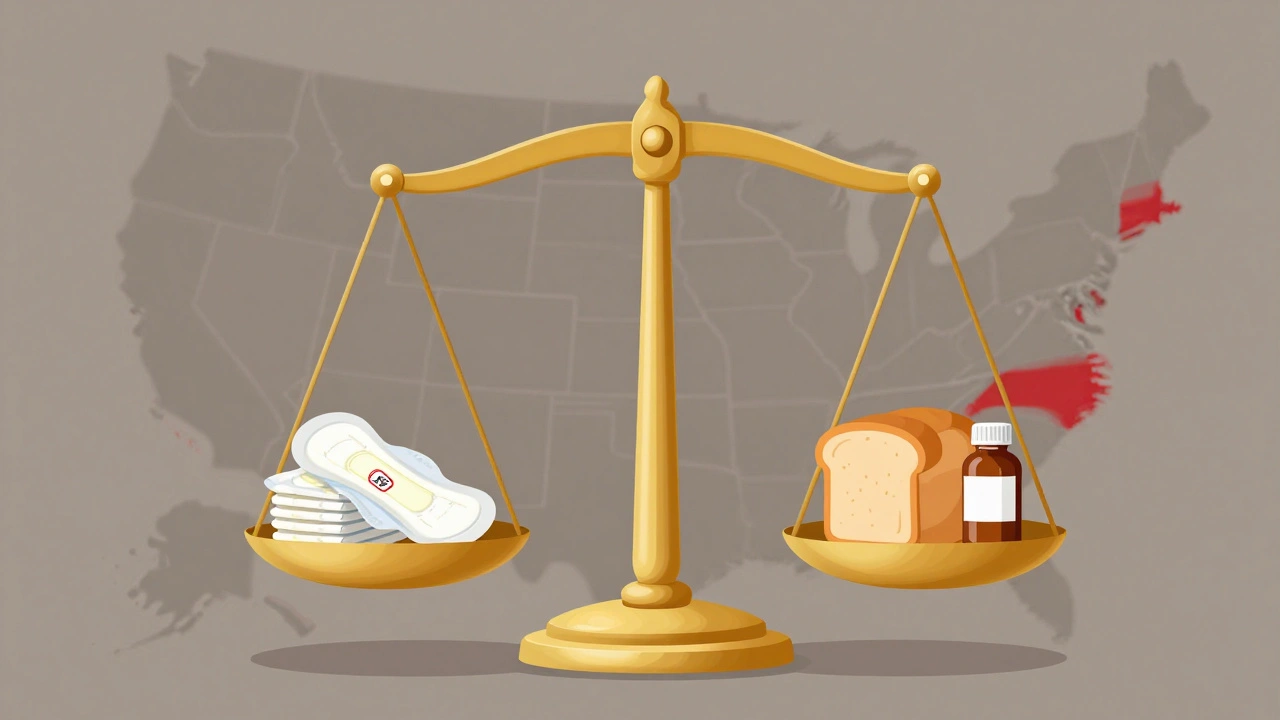
Imagine having to choose between buying food for your family and purchasing the supplies you need to manage your period. For millions of people, this isn’t a hypothetical scenario-it’s their monthly reality. This is period poverty, defined as the inability to afford or access adequate menstrual products, sanitation facilities, and accurate information about menstruation. It forces individuals to miss school, lose work hours, and risk health complications simply because they cannot pay for basic hygiene needs. At the same time, many still face the tampon tax, which is the application of general sales tax or value-added tax (VAT) to menstrual products because they are classified as non-essential or luxury goods. These two issues highlight a stark economic injustice: why should people pay extra taxes for a biological necessity that half the population experiences?
The True Cost of Menstruation
When we talk about the cost of periods, we aren't just talking about a few dollars at the checkout counter. The financial burden accumulates over decades. Estimates vary widely depending on product choices and regional prices, but the lifetime cost is staggering. According to data cited by the National Organization for Women, the average person in the U.S. spends about $20 per menstrual cycle on hygiene products. Over a lifetime-assuming roughly 12 cycles a year for several decades-that adds up to approximately $18,000.
Other estimates suggest lower totals. California Assemblymember Cristina Garcia’s office calculated that women in California pay about $7 per month for tampons and pads over 40 years, totaling around $3,360. Even if we use the more conservative figure, nearly $4,000 is a significant amount of money. When you add in over-the-counter medication for cramps, which can cost an additional $20 annually, the total rises further. Inflation has made this worse recently. In 2021, U.S. prices for pads rose by 8.3% and tampons by 9.8%, outpacing general inflation. For low-income households where wages have stagnated, these price spikes force painful trade-offs between menstrual products and other essentials like utilities or groceries.
Who Is Affected by Period Poverty?
Period poverty is not limited to those living below the federal poverty line. A 2019 survey found that 64% of menstruators in the U.S. reported struggling to afford menstrual products at least once in the previous year. While it affects people across income levels, certain groups face heightened risks:
- Low-income and food-insecure individuals: About 16.9 million menstruating people in the U.S. live in poverty. For them, even small price increases can mean going without proper protection.
- Students: Approximately one in four U.S. students who menstruate have struggled to afford period products. This leads to absenteeism; some surveys estimate that 1 in 5 students have missed class because they lacked access to pads or tampons.
- Homeless populations: Shelters often do not consistently provide free products. Qualitative studies show that homeless women sometimes resort to using socks, rags, or newspaper when nothing else is available.
- Incarcerated individuals: Prisons and jails may provide only a small ration of low-quality pads. Those who need more must buy them from commissaries at marked-up prices or trade favors, leading to situations where women bleed through clothing due to insufficient supplies.
- Transgender and non-binary menstruators: These groups often face additional stigma and lack tailored services, making them less likely to utilize public product programs designed primarily for cisgender women.
Health and Educational Consequences
The impact of period poverty goes beyond financial strain. Health risks increase when people resort to improvised materials like toilet paper, old blankets, or unwashed rags. These unsafe options raise the risk of urogenital infections and skin irritation. Mental health also suffers. Studies link chronic inability to manage menstruation with higher scores on anxiety and depressive symptom scales. The shame and stress of bleeding through clothes in public create a constant background of humiliation and fear.
Educationally, the consequences are clear. Lack of access to products contributes to school absenteeism and reduced concentration in class. When students miss days repeatedly, they fall behind academically. Economically, missing workdays due to lack of supplies can lead to lost wages, disciplinary action, and further financial instability. As researcher Binda Godlove Aka noted, period poverty undermines the "economic live wire" of states, since low- and middle-income women play crucial roles in the labor force and caregiving economy.
The Tampon Tax: A Symbol of Inequity
The term "tampon tax" refers to the fact that menstrual products are subject to general sales tax or VAT in many jurisdictions, rather than being classified as tax-exempt necessities. Critics argue this is discriminatory. Consider what is typically exempt from sales tax: food, prescription medications, and even items like Viagra in some states. Yet, tampons and pads-which are essential for managing an involuntary biological function-are taxed. This creates a structural disparity where women and other menstruators bear a unique financial burden simply for existing.
As of January 2026, the landscape in the United States is shifting. Advocacy organization PERIOD. reports that 32 states have removed the sales tax on period products. However, 18 states continue to treat them as taxable goods, generating an estimated $130 million per year in sales tax revenue nationwide. States like Alaska, Delaware, Montana, New Hampshire, and Oregon have no state sales tax at all, so menstrual products are effectively tax-free there. The movement to eliminate these taxes accelerated after 2015, with early adopters like Minnesota (which exempted them in 1981), followed by New York and Illinois in 2016 after lawsuits argued that taxing tampons while exempting hair growth treatments was unconstitutional sex discrimination.
| Status | Number of States | Notes |
|---|---|---|
| Tax-Free | 32 | Includes states that repealed the tax and those with no state sales tax. |
| Taxable | 18 | Continues to generate approx. $130 million annually in tax revenue. |

Policy Solutions and Global Context
Removing the tampon tax is often seen as "low-hanging fruit"-politically appealing and fiscally modest. Research suggests that when taxes are repealed, consumer prices drop significantly. An econometric study found that after a 6.9% sales tax removal, consumer prices for lower-income women lowered by 12.4% compared to control states. This indicates that tax cuts were fully passed through to consumers, benefiting those most affected by period poverty.
However, tax repeal alone is not enough. Experts advocate for a multi-pronged approach:
- Free Product Provision: Making menstrual products completely free in key settings like schools, shelters, and correctional facilities directly targets access barriers. Scotland became the first country to make period products free for all residents through the Period Products (Free Provision) Act 2021. New Zealand began providing free products in all state schools in 2021.
- Social Protection Integration: Extending coverage of menstrual products under Medicaid and allowing their purchase with public benefit cards would help low-income families. The Menstrual Equity for All Act, introduced by Rep. Grace Meng, proposes such measures along with requiring large employers to provide free products in workplace restrooms.
- Federal Reforms: The 2020 CARES Act already allowed pre-tax flexible spending accounts (FSAs) and health savings accounts (HSAs) to cover menstrual products, recognizing them as eligible medical expenses.
- Education and Stigma Reduction: Combating menstrual stigma is crucial. Open discussion helps reduce shame and encourages people to request accommodations. Prioritizing menstrual education in schools ensures young people understand their bodies and know their rights.
Globally, many countries have taken steps toward equity. Kenya abolished its tampon tax in 2004 and later allocated funds for free pad distribution. Canada eliminated its 5% Goods and Services Tax (GST) on menstrual products in 2015. The UK removed VAT entirely in 2021. These examples show that treating menstrual products as necessities is both feasible and beneficial.
Why Economic Justice Matters Now
The conversation around period poverty and the tampon tax is fundamentally about dignity and equality. When society taxes a biological necessity, it sends a message that menstruation is a luxury or a private inconvenience rather than a public health issue. By removing these taxes and ensuring free access in critical spaces, we acknowledge that everyone deserves to participate fully in education and the workforce without the burden of hidden costs.
While progress has been made-with 32 U.S. states now tax-free and federal allowances for HSAs/FSAs-the fight continues. Eighteen states still tax these products, and comprehensive federal legislation remains unrealized. Addressing period poverty requires sustained commitment from policymakers, institutions, and communities to ensure that no one has to choose between their health and their financial stability.
What is period poverty?
Period poverty is the inability to afford or access adequate menstrual products, sanitation facilities, and accurate information about menstruation. It leads to compromised health, dignity, and participation in education and work.
What is the tampon tax?
The tampon tax is the application of general sales tax or value-added tax (VAT) to menstrual products. It occurs because these items are often classified as non-essential or luxury goods, unlike food or some medications which are tax-exempt.
How much does menstruation cost over a lifetime?
Estimates vary, but the average woman in the U.S. may spend between $3,360 and $18,000 over her lifetime on menstrual products, depending on usage patterns, product types, and regional prices.
Which U.S. states still have a tampon tax?
As of early 2026, 18 U.S. states continue to impose sales tax on menstrual products, generating approximately $130 million annually. Thirty-two states have removed this tax.
Does removing the tampon tax actually lower prices?
Yes. Research shows that when sales taxes are repealed, consumer prices drop significantly. One study found that prices for lower-income women lowered by 12.4% after a tax repeal, indicating benefits were passed through to shoppers.
Can I use my HSA or FSA for menstrual products?
Yes. Under the 2020 CARES Act, menstrual products are eligible medical expenses for Health Savings Accounts (HSAs) and Flexible Spending Accounts (FSAs), allowing pre-tax purchases.
What is the Menstrual Equity for All Act?
Introduced by Rep. Grace Meng, this proposed federal legislation aims to end period poverty by providing free menstrual products in schools, prisons, and workplaces, and allowing states to use federal grants for this purpose.