Roman Phallic Amulets Quiz
How Much Do You Know About Ancient Roman Superstitions?
Test your understanding of Roman phallic amulets and their role in daily life with this interactive quiz. Choose the correct answer for each question.
This quiz is based on the article "Phallic Charms and Fertility Superstitions in Ancient Rome".
What was the fascinum in ancient Rome?
Why did Romans use phallic charms to protect children?
How did the Vestal Virgins guard a phallic symbol?
What did Roman soldiers wear for protection?
Why were phallic images often depicted laughing or drunk?
Quiz Results
Imagine walking through the streets of Pompeii in 50 BCE. You pass a shop with a carved penis hanging above the door. A child wears a tiny bronze phallus around their neck. A general rides past in his chariot, a phallus dangling beneath it. None of this is weird-it’s normal. In ancient Rome, the phallus wasn’t about shock or lust. It was a fascinum, a sacred tool of protection, woven into the fabric of daily life.
The fascinum, a Latin term for the divine phallus, was more than a symbol. It was a working charm. Pliny the Elder called it a medicus invidiae-a doctor against the evil eye. Romans believed envy, or invidia, could bring illness, bad luck, even death. A jealous glance could curse a baby, ruin a harvest, or doom a general in battle. The phallus didn’t just represent fertility-it was thought to overpower envy by overwhelming it with absurdity, laughter, and raw, unapologetic life force.
How a Phallus Protected Babies
Child mortality in Rome was brutal. Half of all children died before age five. Parents didn’t have vaccines, clean water, or antibiotics. What they did have were phallic amulets. Tiny bronze or terracotta penises, often with wings, were hung around infants’ necks. Some were so small they could only fit on a child’s clothing, not an adult’s. Archaeologists have found these amulets buried with babies, sometimes paired with a clenched fist-the manus fica-a gesture like giving the finger, symbolizing luck and genital power. Together, the phallus and fist made a double shield against harm.
One 1st-century BC terracotta figurine shows two tiny phallus-men sawing an eyeball in half. That’s not horror-it’s triumph. The eye represented the evil gaze. The phallus, by contrast, was an active defender. It didn’t just ward off danger; it attacked it. Some pendants were designed so the phallus pointed outward as the child moved, facing any incoming curse head-on. It was practical magic: a shield worn like jewelry.
The Sacred Phallus of the Vestal Virgins
Here’s the twist: the most important fascinum wasn’t worn by children. It was guarded by women who had sworn off sex.
The Vestal Virgins, Rome’s six priestesses of Vesta, kept the fascinus populi Romani-the sacred phallus of the Roman people. Pliny wrote that this object was part of the state’s religious rites, kept alongside the Palladium, the legendary statue believed to protect Rome itself. How could chaste women guard a symbol of male fertility? Classicist Mary Beard explained it: the Vestals weren’t seen as sterile. They were vessels of stored-up reproductive power. Their purity didn’t block life-it contained and directed it.
This wasn’t just ritual. It was political. The phallus in the Temple of Vesta wasn’t a crude object. It was a state secret, a token of Rome’s survival. If the fascinum was lost or damaged, Romans believed the city itself would fall. Its presence was as vital as the eternal flame.
Generals, Chariots, and Military Luck
When a Roman general won a battle, he didn’t just ride into Rome with gold and slaves. He rode with a phallus under his chariot.
Pliny recorded that the fascinum was attached beneath the triumphant general’s vehicle, acting like a physician warding off envy. Why? Because success invited jealousy. A general who returned with too much glory could become a target for curses, sabotage, or even assassination. The phallus didn’t just protect him-it mocked the idea that his power could be taken. It said: Look at this. Laugh at this. Can you really harm someone who owns this?
Soldiers wore the same amulets. The largest collection of phallic finger rings was found at Camulodunum (modern-day Colchester), a Roman military base in Britain. These weren’t fashion. They were armor. A soldier with a phallus on his belt believed he was less likely to be wounded. The fist-and-phallus combo was especially popular. The fist was a sign of defiance. The phallus was the punchline. Together, they were psychological warfare-against curses, and against fear.

Phalluses in Public: Festivals, Lamps, and Wind Chimes
The fascinum wasn’t hidden. It was everywhere.
At the festival of Liber, a god of wine and fertility, Romans dragged a giant phallus on a trolley through the countryside and into the city. They didn’t cover it. They paraded it. They danced around it. They shouted. They laughed. This wasn’t indecency-it was ritual. The noise, the movement, the absurdity, were meant to confuse and scatter any lurking evil spirits.
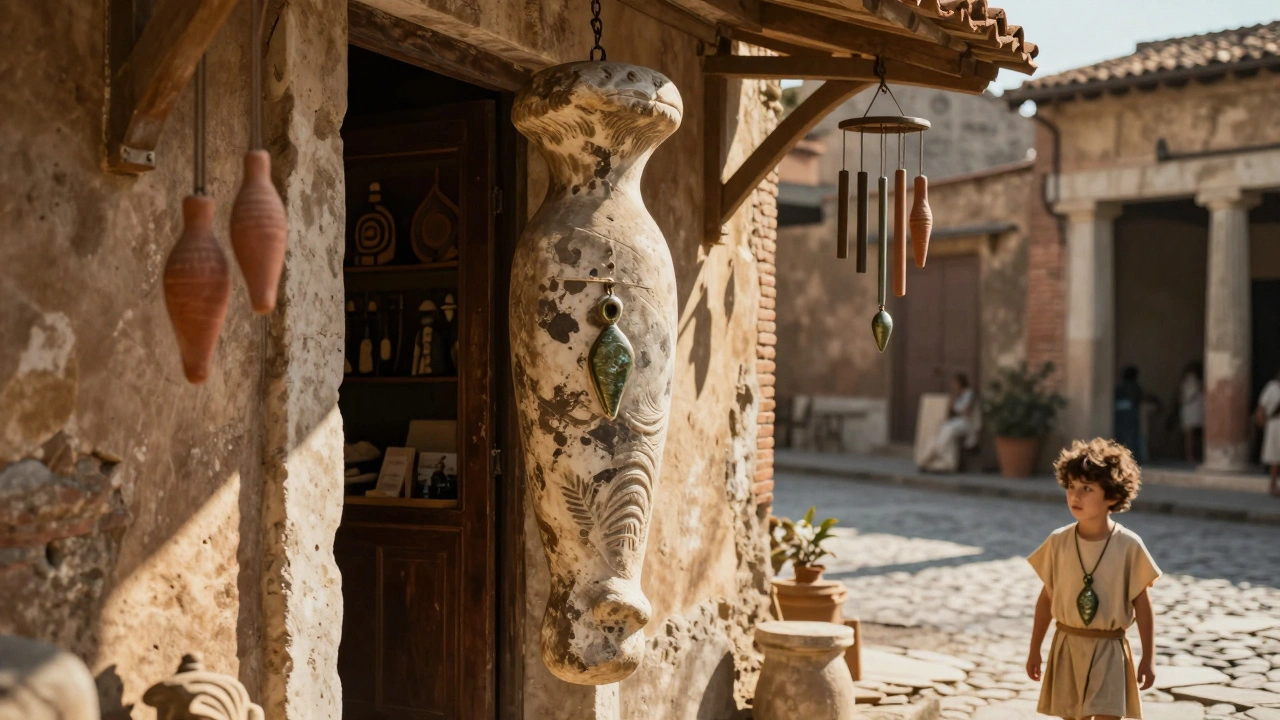
Phallic images appeared on lamps, door knockers, and wind chimes called tintinnabula. When the wind blew, the clanging metal phallus would ring out, not just as decoration, but as a constant ward. In Pompeii, you’ll find carved penises on street corners, pointing toward houses. They weren’t there to titillate. They were there to block bad luck from entering.
At Leptis Magna in Libya and along Hadrian’s Wall in Britain, reliefs show phalluses ejaculating toward eyes. One carving depicts a phallus with legs, standing triumphantly over a shattered eyeball. These weren’t jokes. They were prayers made visible.
Why Laughter Was the Best Medicine
The power of the fascinum didn’t come from magic spells alone. It came from emotion.
Modern scholars suggest the phallus worked because it made people laugh-or feel ashamed. When someone looked at a giant penis on a wall, they didn’t stare in lust. They grinned. They looked away. They whispered. That reaction-shock, humor, discomfort-was the shield. It broke the power of the evil eye. Envy thrives on silence, on seriousness, on reverence. The phallus refused to take itself seriously. It laughed in the face of fear.
Many phallic figures were shown drunk, dancing, or passed out. They weren’t gods of lust. They were gods of release. They were Bacchic, chaotic, alive. And in a world where disease, infant death, and war were constant, that chaos was comforting. It meant life couldn’t be controlled-but it could be celebrated.

Beyond the Phallus: Fertility Symbols in Roman Life
The fascinum was part of a larger world of fertility symbols. Votive offerings at Roman shrines included not just penises, but breasts, uteri, ovaries, and even placentas. These weren’t medical diagrams. They were petitions. A woman hoping to conceive might leave a clay uterus at a temple. A farmer worried about crop failure might hang a phallus over his field.
It’s important to note: these symbols weren’t gendered in the way we think of them today. A woman might offer a phallus not because she wanted male power, but because she wanted fertility itself. The phallus had become a universal sign of life force-not just male, but generative.
This tradition lasted centuries. In medieval and Renaissance Italy, people still left phallic votives at shrines. The fascinum didn’t die with Rome. It just changed form.
What the Fascinum Teaches Us
Rome didn’t have modern medicine. But it had a deep understanding of fear. They knew that when people feel powerless, they reach for symbols-anything that makes them feel safe.
The fascinum wasn’t superstition. It was a response to uncertainty. It turned anxiety into action. It made the invisible visible. It used humor, ritual, and art to fight what couldn’t be fought with swords or science.
Today, we wear lucky charms too. A rabbit’s foot. A horseshoe. A necklace with a cross. We hang them on rearview mirrors. We whisper prayers before exams. We carry stones for luck. The fascinum was Rome’s version of that. It was their way of saying: I can’t control the world. But I can protect myself.
They didn’t need to believe in magic to believe in the phallus. They just needed to believe it worked. And for centuries, it did.
What was the fascinum in ancient Rome?
The fascinum was a phallic amulet or symbol in ancient Rome, believed to protect against the evil eye (invidia) and bring fertility. It was used as a charm for children, soldiers, and generals, and was even kept as a sacred object by the Vestal Virgins. It appeared in many forms-from pendants to carvings to wind chimes-and was thought to ward off harm through its association with life force and its ability to provoke laughter or shame in those who looked upon it.
Why did Romans use phallic charms to protect children?
With up to 50% of children dying before age five, Roman families had little medical protection. Phallic amulets were given to babies as a form of apotropaic magic-meant to deflect envy, disease, and bad luck. The phallus symbolized generative power, and its presence was thought to shield the vulnerable. Many were so small they could only be worn by infants, and some were buried with them as protective tokens in death.
How did the Vestal Virgins guard a phallic symbol?
The Vestal Virgins, priestesses sworn to chastity, were entrusted with the fascinus populi Romani, the sacred phallus believed to protect the Roman state. Though they had no sexual relationships, Romans saw their purity as a container of stored fertility, not its absence. Their role was to maintain the sacred flame of Vesta, and by extension, the phallus that represented the city’s life force. This paradox-virgins guarding a symbol of male power-highlighted how Roman religion linked purity with generative energy, not reproduction.
Did Roman generals really wear phallic charms into battle?
Yes. When a general entered Rome in triumph, a phallic charm was hung beneath his chariot to protect him from envy. Soldiers also wore phallic rings and pendants, especially the combination of a phallus and a clenched fist (manus fica). Archaeological finds from military sites like Camulodunum show these were common. They weren’t for decoration-they were talismans meant to ensure victory and survival in a world where luck, curses, and fate played a major role.
Why were phallic images shown laughing or drunk?
These depictions were tied to the god Bacchus and the chaotic energy of fertility festivals. A laughing, drunken phallus wasn’t obscene-it was powerful. The Romans believed that humor and absurdity disrupted the power of the evil eye. If something made you laugh, you couldn’t be consumed by envy or fear. The phallus didn’t just protect; it distracted. It turned danger into a joke, and that was its magic.