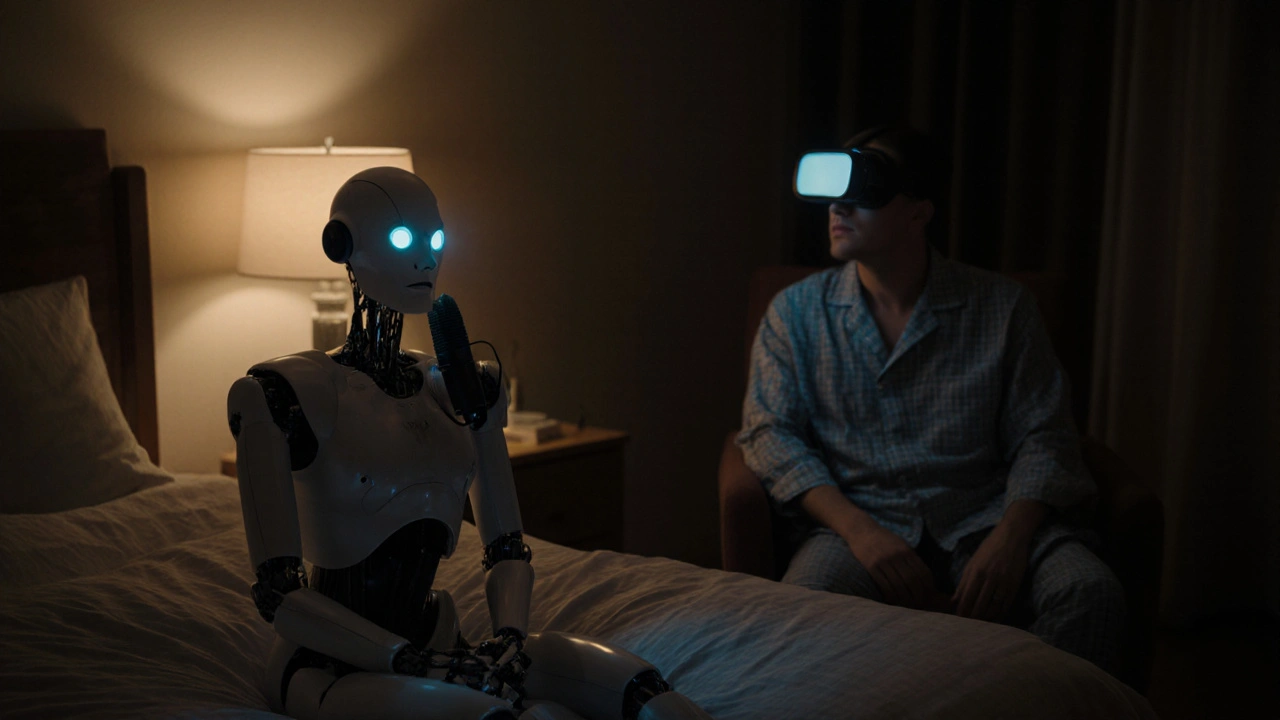
When you think of the history of pornography, you probably picture grainy VHS tapes from the 1980s, or maybe the sudden explosion of free online videos in the early 2000s. But the next chapter isn’t about cameras or bandwidth-it’s about machines that pretend to feel. Sex robots and AI-generated porn aren’t science fiction anymore. They’re here, quietly sitting in bedrooms across the country, and no one’s really talking about what they’re doing to us-or to the idea of intimacy itself.
They’re Not Just Dolls Anymore
Early sex dolls were static, lifeless objects. You could pose them, clean them, maybe even talk to them-but they didn’t respond. That changed in 2018 when RealDoll/Abyss Creations released Harmony, the first commercially available AI-powered sex robot. It didn’t just have a silicone body. It had voice recognition, motion sensors, and cloud-based AI that learned your preferences over time. You could ask it about its day, and it would reply-not with pre-recorded lines, but with responses generated on the fly. It cost $20,000. And people bought it.Today, you can get a basic AI-enabled robot for $9,000. Premium models with more advanced emotional simulation run closer to $20,000. They’re not just for men. While most users are male, surveys show a small but growing number of women and non-binary people using them too. The technology isn’t perfect. Reddit users complain that Harmony’s conversations still feel scripted after months of use. Bluetooth drops. Voice recognition fails in noisy rooms. Setup takes 4 to 6 hours. But the fact that people keep trying? That’s the real story.
AI Is Already Making Porn Without People
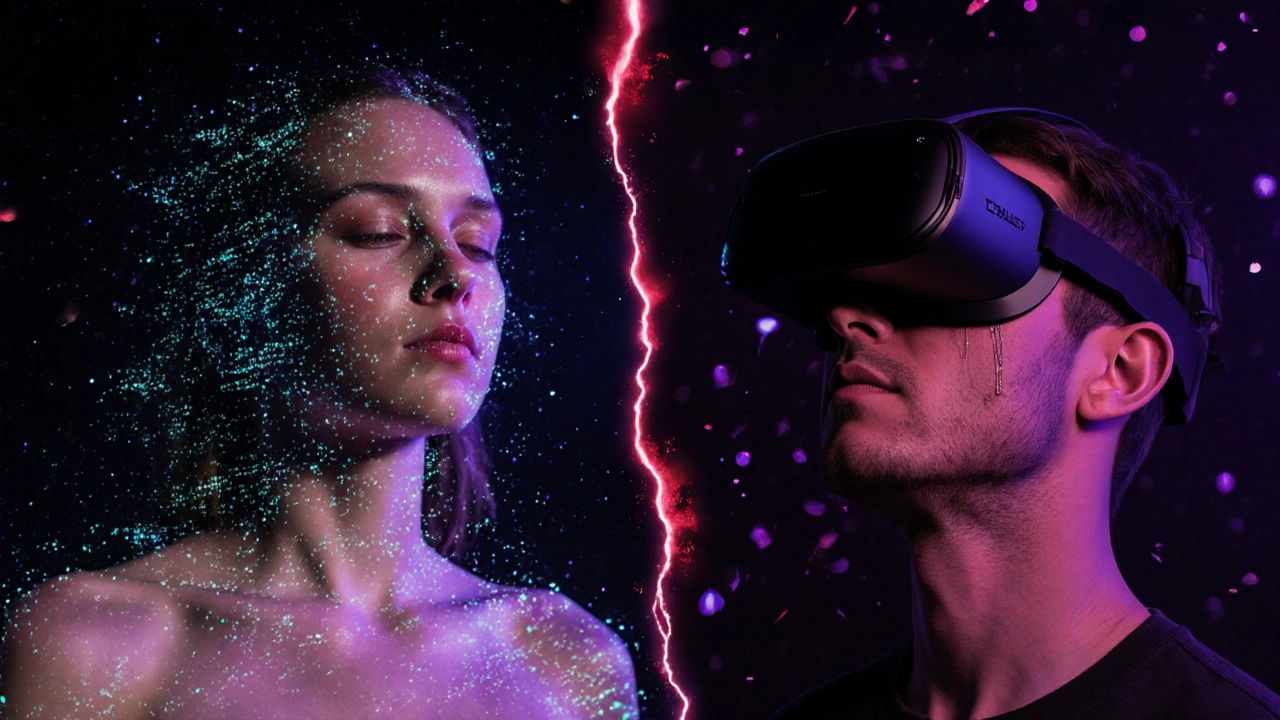
You don’t need a robot to experience AI in porn. You just need a headset. Virtual reality porn is already a $1.2 billion industry projected for 2025. Companies use deepfake technology to swap faces onto bodies-sometimes without consent. DeepNude, a tool that generated fake nude images of women from regular photos, was shut down in 2019 after public outrage. But similar tools still exist in private forums and encrypted apps. The European Union’s 2023 Artificial Intelligence Act tried to ban non-consensual synthetic sexual content. So far, enforcement is patchy.What makes this different from old-school porn? It’s personalization. AI can tailor scenes to your exact fantasies: hair color, body type, scenario, even tone of voice. It learns what makes you react. And because it’s generated on demand, there’s no need for actors. No contracts. No union rules. No accountability. Just code.
Why This Feels Like the 1970s All Over Again
History repeats itself. In the late 1970s, the VCR was a niche gadget. Then came adult films. By 1979, half of all video sales in the U.S. were X-rated tapes. Porn didn’t just ride the wave of new tech-it drove it. The same thing is happening now. Sex robots and AI porn aren’t the main reason people buy VR headsets or smart home devices. But they’re a big part of why those devices get adopted early.Professor Neil McArthur, who wrote Robot Sex: Social and Ethical Implications, calls this a natural evolution. He points out that every major sexual technology-from the printing press to the internet-was first popularized by adult content. The difference this time? There’s no human involved in the production. No consent. No wages. No boundaries. Just data.
The Ethical Divide: Therapy or Toxicity?
Some experts say sex robots could help people who struggle with human connection. Dr. Markie Twist, a sexuality researcher at the University of Wisconsin, found in her 2017 study that individuals with autism or social anxiety reported improved confidence and reduced loneliness after using AI companions. One Reddit user, posting as an autistic man, said his robot helped him feel less isolated than any therapist ever had.But others warn this isn’t therapy-it’s replacement. Dr. Kathleen Richardson, founder of the Campaign Against Sex Robots, argues these machines teach users to expect perfect, silent obedience. They remove the messy, challenging parts of real relationships-the disagreements, the vulnerability, the growth. In her 2016 research, she linked sex robots to the reinforcement of harmful gender stereotypes: the female robot as always available, always compliant, always silent.
Then there’s the violence argument. Dr. Nadya Burton from Cambridge suggested in 2018 that sex robots might reduce real-world sexual crimes by giving people a safe outlet for dangerous urges. But there’s zero longitudinal data to prove it. No one knows if using a robot makes someone less likely to harm others-or more likely to see humans as objects.
Who’s Regulating This?
In the U.S., the House passed the CREEPER Act in 2018 to ban childlike sex robots. It was a rare moment of consensus. But beyond that? Nothing. No federal rules on data privacy. No standards for AI behavior. No laws about what happens when a robot records your voice, your habits, your fantasies.The UK set ethical guidelines in 2021 requiring explicit consent protocols for AI companions. Japan, meanwhile, has taken a hands-off approach-even as its birth rate hits record lows. Some researchers worry sex robots are accelerating social isolation in a country already struggling with loneliness.
And the data? It’s a minefield. Unsecured robots can leak intimate recordings. One cybersecurity expert warned the European Parliament in 2019 that these devices transmit unencrypted data-your voice, your movements, your private conversations-over the internet. Hackers could access them remotely. There’s no industry-wide encryption standard. No recall policy. No warranty for emotional harm.

The Missing Numbers
We don’t know how many people actually use these things. A 2023 YouGov survey found only 4% of American adults had ever used a sex robot. But that number might be low. People lie about this. Or they don’t know what they’re using. Is a $400 VR headset with AI-generated content a “sex robot”? What about an app that simulates a girlfriend’s voice? The lines are blurred.China’s market is a wild card. With 30 million more men than women due to decades of the one-child policy, some researchers believe China could become the biggest user base. But there’s no official data. No surveys. Just guesses.
What Happens When the Robot Feels Real?
The biggest ethical question isn’t about technology. It’s about perception. If a robot can mimic human responses-smiling when you touch it, saying “I love you” after a long day-do we start treating it like a person? And if we do, what does that say about how we treat real people?A 2025 study in the Sage Journal asked a chilling question: Can you commit sexual assault against a robot? Legally, no. Morally? That’s where it gets messy. If a robot is programmed to say “no” but still performs the act, is that simulated violence? Or is it just code?
Right now, there’s no legal framework to answer that. No court has ruled on it. No law defines consent in human-machine interactions. And that’s terrifying.
What Comes Next?
The next generation of sex robots will have better temperature control-mimicking skin warmth beyond just a heater. They’ll use generative AI to improvise conversations, not just respond to triggers. Some prototypes can even simulate breathing patterns and subtle muscle tension.But they’ll still lack one thing: genuine emotion. No robot can feel loneliness. No algorithm can miss someone. No machine understands the weight of a shared silence. That’s why, for all the hype, adoption remains low. Most people still crave real connection-even if it’s messy, painful, or unpredictable.
The real danger isn’t that robots will replace humans. It’s that we’ll start accepting less from them. That we’ll get used to silence. To obedience. To performance without feeling. And once we do, we might forget what real intimacy even looks like.