
Wedding Ring Belief Tracker
Based on the article "The Vein of Love: How a Medical Myth Shaped Wedding Ring Tradition"
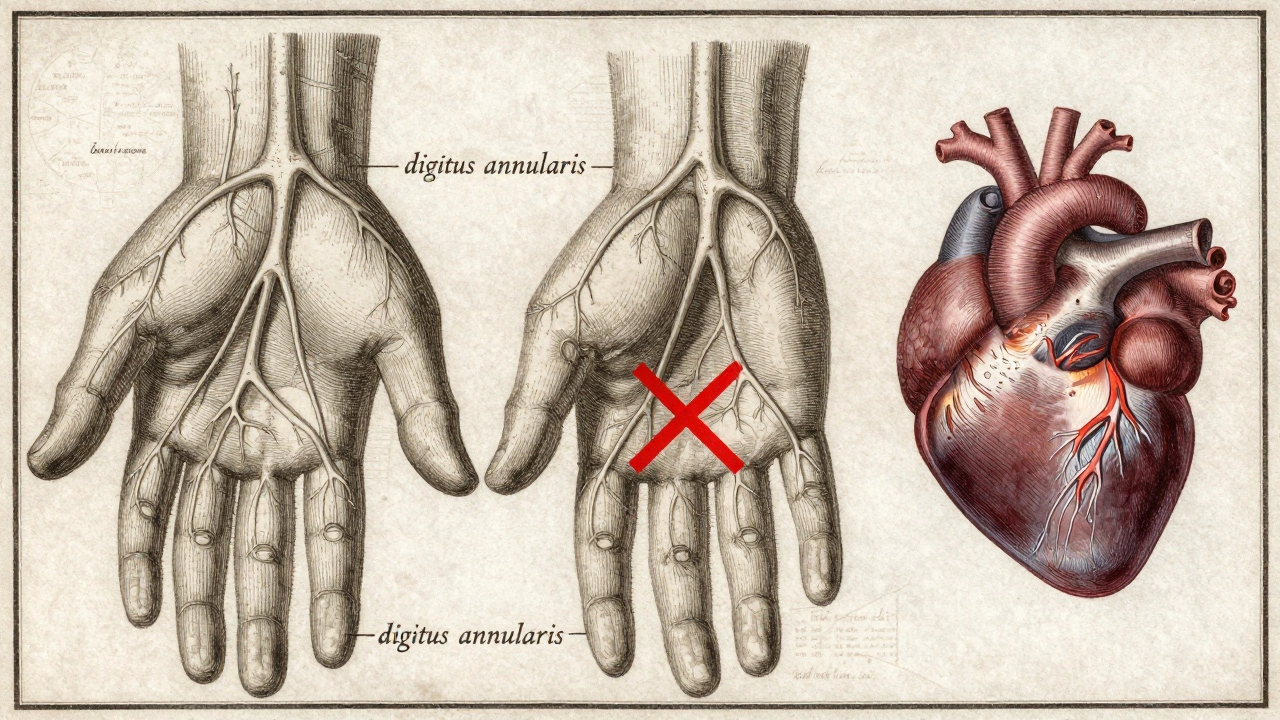
The idea that a special vein runs straight from the fourth finger of your left hand to your heart isn’t just romantic-it’s completely false. Yet, for over 1,600 years, people have believed it. And because of that myth, billions of people around the world still wear wedding rings on their ring finger today. This isn’t just a sweet story. It’s a case of how a misunderstanding in ancient anatomy became one of the most enduring symbols of love in human history.
Where Did the Vein of Love Come From?
The term vena amoris-Latin for "vein of love"-first appeared in writing in the late 17th century, in a book by English lawyer Henry Swinburne. But the idea is much older. The earliest known reference comes from Macrobius, a Roman writer from the 4th century AD, who wrote in his book Saturnalia that ancient Egyptians believed a nerve connected the fourth finger to the heart. He didn’t mention a vein. That detail came later.
By the Middle Ages, Christian wedding ceremonies in Europe had already started placing the ring on the left ring finger. Priests would touch the thumb, index, middle, and finally the ring finger while reciting, "In the name of the Father, the Son, and the Holy Spirit, Amen." The last touch landed on the fourth finger. Why? Because people believed that’s where the special connection to the heart was. The ritual didn’t need proof-it just needed meaning. And the vena amoris gave it that.
Why the Ring Finger? It’s Not About Blood
Modern anatomy says otherwise. William Harvey, the English physician who discovered how blood circulates through the body in 1628, proved there’s no unique vein from any finger to the heart. All the veins in your hand-whether from your pinky, pointer, or ring finger-drain into the same network: the cephalic and basilic veins, then up through the arm, and finally to the heart. No finger has a VIP route.
Even the name "ring finger" is a clue. In Latin, it’s digitus annularis-the "ring finger." In Russian, it’s bezymianny-"nameless." In Japanese, it’s kusuri yubi-"medicine finger," because it was once used to handle powdered herbs without contaminating them. In Hungarian, it’s called the "nameless finger" too. Across cultures, this finger was treated differently, but never because of a special vein.
Why Did the Myth Stick Around?
Because it was useful. In a time when science was still developing, people needed symbols to explain the unexplainable. Love was mysterious. Death was sudden. Marriage was a social contract with spiritual weight. The idea that your heart and your partner’s were physically linked through your fingers? That made the bond feel real, tangible, almost magical.
The myth survived long after it was debunked. In the 1800s, Mrs. Beeton’s Book of Household Management, a hugely popular guide for British brides, repeated the vena amoris story as fact. By the 1900s, jewelry companies picked up on it. Advertisements for engagement rings started showing hearts connected to fingers by glowing lines. Tiffany & Co.’s 2022 "True Love" campaign used the line: "Following the vein that leads to the heart." They knew it wasn’t true. But they also knew it sold rings.
It’s Still Believed-Even Today
A 2021 YouGov survey of over 8,000 adults in seven Western countries found that 68% still believe in the vein of love. In the U.S., it’s 74%. Even in Germany, where scientific literacy is high, nearly 60% believe it. And it’s not just random people. A 2022 study at Johns Hopkins found that over a third of first-year medical students thought the vein was real-until they took a proper anatomy class.
On TikTok, the #VenaAmorisChallenge went viral in 2022. Users pressed their fingers to their chests, claiming they could feel their heartbeat through the ring finger. The American Heart Association had to step in and clarify: "You can feel your pulse in any finger. That’s arterial pressure, not a special vein."
Yet, the myth persists. Why? Because it’s not about science. It’s about meaning.
How Other Cultures Do It Differently
The vena amoris myth is mostly a Western tradition. In Russia, Greece, and other Orthodox Christian countries, wedding rings go on the right hand. In India, wedding rings-when worn-are usually on the second finger. In some parts of China, couples wear matching bands on the right hand. In parts of Latin America, the ring is worn on the left hand before marriage, then switched to the right after.
And in rural Mexico, a 2023 study found that nearly 80% of communities still tie the ring finger to healing rituals. Some believe placing a ring on the finger during childbirth brings protection. Others use it in folk remedies for heart-related ailments. The myth isn’t dead-it’s evolving.

The Ring Finger Today: Symbol Over Science
Plastic surgeons now call the ring finger the "power finger"-not because of a vein to the heart, but because of its strength and dexterity. It’s often used in microsurgery to hold tiny grafts. That’s a modern, practical reason. But it’s not the one most people care about.
The global wedding ring market was worth $38.5 billion in 2023. Over 60% of marketing campaigns still use heart-hand imagery. Companies like Vena Amoris Jewelry LLC, founded in 2017, sell rings engraved with "vein to heart" designs-and they’re growing 37.5% a year.
Wedding planners now report that 32% of couples want to know the story behind ring placement. Some want to keep the myth. Others want to replace it with their own meaning: "It’s where we touch most when we hold hands," or "It’s the finger we always point to when we say, ‘I love you.’"
What’s Next for the Vein of Love?
Medical schools now teach the vena amoris myth as part of cultural competency. The 2024 update to Gray’s Anatomy includes a sidebar debunking it with diagrams showing identical vein paths across all fingers. The American Medical Association has even printed pamphlets warning that believing in the myth can cause confusion during medical procedures-like blood draws or IV placements.
But here’s the twist: the myth isn’t going away. Not because people are ignorant. Because they don’t want it to.
The vena amoris isn’t a medical fact. It’s a cultural artifact. It’s the reason we choose a ring, not a necklace or a bracelet, to symbolize lifelong commitment. It’s why we put it on the fourth finger, not the thumb. It’s why, even in 2025, millions of people still believe that love has a direct line to the heart.
Science may have disproven the vein. But it can’t undo the meaning.
Is there really a vein from the ring finger to the heart?
No. There is no unique vein connecting the ring finger directly to the heart. All fingers in the hand drain blood through the same network of veins-mainly the cephalic and basilic veins-that eventually lead to the heart. This myth was debunked by William Harvey in 1628, who mapped the full circulatory system. Modern anatomy confirms that every finger has identical venous pathways.
Why do we wear wedding rings on the left hand?
The tradition of wearing wedding rings on the left hand comes from ancient Roman and medieval European customs. Romans believed the vena amoris ran from the fourth finger to the heart, so they placed the ring there. Medieval Christians continued the practice during wedding rites, touching each finger in sequence before settling on the fourth. Over time, it became standard in Western cultures-even after the myth was disproven. In many Eastern Orthodox countries, rings are worn on the right hand instead.
Do other cultures have similar beliefs about the ring finger?
Yes, but not always about the heart. In Japan, the ring finger is called "kusuri yubi" (medicine finger) because it was used to handle powdered medicine without contaminating it. In Russian and Hungarian, it’s called the "nameless finger," reflecting its special but undefined role. In India, wedding rings are often worn on the second finger, not the fourth. These traditions show that while the "vein of love" is uniquely Western, the ring finger’s symbolic importance is global.
Why do jewelry companies still use the vein of love in ads?
Because it works. Even though the myth is scientifically false, it’s emotionally powerful. Ads that show a glowing line from finger to heart tap into deep cultural associations with love, permanence, and connection. Marketing research shows that campaigns using this imagery drive higher sales. Companies like Tiffany & Co. know the truth-but they also know that romance sells better than anatomy.
Is the vena amoris myth dangerous?
It can be. Some people believe the ring finger is "special" and avoid having blood drawn or IVs placed there, thinking it might harm their heart. Others assume their pulse in that finger is proof of a unique connection, which can delay medical attention for real issues. The American Medical Association now includes the myth in patient education materials to prevent these misunderstandings. It’s not the belief itself that’s dangerous-it’s mistaking symbolism for biology.