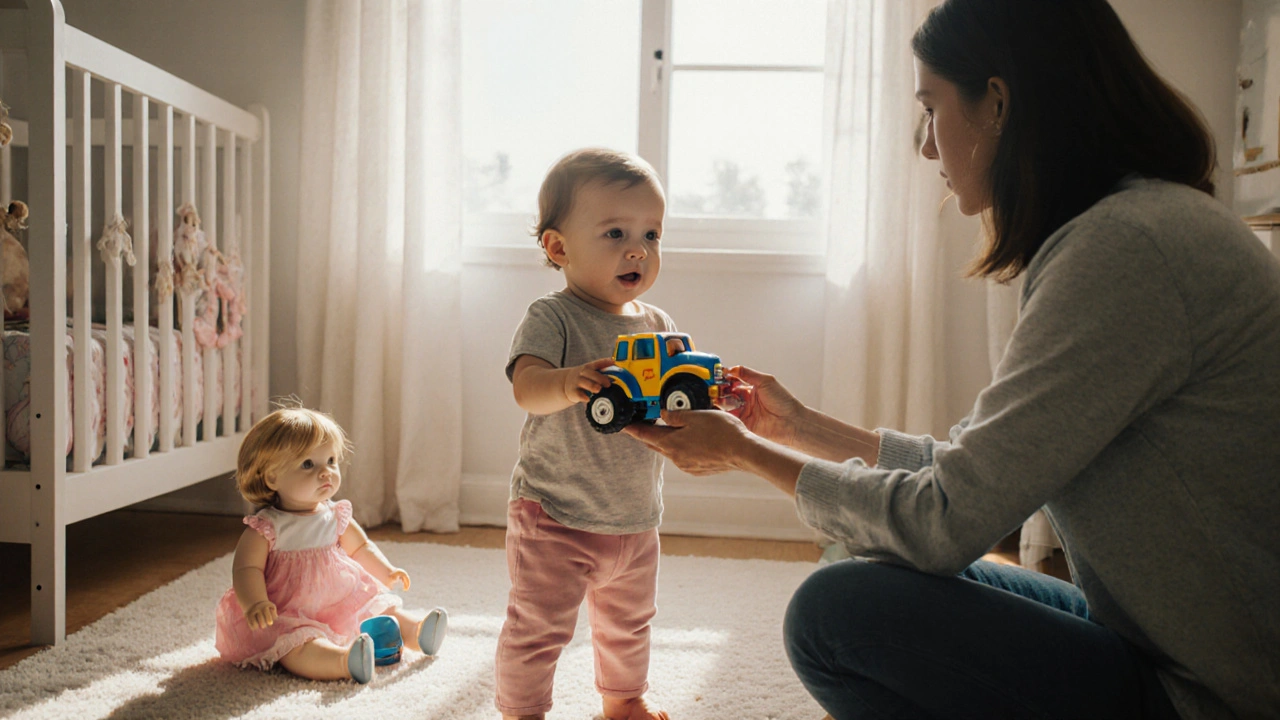
By the time a child is two years old, they already know which toys are "for boys" and which are "for girls." They’ve learned it not from a textbook, but from the quiet, everyday choices their parents make: handing them a truck instead of a doll, praising them for being "strong" or "pretty," avoiding the color pink, or insisting they sit up straight because "that’s how ladies sit." This isn’t coincidence. It’s gender socialization-the invisible curriculum families teach every day.
How Gender Roles Start Before You Even Notice
Gender socialization begins the moment a baby is born. The first thing many parents ask isn’t "Is the baby healthy?" but "Is it a boy or a girl?" That single question sets the stage. Studies show that even when researchers tell parents a baby is a boy when it’s actually a girl, parents still describe the infant as "strong" or "active." When told it’s a girl, they call the same baby "delicate" or "cute." The baby hasn’t done anything different. The parents’ expectations have. By 18 to 24 months, children start showing clear preferences for gender-typed toys and activities. By age three, most kids can label themselves as a boy or girl and understand that gender is "fixed." This isn’t because they’re born with gender scripts in their brains. It’s because they’ve been watching, listening, and absorbing-constantly. Parents don’t need to sit their kids down and say, "Boys don’t cry." They just react differently when their son falls and cries versus when their daughter does. They laugh at the boy’s roughhousing. They comfort the girl’s tears. Over time, children learn what behavior gets approval and what doesn’t.What Parents Do (Even When They Don’t Mean To)
Parents aren’t trying to lock their kids into stereotypes. Most want their children to be happy, confident, and free to explore. But old habits die hard. Research from the University of Massachusetts tracked 109 working-class families and found that mothers’ early behaviors-like choosing gendered toys or using gendered praise-were the strongest predictor of how much gender stereotype knowledge their children developed. Fathers mattered too. Kids who spent more time with their fathers in early childhood were more likely to grow up with traditional gender roles, especially daughters who ended up in less gender-typical careers later in life. It’s not just about toys. It’s about chores. Girls are more likely to be assigned cleaning and caregiving tasks. Boys get outdoor work or fixing things. Girls are praised for being quiet and helpful. Boys are praised for being bold and independent. These aren’t big lectures. They’re small moments: a mother helping her daughter braid her doll’s hair while her son builds a Lego tower alone. A father cheering his son for tackling a soccer ball hard, but gently correcting his daughter’s rough tackle. Even well-meaning parents do this. A 2023 Pew Research report found that 68% of parents say they’re trying to avoid gender stereotypes. But 79% admit they still hand their daughter a pink cup or steer their son away from ballet. The gap between intention and action is real-and it’s where gender roles get reinforced without anyone realizing it.Family Structure Changes the Script
Not all families follow the same pattern. Research published in Nature’s Humanities and Social Sciences Communications in 2023 found that children in two-parent households showed stronger social adjustment when their parents held traditional gender attitudes-because the messages were consistent. In single-parent homes, kids were more likely to develop flexible views of gender, not because the parent was more progressive, but because they didn’t have a second adult reinforcing a rigid script. The child’s relationship with their parent also matters. Kids who strongly identify with their same-gender parent are more likely to adopt their gender attitudes. A daughter who sees her mother as a strong, independent breadwinner is more likely to believe women can lead. A son who watches his father cry at a funeral or help with laundry learns that masculinity isn’t about emotional suppression. This is why gender socialization isn’t just about what parents say-it’s about what they show. Children don’t learn gender from lectures. They learn it from observation. They watch how their mother and father divide work. They notice who gets praised for being smart and who gets praised for being nice. They pick up on who gets to be loud and who gets told to be quiet.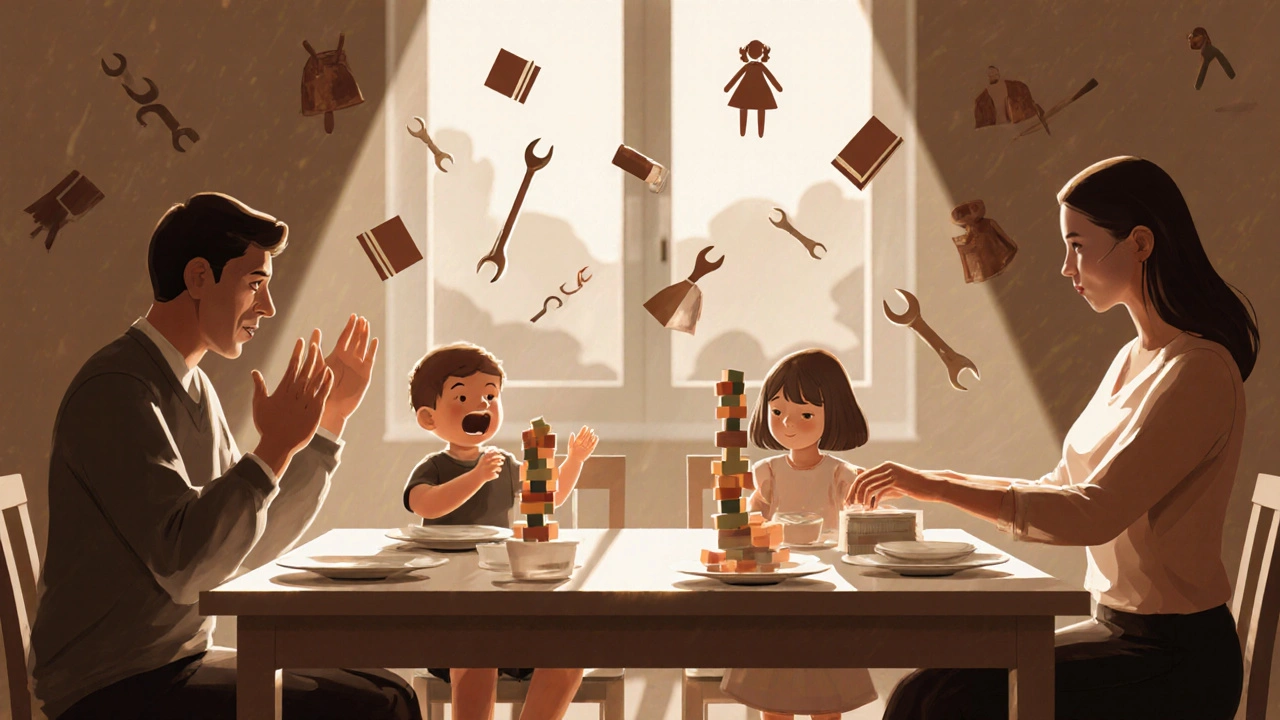
The Cost of Rigid Gender Roles
When kids are pushed into narrow gender boxes, they lose more than just toy choices. They lose opportunities. Girls who are discouraged from playing with building toys or doing science projects are less likely to develop spatial reasoning skills linked to success in engineering and math. Boys who are told not to cry or show fear are more likely to struggle with emotional regulation later in life-and face higher rates of depression and suicide. A 2002 study by Liben, Bigler, and Krogh showed that children who internalize strict gender roles also develop lower confidence in subjects they’re told aren’t "for their gender." Girls believe they’re worse at math. Boys believe they’re worse at reading. These beliefs stick. They shape what classes kids take, what careers they consider, and how they see themselves as adults. The damage isn’t just psychological. It’s economic. Women still earn less than men, in part because they’re steered away from high-paying fields. Men still die younger, in part because they’re taught to ignore pain and avoid doctors. These aren’t random outcomes. They’re the long-term results of early socialization.How to Break the Cycle
The good news? Gender socialization isn’t fixed. It can be changed. And it starts at home.- Offer diverse toys and activities. Give your daughter a wrench. Give your son a stuffed animal. Let them choose. Don’t assume their interests based on gender.
- Use gender-neutral language. Instead of "good job, brave boy," say "good job, you didn’t give up." Instead of "you’re such a pretty girl," say "you look so confident in that outfit."
- Model flexibility. Let your kids see you doing tasks that break stereotypes. Cook if you’re a dad. Fix the sink if you’re a mom. Talk about your feelings. Cry if you need to.
- Challenge stereotypes when you hear them. If your child says, "Only girls like dolls," ask why they think that. What made them say that? Where did they learn it?
- Encourage mixed-gender play. Support your son joining a dance class. Support your daughter on the soccer team. Don’t wait for them to ask. Offer.

It’s Not Just About Families
Families are powerful, but they’re not the only influence. Media, teachers, peers, and culture all play a role. A child might be encouraged to be a scientist at home, but then hear a teacher say, "Boys are better at math." Or see only male characters in action movies. That’s why change needs to happen everywhere. But families are the first and most consistent teachers. What happens at home sets the foundation. If a child grows up believing they can be anything-no matter their gender-they’re more likely to grow into an adult who believes the same. The goal isn’t to erase gender. It’s to expand what it means. To let boys be gentle. Let girls be loud. Let kids be curious, not confined.What’s Next?
Researchers are now looking at how gender socialization works across cultures, races, and non-binary identities. Most studies still focus on boys and girls. But what about kids who don’t fit into either box? What happens when a child’s gender identity doesn’t match the one their parents assumed? That’s the next frontier. For now, the clearest path forward is simple: pay attention. Notice what you’re teaching-not through words, but through actions. Ask yourself: Am I giving my child the freedom to be themselves? Or am I passing on old rules they didn’t ask for? Because the most powerful thing a parent can teach a child about gender isn’t what it means to be a boy or a girl. It’s that they’re allowed to define it for themselves.At what age do children start understanding gender roles?
Children begin showing awareness of gender roles as early as 18 to 24 months. By age three, most kids can label themselves as a boy or girl and understand that gender is a fixed category. They pick up on societal cues from parents, media, and peers long before they can explain them.
Do mothers and fathers socialize gender differently?
Yes. Research shows mothers’ early behaviors-like toy selection and praise-are the strongest predictor of children’s gender stereotype knowledge. Fathers play a key role too: children who spend more time with their fathers are more likely to adopt traditional gender roles, especially daughters who later enter less gender-typical careers. Both parents model behavior, but often in different ways based on their own upbringing and societal expectations.
Can gender socialization be changed?
Absolutely. While early socialization is powerful, it’s not permanent. Parents who intentionally offer gender-neutral toys, use non-gendered praise, model diverse behaviors, and challenge stereotypes can significantly reduce rigid gender expectations. Studies show that children raised this way develop broader emotional, cognitive, and social skills.
Why do some parents unintentionally reinforce gender stereotypes?
Most parents aren’t trying to limit their children. They’re repeating patterns they grew up with. Even well-intentioned caregivers hand a girl a doll because it’s "what girls like" or steer a boy away from crying because "boys don’t do that." These habits are deeply embedded in culture, media, and family traditions. Without conscious effort, they’re passed down automatically.
How does family structure affect gender socialization?
Children in two-parent households often develop stronger adherence to traditional gender roles because they receive consistent messages from both parents. In single-parent homes, children are more likely to develop flexible views of gender-not because the parent is more progressive, but because there’s no second person reinforcing a rigid script. The child’s emotional connection to the parent also matters: those who strongly identify with their parent are more likely to adopt their gender attitudes.
What’s the biggest mistake parents make in gender socialization?
The biggest mistake is assuming gender determines interest or ability. Telling a girl she’s not good at math because she’s a girl, or a boy he shouldn’t cry because he’s a boy, limits their development. It’s not about being perfect-it’s about being aware. Letting kids explore without judgment, even when it goes against tradition, gives them the freedom to become their fullest selves.