Interactive Timeline of the Early AIDS Crisis
Click on the timeline events below to reveal detailed information about each stage of the early AIDS crisis.
January 1981: The First Signal
Physicians in Los Angeles noticed five young, previously healthy gay men suffering from Pneumocystis carinii pneumonia (PCP). This rare fungal infection typically only affects those with severely compromised immune systems, signaling an unknown cause of immune collapse.
Knowledge Check
Question 1: What was the initial term used by media and some professionals that fueled stigma?
Question 2: When did the CDC officially adopt the term "AIDS"?
Imagine waking up in 1981 Los Angeles with a rare pneumonia that doctors had only ever seen in people whose immune systems were already destroyed. You are young, previously healthy, and suddenly your body is failing. This wasn't science fiction; it was the terrifying reality for five gay men who became the first officially recorded AIDS cases, marking the beginning of a global health crisis defined by confusion, stigma, and delayed action.
The story of how we identified this disease is just as critical as the medical facts. It involves a chain of miscommunications, bureaucratic delays, and a community fighting to be heard. If you want to understand why the initial response was so slow, you have to look at the specific timeline of those first few months. The gap between "something is wrong" and "we know what it is" cost thousands of lives.
Key Takeaways
- The first official report was published in June 1981 by the CDC, describing five cases of rare pneumonia in Los Angeles.
- Early terminology like "GRID" (Gay-Related Immune Deficiency) fueled stigma and delayed broader public health responses.
- The connection to intravenous drug use and hemophilia emerged later, proving the virus was not limited to one demographic.
- Lack of knowledge about transmission led to widespread fear and discrimination against healthcare workers and patients.
- The identification of HIV as the causative agent didn't happen until 1983-1984, years after the first cases appeared.
The January 1981 Signal: Pneumocystis Carinii Pneumonia
Before there was a name for the disease, there were symptoms. In late 1980 and early 1981, physicians in Los Angeles began noticing a pattern. They treated five young, previously healthy gay men for Pneumocystis carinii pneumonia (PCP). This fungal infection is opportunistic, meaning it typically only attacks people with severely compromised immune systems, such as organ transplant recipients or cancer patients undergoing chemotherapy.
Dr. Joel Weisman and Dr. Michael Gottlieb were among the clinicians who noticed these anomalies. They reported their findings to the Centers for Disease Control and Prevention (CDC). The data was sparse-just five case reports-but the implication was shocking. Why were five young men, none of whom had known immunodeficiencies, developing a disease associated with total immune collapse?
| Date | Location | Observation | Implication |
|---|---|---|---|
| Jan 1981 | Los Angeles, CA | 5 cases of PCP in gay men | Rare infection suggests immune failure |
| June 1981 | New York City | 26 cases of Kaposi's Sarcoma | Unusual cancer in young gay men |
| July 1981 | San Francisco | Cluster of immune disorders | Geographic spread beyond LA/NY |
The MMWR Report That Changed Everything
On June 5, 1981, the CDC published a brief report in its Morbidity and Mortality Weekly Report (MMWR). Titled "Pneumocystis-Pneumonia-Los Angeles," it described the five cases from the previous section. At the time, it looked like a minor footnote. The report noted that all five patients were homosexual males. Two had died within weeks of diagnosis.
This publication is widely cited as the official start of the AIDS epidemic. But here is the catch: the report did not mention the word "AIDS." It didn't even suggest a new disease. It simply presented data points. The confusion started here. Was this a new pathogen? A reaction to recreational drugs? Or something else entirely? The lack of a clear hypothesis left doctors scrambling.
Meanwhile, on the East Coast, dermatologist Alvin Friedman-Kien reported a cluster of 26 cases of Kaposi's sarcoma in New York City. KS is a rare cancer usually found in elderly Mediterranean men or those with suppressed immune systems. Seeing it in young gay men in rapid succession confirmed that the issue wasn't isolated to Los Angeles. The immune system was breaking down across the country.

Naming the Crisis: GRID vs. ARDS
Language shapes perception. In the early days, the media and some medical professionals used the term GRID, which stood for Gay-Related Immune Deficiency. This label was medically inaccurate but socially powerful. It immediately framed the disease as a "gay plague," ignoring the fact that heterosexuals, hemophiliacs, and infants were also falling ill.
The scientific community pushed back. By September 1982, the CDC adopted the term Acquired Immune Deficiency Syndrome (AIDS). This shift was crucial for two reasons. First, it removed the identity-based stigma from the clinical definition. Second, it acknowledged that the syndrome could be acquired by anyone exposed to the underlying cause. However, the cultural damage of the "GRID" era lingered. Public health messaging remained focused almost exclusively on the gay community for years, leaving other risk groups unaware of their vulnerability.
Why does this matter today? Because naming errors create blind spots. When a disease is labeled by who gets it rather than what causes it, testing and treatment follow the label, not the biology. This delay meant that blood banks continued to accept donations from carriers who weren't part of the perceived "at-risk" group, leading to infections in hemophiliacs and transfusion recipients.
The Transmission Mystery: Blood and Sex
Once the pattern was recognized, the next urgent question was: How is it spreading? Doctors observed clusters among sexual partners. If one man had the syndrome, his regular partner often developed similar symptoms. This pointed toward a sexually transmitted agent. But there was another clue. Intravenous drug users who shared needles were also showing signs of immune collapse. Additionally, hemophiliacs-who received clotting factor concentrates made from pooled plasma-were getting sick at alarming rates.
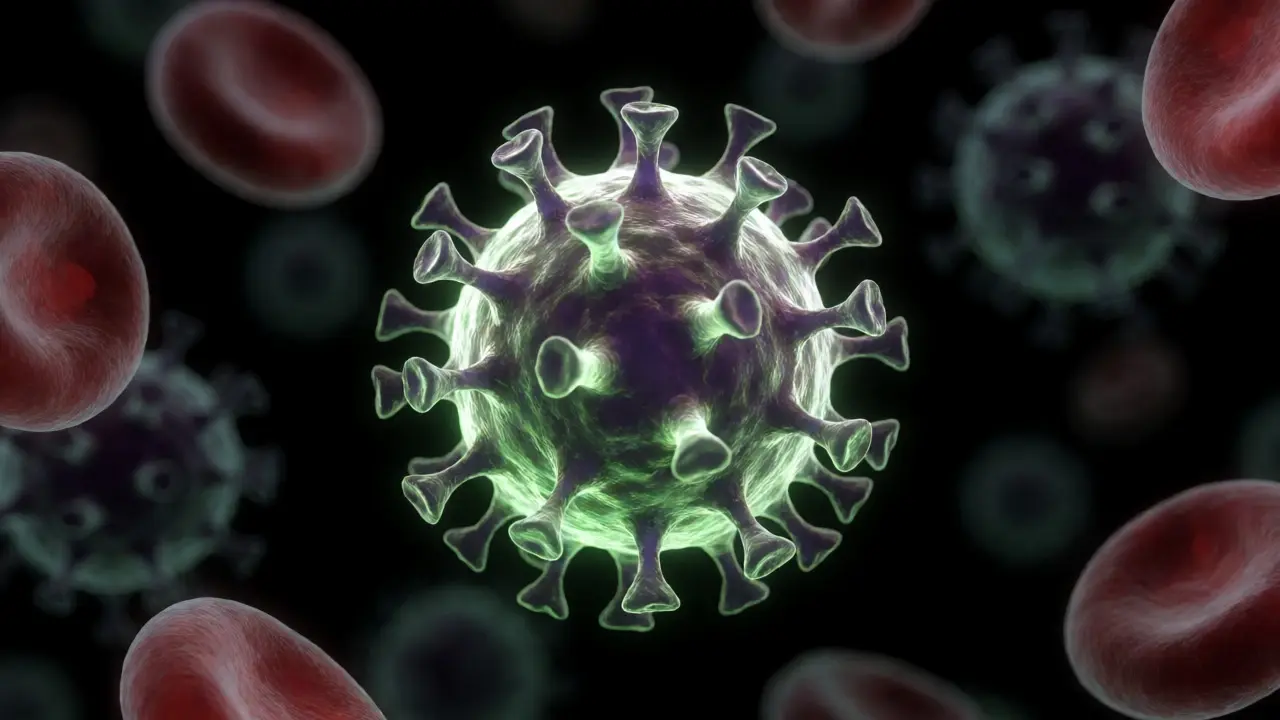
These three distinct groups-men who have sex with men, IV drug users, and hemophiliacs-shared one thing: exposure to bodily fluids. The hypothesis shifted toward a blood-borne pathogen. Yet, without a visible virus, proof was elusive. Researchers couldn't see the enemy. They were fighting a shadow.
In 1983, French researcher Luc Montagnier and his team at the Pasteur Institute isolated a retrovirus they called LAV (Lymphadenopathy-Associated Virus). Shortly after, Robert Gallo in the United States announced the discovery of HTLV-III. Years of priority disputes followed, but both teams had essentially found the same thing. By 1986, the International Committee on Taxonomy of Viruses named it Human Immunodeficiency Virus (HIV).
Public Fear and Institutional Paralysis
While scientists debated names and mechanisms, the public panicked. News coverage was sensationalist. Headlines screamed about "gay cancer" and "immune deficiency." Without knowing how HIV was transmitted, people feared casual contact. Dentists refused to treat patients. Nurses avoided changing bedpans. Parents pulled children out of schools if a teacher was diagnosed.
This fear was irrational but understandable given the information vacuum. The government’s response was painfully slow. President Reagan did not publicly address the epidemic until 1985, four years after the first MMWR report. Funding for research remained low compared to other diseases with similar mortality rates. The political hesitation reflected a society unwilling to confront issues related to sexuality and drug use.
Community activism filled the void. Groups like GMHC (Gay Men's Health Crisis) in New York provided support when institutions failed. They educated peers about safer sex practices before the CDC issued formal guidelines. This grassroots effort saved countless lives and forced the medical establishment to listen. It proved that patient advocacy is not just a moral imperative-it is a public health necessity.
Lessons from the Early Years
The early response to AIDS offers harsh lessons for future pandemics. Speed matters. Ambiguity kills. And stigma is a barrier to effective medicine. The delay in identifying HIV allowed the virus to establish itself globally before treatments existed. By the time AZT-the first antiretroviral drug-was approved in 1987, tens of thousands had already died.
We must remember that the "discovery" of AIDS wasn't a single eureka moment. It was a messy, contentious process involving flawed assumptions and social biases. Recognizing this helps us appreciate the complexity of emerging infectious diseases. It reminds us that science doesn't operate in a vacuum; it operates in a society with prejudices, politics, and limitations.
When were the first cases of AIDS officially reported?
The first official report was published on June 5, 1981, in the CDC's Morbidity and Mortality Weekly Report (MMWR). It described five cases of Pneumocystis carinii pneumonia in young gay men in Los Angeles.
What was the original name for AIDS?
It was initially referred to as GRID (Gay-Related Immune Deficiency) and later ARDS (Acquired Immune Deficiency Syndrome) before the term AIDS was standardized in 1982.
How long did it take to identify HIV as the cause?
It took approximately two to three years. The first cases were reported in 1981, while the virus was isolated in 1983 and named HIV in 1986.
Why was the early response considered inadequate?
The response was hindered by stigma, lack of funding, and the misconception that the disease only affected marginalized groups. Political leadership was slow to acknowledge the scale of the crisis.
Did only gay men get AIDS in the early days?
No. While gay men were disproportionately affected and highlighted in early reports, hemophiliacs, intravenous drug users, and their sexual partners also contracted the disease early on.