Mammalian Reproduction Comparison Tool
Explore how different mammal groups evolved distinct reproductive strategies over 200 million years. Select a type to see key characteristics, gestation periods, and evolutionary advantages.
Reproduction Type: Egg-laying (oviparous)
Example Species: Platypus, Echidnas
For over 200 million years, mammals have been quietly rewriting the rules of reproduction. It didn’t start with live birth. It didn’t even start with placentas. It started with eggs-leathery, fragile, buried in dirt like those of ancient reptiles. And yet, somehow, that simple beginning led to the diversity of life we see today: humans giving birth to fully formed babies, kangaroos carrying underdeveloped young in pouches, and platypuses hatching from eggs like birds. How did we get here? The story isn’t just about biology-it’s about survival, adaptation, and a quiet revolution that changed everything.
The First Mammals Laid Eggs
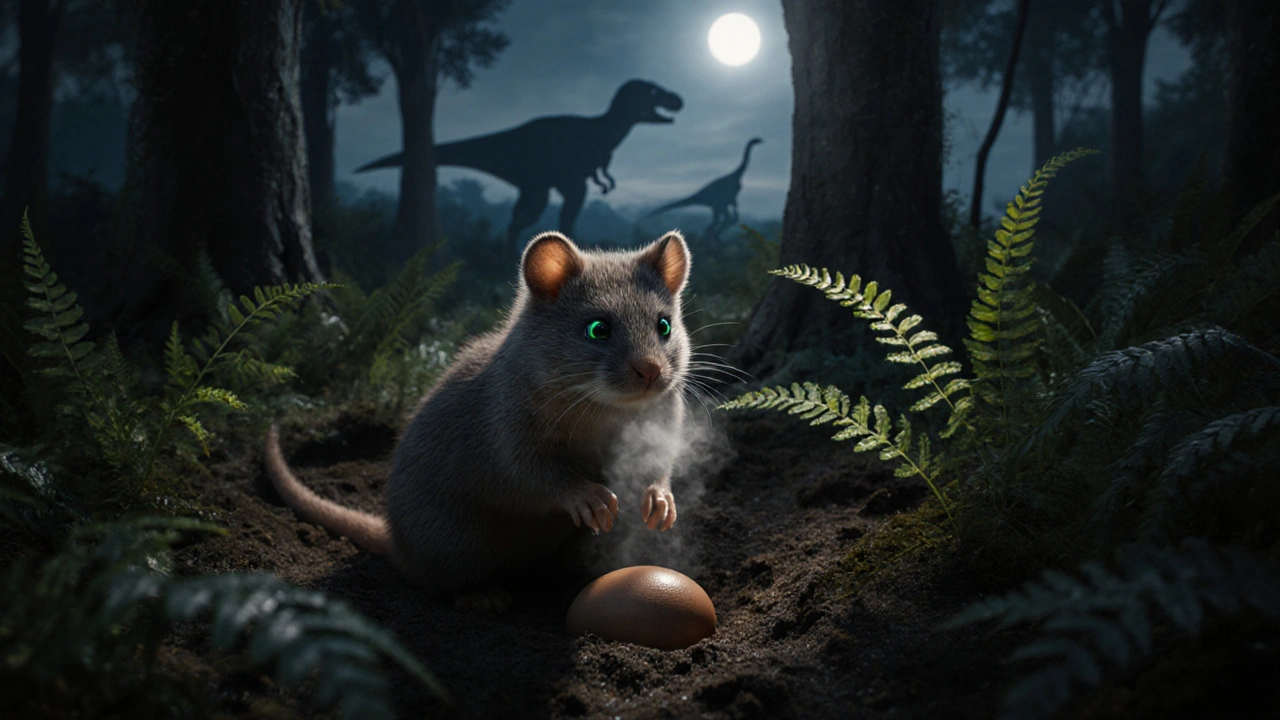
The earliest mammals didn’t look like anything we’d recognize today. They were small, nocturnal, and lived in the shadows of dinosaurs. But they had something new: fur, warm blood, and mammary glands. Oddly, they still laid eggs. Today, only five living species still do this-the platypus and four species of echidna. These are the monotremes, and they’re not anomalies. They’re living fossils. Their eggs are soft-shelled, like those of reptiles, and hatch after a few weeks of incubation. Yet, right after hatching, the babies nurse from milk secreted through patches of skin-no nipples, just milk-soaked fur. This mix of reptilian and mammalian traits tells us something important: mammalian reproduction didn’t evolve all at once. It layered on top of older systems.
Scientists agree that oviparity (egg-laying) was the original state for all amniotes-the group that includes reptiles, birds, and mammals. So when the first true mammals appeared around 200 million years ago in the Late Triassic, they inherited this trait. The shift away from eggs didn’t happen overnight. It was slow, driven by pressure. Smaller eggs meant shorter incubation times. That meant mothers could move more freely, avoid predators, and better control the environment for their developing young. But smaller eggs also meant less yolk-less built-in food. So the next step wasn’t just about giving birth. It was about feeding.
The Rise of Live Birth
By the Early Cretaceous, about 130 million years ago, a new group emerged: the Therians. This branch split into two paths-marsupials and placentals. Both gave live birth, but in wildly different ways. Marsupials, like opossums and kangaroos, give birth after just 12 to 40 days. Their young are tiny, blind, and barely more than embryos. They crawl to a pouch, latch onto a teat, and spend months growing. Placentals, which include everything from mice to whales, carry their young much longer. The placenta-a complex organ made of fetal and maternal tissues-delivers oxygen and nutrients directly from mother to baby, while removing waste. This allows for longer, more protected development inside the womb.
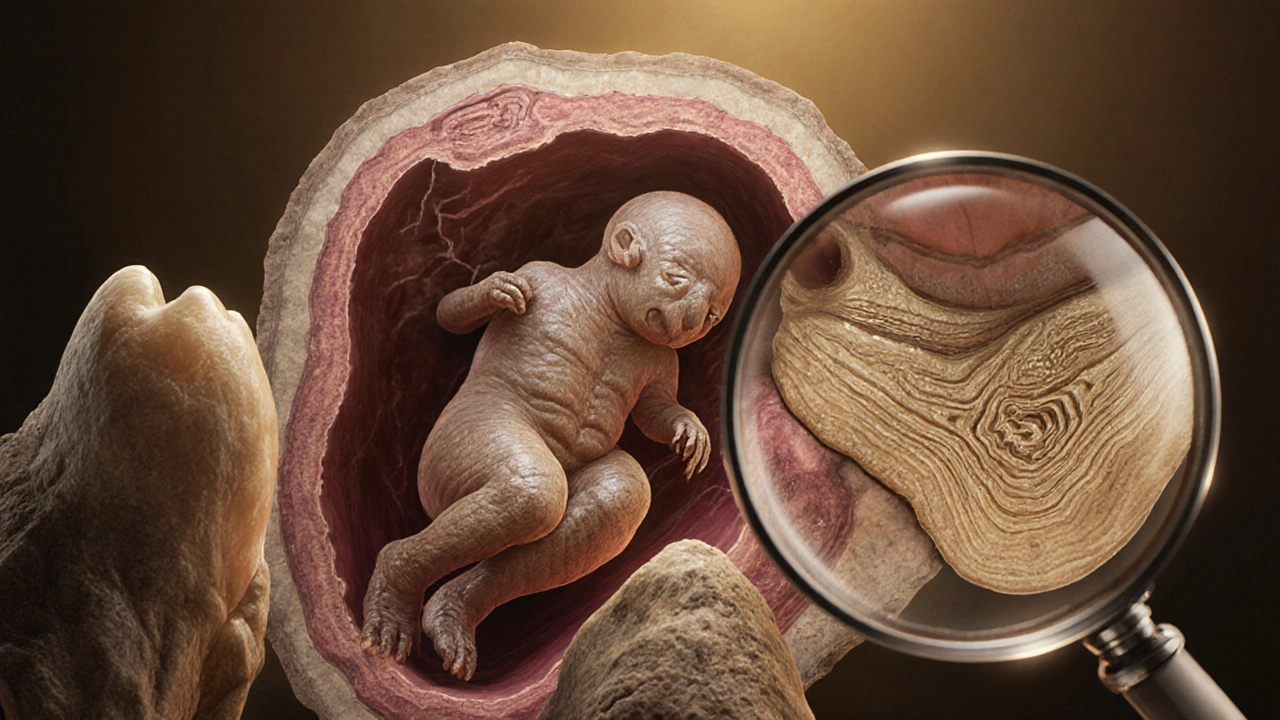
For decades, scientists assumed that marsupial reproduction was the "primitive" version and placental was the "advanced" one. It made sense: placentas looked more complex, and the babies were more developed at birth. But that view started to crack in 2022. A team from the University of Washington, working with the Burke Museum, analyzed fossilized teeth from multituberculates-an extinct group of rodent-like mammals that thrived for over 100 million years. By studying growth lines in the teeth, they estimated how long these animals nursed their young: about 30 days. That’s almost identical to modern mice. More importantly, the structure of their jaws and teeth suggested they had a placenta-like system to nourish their young before birth.
This discovery flipped the script. If multituberculates-animals that branched off before marsupials and placentals even split-had placental-like reproduction, then maybe the common ancestor of all live-bearing mammals already had it. Maybe marsupials didn’t evolve from a simple system. Maybe they lost something. Maybe the pouch and short gestation aren’t primitive. Maybe they’re a clever adaptation to a different kind of survival.
Why the Change? Survival in a Dangerous World
Evolution doesn’t care about elegance. It cares about survival. Around 66 million years ago, an asteroid hit Earth. Dinosaurs died. Many mammals died too. But some didn’t. Why? New research from the NIH (PMC8157036) shows that the mammals that survived were the ones that bred early and had fewer offspring. They didn’t rely on laying dozens of eggs or producing huge litters. They invested in a few, well-cared-for babies. This is called K-selection: quality over quantity.
Before the extinction, most mammals were "late breeders." They waited until they were older, had fewer offspring, and invested more in each one. After the extinction, the survivors were those who could reproduce quickly and still give their young a fighting chance. Live birth helped. A mother could carry her young safely, keep them warm, and protect them from predators. A placenta allowed for longer development without exposing the embryo to the outside world. Even in marsupials, the pouch became a mobile nursery.
What’s fascinating is that this shift didn’t happen all at once. Different lineages evolved similar strategies independently. Some multituberculates may have been viviparous; others may not have been. Some early marsupials might have had longer gestations. Evolution doesn’t follow a straight line. It branches, experiments, and sometimes backtracks.
The Role of Miniaturization
One of the most important ideas in this story comes from James Hopson’s 1973 hypothesis: egg miniaturization. Think of it this way. If your eggs are too big, you can’t carry them around. You’re stuck. You’re vulnerable. But if your eggs are tiny, you can carry them inside you. You can move. You can hide. You can keep them warm. But tiny eggs mean tiny yolk. So the mother has to step in. She has to feed the embryo. That’s the trigger. Once the mother started providing nutrients beyond the egg, the stage was set for a placenta.
Modern monotremes still lay eggs, but they’re small-only about 1.5 centimeters long. Their embryos develop for only 10 to 12 days before hatching. That’s barely enough time to form limbs. Compare that to a human embryo, which develops for nine months. The difference isn’t just time. It’s control. The mother controls the environment. She controls the food. She controls the temperature. And that control became the key to mammalian success.
What Does This Mean for Us?
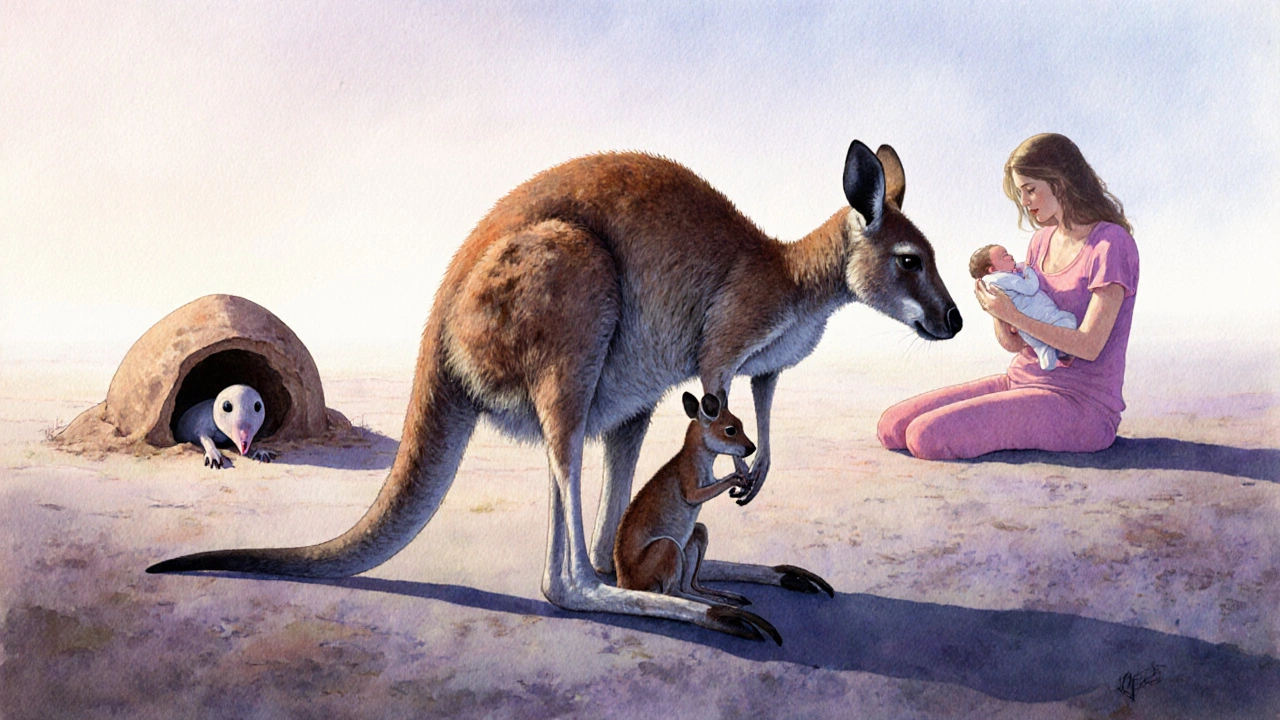
We’re placental mammals. Our babies are born relatively developed. We carry them for nine months. We nurse them for months after. We teach them. We protect them. That’s not an accident. It’s the result of 200 million years of trial and error. The fact that we’re here at all is because our ancestors figured out how to turn reproduction from a gamble into a strategy.
And it’s not just about biology. It’s about identity. For a long time, we thought of marsupials as "less evolved." But now we know: they didn’t fall behind. They took a different path. Their young are born underdeveloped, but they’re not broken. They’re perfectly adapted to their environment. Kangaroo joeys don’t need to be born fully formed because they don’t need to survive on open ground. They need to cling, nurse, and grow in safety. That’s not a flaw. It’s a solution.
Our own reproductive system didn’t come from perfection. It came from necessity. From a world full of predators. From climate shifts. From mass extinctions. The fact that we can now study this through fossilized teeth, growth rings, and DNA is a miracle of science. But the real miracle is how life adapts-not by being the strongest, but by being the most flexible.
Why This Matters Today
Understanding how mammals evolved reproduction isn’t just about ancient history. It helps us understand fertility, pregnancy complications, and even why some species struggle to survive in changing environments. When we see a premature human baby in an incubator, we’re seeing the same problem that faced early mammals: how to keep a fragile life alive outside the womb. When we study marsupial pouches, we’re learning how to support underdeveloped young in ways that mimic nature. Evolution didn’t invent new tools. It repurposed old ones. And that’s still true today.
Every time a baby is born, we’re seeing the legacy of a decision made by a small, furry creature in the shadow of a dinosaur-200 million years ago. It chose to carry its young inside. To feed them. To protect them. And in doing so, it changed the fate of an entire class of animals. We’re the result of that choice.
Are monotremes the ancestors of all mammals?
No, monotremes aren’t the direct ancestors of other mammals. They’re a separate branch that split off early-around 160 million years ago-and retained egg-laying as their reproductive strategy. All mammals share a common ancestor that lived before monotremes diverged. That ancestor likely laid eggs too. Monotremes didn’t evolve into marsupials or placentals. They just kept the old way while the others changed.
Why do marsupials have such short pregnancies?
Marsupials have short pregnancies because their placentas are simple and short-lived. Instead of nourishing the embryo for months, they give birth to underdeveloped young and continue development outside the womb-mostly through nursing in a pouch. This may be an adaptation to unpredictable environments. If food is scarce, a mother can delay development or even abandon a joey without losing a fully formed fetus. It’s a low-risk strategy.
Did placental mammals evolve from marsupials?
No. Placental mammals and marsupials evolved from a common ancestor that gave live birth. They’re two separate branches that split around 160 million years ago. Neither came from the other. The old idea that marsupials are "primitive" placentals is outdated. New evidence shows the common ancestor likely had a placenta-like system, and marsupials simplified it, while placentals made it more complex.
How do scientists know what ancient mammals’ reproduction was like?
They study fossils-especially teeth and bones. Growth rings in teeth, similar to tree rings, reveal how long young were nursed. Pelvic bones show whether a female could give birth to large offspring. Some fossils even preserve embryos inside the mother. The 2022 study on multituberculates used dental histology to estimate lactation periods. Other research uses CT scans to reconstruct reproductive anatomy from crushed skulls. It’s detective work, but it works.
What’s the difference between a placenta and a marsupial pouch?
The placenta is an internal organ that connects mother and fetus, exchanging oxygen, nutrients, and waste while the baby grows inside the womb. The pouch is an external structure that holds the baby after birth. It’s not a reproductive organ-it’s a protective carrier. Marsupials rely on nursing for development; placentals rely on the placenta. One happens before birth, the other after.
Why did live birth evolve more than once?
It didn’t evolve more than once in mammals-it likely evolved once in the common ancestor of all live-bearing mammals. But in other animal groups-like some sharks and lizards-live birth evolved independently. That’s because it’s a powerful survival tool. When conditions are dangerous, carrying young inside offers protection. So evolution keeps finding the same solution, even in unrelated species. In mammals, it happened once. In reptiles, it happened many times.