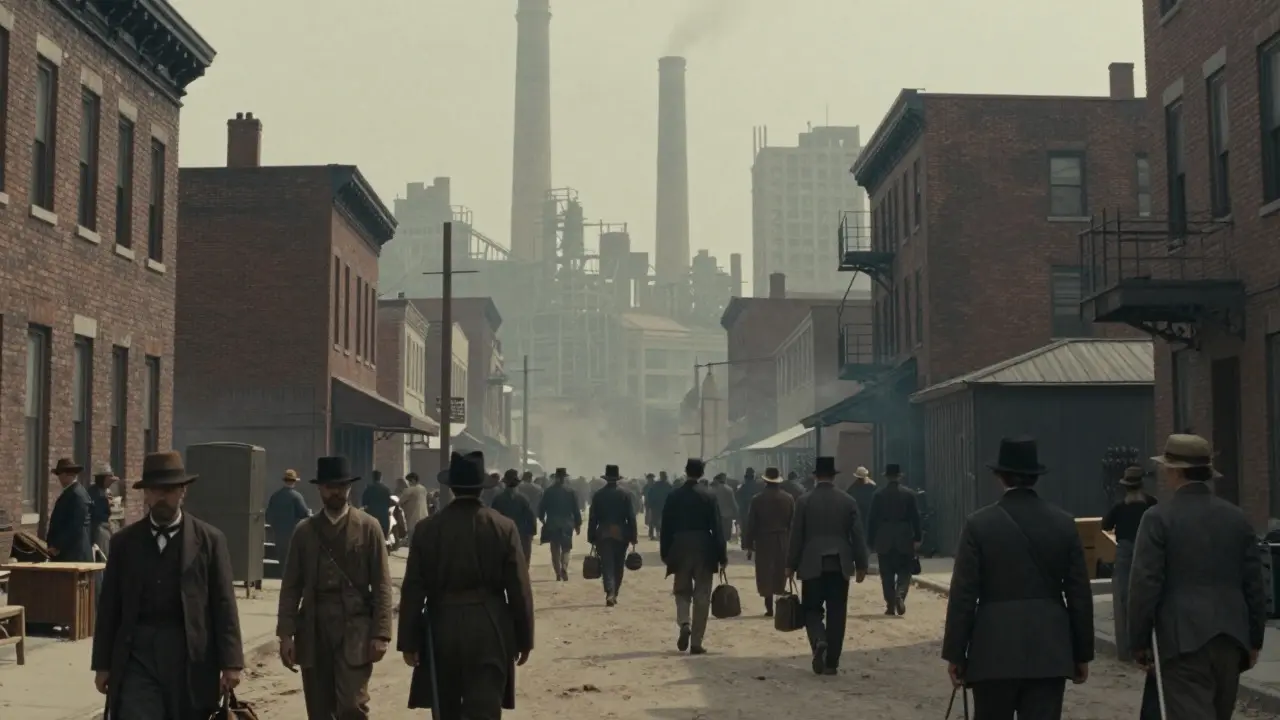
Urbanization & Moral Surveillance Simulator
Adjust the sliders below to simulate the shift from a pre-industrial village to a modern digital metropolis. Observe how changes in physical density and digital connectivity impact your social freedom and isolation levels.
Environment Parameters
Social Control Mechanisms Comparison
| Feature | Rural / Traditional | Urban / Modern |
|---|---|---|
| Primary Enforcement | Public Shaming & Economic Exclusion | Legal Codes & Professional Therapy |
| Level of Privacy | Low (High Visibility) | High (Anonymity) |
| Definition of Deviance | Violation of Traditional Norms | Violation of Written Law |
| Impact on Sexuality | Strictly Regulated for Procreation | Privatized for Pleasure/Intimacy |
| Community Cohesion | High (Interdependent) | Low (Individualistic) |
Walk through a small village in rural France or a tight-knit neighborhood in pre-industrial London, and you will notice something striking: everyone knows everyone else's business. Not because they are nosy, but because survival depended on it. In these settings, Moral Surveillance is the informal system where community members monitor each other's behavior to enforce shared social norms without legal intervention. It was the glue holding society together when police forces were weak or non-existent. But as cities grew during the 18th and 19th centuries, this invisible web began to fray. The rise of Urbanization introduced anonymity, which fundamentally changed how humans relate to one another and, crucially, how we view sex, privacy, and personal freedom.
The Mechanics of the Village Watch
To understand what was lost, we have to look at how it worked. In pre-modern communities, social control wasn't just about punishment; it was about reputation. Your worth was determined by your neighbors' perception of you. If you broke a norm-whether it was working hard enough, dressing appropriately, or keeping your affairs private-the cost was immediate. You might lose access to credit, find no one willing to trade with you, or face public shaming.
This system relied heavily on low population density. When you live within walking distance of your employer, your priest, and your extended family, there is nowhere to hide. This constant visibility created a rigid code of conduct. For example, in many European villages, sexual activity outside of marriage was not just a sin; it was an economic disruption. An illegitimate child meant a burden on the community's resources, so the community policed bedchambers with intense scrutiny.
- Reputation Capital: Social standing acted like currency. Losing it meant economic isolation.
- Proximity: Physical closeness ensured that deviations from norms were spotted quickly.
- Homogeneity: Shared religious and cultural values made "correct" behavior easy to define and enforce.
The City as a Space of Anonymity
Then came the city. As industrialization pulled millions from farms to factories, the social fabric stretched thin. In a metropolis like Paris, London, or New York, you could live for years next door to someone without knowing their name, let alone their secrets. This shift toward Social Anonymity is the state of being unobserved by one's peers due to high population density and transient populations was revolutionary. It didn't just change where people lived; it changed who they were allowed to be.
When you are anonymous, the threat of social ostracism diminishes. You can hold a job that doesn't align with your church views. You can date someone your family disapproves of. You can experiment with lifestyle choices that would have been unthinkable in a village. This newfound freedom was particularly potent regarding sexuality. The bedroom became a truly private space, detached from the communal gaze. No longer did every neighbor know if you were faithful, fertile, or frigid. The pressure to perform a specific moral identity eased significantly.
Enlightenment Sexuality and the Private Sphere
This shift coincided with the intellectual movements of the Enlightenment, which emphasized reason, individual rights, and secular governance over traditional religious authority. Thinkers began to argue that morality was a matter of personal conscience rather than communal obligation. This philosophical backdrop gave urban dwellers the language to justify their new behaviors.
In the context of Enlightenment Sexuality, sex began to be viewed less as a procreative duty to God and community, and more as a source of personal pleasure and emotional intimacy. While Victorian-era prudery later pushed back against this, the seed had been planted. The decline of moral surveillance allowed for the emergence of distinct sexual identities. Before the city, you were simply "a sinner" or "a virtuous person." In the city, you could be a "homosexual," a "bachelor," or a "spinster"-categories that required a certain level of privacy to exist safely.
The relationship between urbanization and sexual freedom is not linear, but the correlation is strong. As communities fragmented, the power of the group to dictate individual desire weakened. People started making choices based on internal satisfaction rather than external approval. This was a massive psychological shift. It moved the locus of control from the village square to the individual mind.
Comparing Rural and Urban Social Control
The difference between these two environments is stark. To visualize this, consider the following comparison of how social norms are enforced in different settings:
| Feature | Rural Community | Urban Metropolis |
|---|---|---|
| Primary Enforcement Method | Public Shaming & Economic Exclusion | Legal Codes & Professional Therapy |
| Level of Privacy | Low (High Visibility) | High (Anonymity) |
| Definition of Deviance | Violation of Traditional Norms | Violation of Written Law |
| Impact on Sexual Behavior | Strictly Regulated for Procreation | Privatized for Pleasure/Intimacy |
| Community Cohesion | High (Interdependent) | Low (Individualistic) |
Notice how the enforcement method changes. In the village, if you cheated on your spouse, the whole town knew within days. In the city, you could cheat for decades without a single colleague finding out. This isn't necessarily a moral improvement, but it is a structural reality. The city replaced the "village watch" with the "state watch." We traded informal, local judgment for formal, distant laws. And while laws are more consistent, they are also less personal. They don't care about your feelings; they only care about your compliance.
The Psychological Cost of Anonymity
However, the decline of moral surveillance wasn't all upside. Sociologists often point out that anonymity can lead to alienation. When no one is watching, some people feel free to act selfishly or cruelly without consequence. This is known as the "deindividuation" effect. In large crowds, individuals may lose their sense of personal responsibility because they feel hidden.
For those struggling with mental health, the lack of a tight-knit support network can be isolating. In a village, if you were depressed, your neighbors would bring you soup. In a city, you might sit in your apartment for three days without anyone noticing. The same anonymity that freed us to explore our sexuality also removed the safety net of constant community presence. We gained freedom, but we paid for it with loneliness.

Modern Implications: Digital Villages
Fast forward to today. Have we fully escaped moral surveillance? Or has it just changed form? With social media, we have created digital villages where thousands of strangers can monitor our lives. We post our meals, our vacations, and our relationships. In many ways, modern online culture mimics the old village dynamic: we curate our image for an audience, and deviation from expected norms can lead to viral shaming.
Yet, unlike the physical village, the digital village is global and fragmented. You can be judged by people who share none of your cultural values. This creates a new kind of anxiety. We are no longer just accountable to our neighbors; we are accountable to the internet. This suggests that while urbanization killed the *local* moral surveillance, technology has resurrected a *global* version of it. The result is a complex hybrid: we have the privacy of the city but the scrutiny of the village, amplified by algorithms.
Navigating the Balance
So, what does this mean for us now? Understanding the history of moral surveillance helps us navigate modern life. It reminds us that our current freedoms-sexual, social, and professional-are products of historical shifts in density and anonymity. We should cherish them, but also recognize their costs.
If you feel isolated in a big city, remember that it’s a structural feature, not a personal failure. Seek out intentional communities-clubs, groups, neighborhoods-that recreate the supportive aspects of the village without the oppressive aspects. Conversely, if you feel suffocated by online judgment, remember that the old village didn’t have a mute button. Learning to disconnect is the modern equivalent of moving to the city: it’s a way to reclaim privacy.
Frequently Asked Questions
What is moral surveillance?
Moral surveillance is the informal process where community members observe and judge each other's behavior to ensure compliance with shared social norms. It relies on reputation and social pressure rather than legal punishment.
How did urbanization reduce moral surveillance?
Urbanization increased population density and mobility, creating anonymity. When people do not know their neighbors well, the fear of social ostracism decreases, allowing individuals greater freedom to deviate from traditional norms.
What is Enlightenment sexuality?
Enlightenment sexuality refers to the shift in the 18th century where sex began to be viewed as a matter of personal pleasure and private intimacy, influenced by ideas of individual rights and reason, rather than solely a religious or procreative duty.
Is social media a form of moral surveillance?
Yes, social media acts as a modern form of moral surveillance. It allows large, disconnected groups to monitor and judge individual behavior, combining the privacy of urban life with the scrutiny of close-knit communities.
Did rural communities always have strict moral controls?
Generally, yes. Pre-industrial rural societies relied on tight social bonds for survival. Strict moral codes helped maintain cooperation and resource sharing, making deviation from norms a significant risk for the individual.