For centuries, the story of ancient Israel’s religion was told as a straight line: one God, Yahweh, from the beginning. But archaeology, inscriptions, and forgotten artifacts tell a different story-one where a powerful goddess named Asherah stood beside Yahweh, not as a rival, but as his partner. She wasn’t a fringe belief. She was everywhere. And then, suddenly, she vanished.
Who Was Asherah?
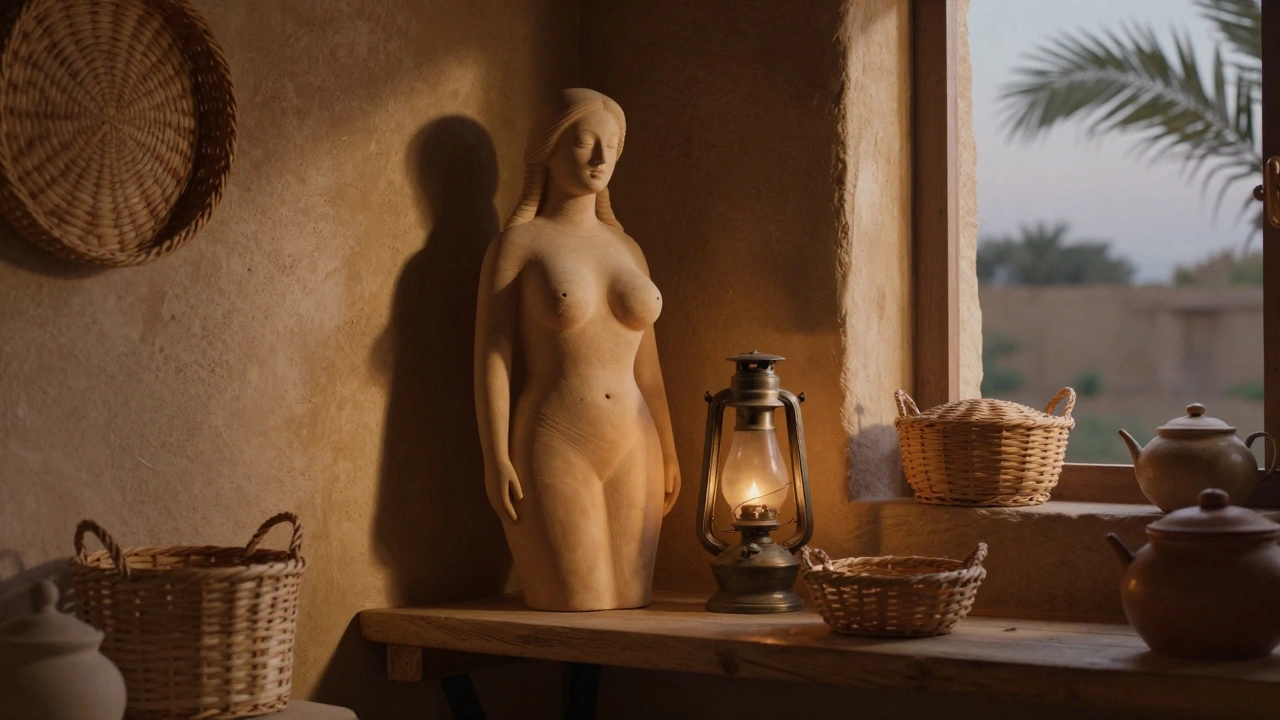
Asherah wasn’t just some minor deity. In the Canaanite world, she was Athirat-the mother of the gods, consort of El, the Creator of Creatures. She was called "Lady Asherah of the Sea" and "Progenitress of the Gods." When Israelite tribes settled in the highlands of Canaan, they didn’t start from scratch. They brought their gods with them. And Asherah came too.She wasn’t just a symbol of fertility. She was the source of it. Women prayed to her for children. Farmers asked her for good harvests. She was tied to trees-especially the date palm-because life flowed from roots, branches, and sap. In figurines found across Judah, she’s shown as a nude woman with exaggerated breasts, hands pressed to her chest like she’s offering milk. These aren’t just art. They’re ritual objects. Over 1,000 of them have been dug up. Most were found in homes, not temples. This wasn’t elite religion. It was everyday life.
Yahweh and His Asherah
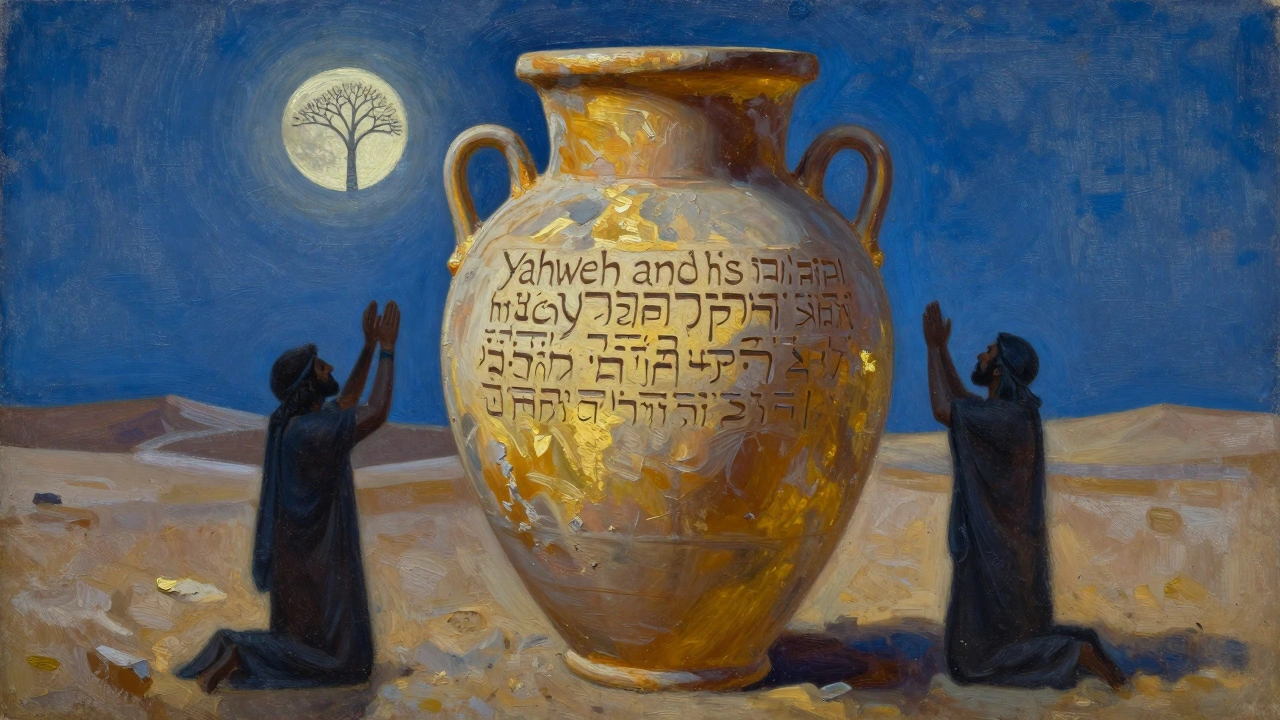
The Bible calls Asherah an idol. But what if it’s the other way around? What if the Bible is trying to erase something that was once normal?In 1975, archaeologists uncovered pottery jars at Kuntillet ‘Ajrud, a remote desert site in northern Sinai. On them were inscriptions in ancient Hebrew. One read: "I have blessed you by Yahweh of Samaria and his Asherah." Another said: "I have blessed you by Yahweh of Teman and his Asherah." This wasn’t a typo. It wasn’t a mistake. It was worship. Two decades later, another inscription appeared on a tomb wall at Khirbet el-Qom: "Yahweh and his Asherah."
These aren’t fringe finds. They’re from the 8th and 9th centuries BCE-the height of the Israelite monarchy. They prove that for hundreds of years, people didn’t see Yahweh as alone. He had a divine partner. Asherah wasn’t an afterthought. She was part of the structure. Think of it like a royal court: Yahweh was the king. Asherah was the queen. Together, they ruled over life, fertility, and the land.
The Pillar Figurines: Women’s Religion
The Judean Pillar Figurines are the clearest evidence of Asherah’s role in daily life. Made of clay, about 10-15 centimeters tall, they’re stylized female forms with no face, but huge breasts and sometimes a round belly. Scholars like Raz Kletter argue they represent Asherah as a lactating mother, pouring out life-giving milk. Some even have tiny holes where oil or incense might have been poured.Where were they found? In kitchens. In bedrooms. In the corners of homes. Not in the Temple in Jerusalem. That’s key. This wasn’t state religion. This was women’s religion. While men went to the Temple to offer sacrifices, women stayed home and prayed to Asherah for safe childbirth, healthy babies, and abundance. In a society where a woman’s worth was tied to her ability to bear children, Asherah was their only direct link to the divine.
And yet, the Bible never calls these figurines "Asherah." It calls them "the asherah"-lowercase, as if it’s an object, not a person. That’s the erasure beginning. The text tries to reduce a goddess to a wooden pole.
The Suppression: From Consensus to Condemnation
By the 7th century BCE, things changed. King Josiah launched a religious revolution. He tore down altars. He smashed idols. He burned Asherah poles and ground them to dust. He ordered the removal of the Asherah from the Temple of Yahweh itself-"and he took the Asherah pole from the temple of the Lord to the Kidron Valley outside Jerusalem and burned it" (2 Kings 23:6).This wasn’t random. It was systematic. King Asa had started it in the 9th century. King Jehu had continued it. But Josiah made it total. He didn’t just remove statues. He rewrote history. The Deuteronomistic History-the books from Deuteronomy through 2 Kings-was likely compiled during his reign. And in it, Asherah is never a goddess. She’s a sin. A corruption. A threat to the one true God.
Why? Because power was shifting. The Temple in Jerusalem was becoming the center of religious authority. Local shrines, family altars, women’s rituals-all of it was being centralized and controlled. Asherah worship was decentralized. It didn’t need priests. It didn’t need sacrifices. It happened in kitchens. That made it dangerous to a state religion trying to consolidate power.
It wasn’t just theology. It was politics. As Niels Peter Lemche points out, the crackdown wasn’t just about purity-it was about control. And who lost the most? Women.
What Happened to Asherah’s Power?
She didn’t disappear. She was absorbed.After Asherah was erased from the official record, her traits didn’t vanish. They got folded into Yahweh. The God of Israel started being described with feminine language: "As a mother comforts her child, so I will comfort you" (Isaiah 66:13). Yahweh became the one who gives life, who nurtures, who protects like a mother. The divine feminine didn’t die-it was rewritten as masculine.
Even the sacred tree, once linked to Asherah, became the Tree of Life in Genesis-now connected to Yahweh alone. The same symbols, the same power, the same meaning. But now, no woman could look up and say, "That’s her. That’s my goddess."
Some scholars, like Carol Meyers, argue this wasn’t just theological-it was gendered. Removing Asherah meant removing a visible, powerful female image of the divine. For women, it was a spiritual loss. They no longer had a god who looked like them, who understood their bodies, their fears, their hopes.
The Forgotten Evidence
New discoveries keep coming. In 2021, a shrine was found at Tel Rehov with Asherah-related artifacts dating to 900-800 BCE-far from Jerusalem, proving her worship wasn’t limited to the capital. In 2019, Susan Ackerman identified 27 new inscriptions mentioning Asherah in domestic settings. These weren’t temple texts. They were notes left by ordinary people.And the suppression wasn’t complete. After the Babylonians destroyed Jerusalem in 586 BCE, Asherah-related artifacts vanish from the archaeological record. But that doesn’t mean the worship ended. It went underground. Folk traditions persisted. Even Talmudic texts, written centuries later, refer to Asherah poles as having healing powers. People still remembered. They still needed her.
Why Asherah Matters Today
Asherah isn’t just ancient history. She’s a mirror.In 2020, a Pew Research survey found that 68% of progressive Jewish communities and 45% of mainline Protestant churches now use Asherah imagery in worship. Feminist theologians like Carol Christ have turned her into a symbol of reclaiming the sacred feminine. Her story is used in ecofeminist movements to challenge the idea that nature and the female body are something to be controlled.
Every year, the Asherah Conference at Harvard draws over 200 scholars from 30 countries. At Kuntillet ‘Ajrud, 15,000 visitors now trek to the desert each year-not to study ruins, but to stand where a woman once whispered a prayer to a goddess who was told she didn’t exist.
Asherah’s erasure wasn’t just about religion. It was about who gets to speak for the divine. It was about silencing women’s spiritual voices. And today, her return isn’t about bringing back idols. It’s about asking: What other voices were silenced? What parts of ourselves were told to hide?
She wasn’t just a goddess. She was a mother. A provider. A force of life. And for a long time, we were told she never was.
What’s Left of Asherah?
You won’t find her in most Bibles. But if you look closely, she’s still there-in the way the earth gives life, in the quiet prayers of mothers, in the tree that stands in a garden, in the way some still whisper to the divine not as a distant king, but as a nurturing presence.Asherah’s story isn’t over. It’s just beginning again.