Athenian Prostitution Cost Calculator
Calculate Ancient Wages
Enter a modern equivalent wage to see how it compares to Athenian sex worker rates.
Key Differences
Under Athenian law:
- Pornai: Worked in state-regulated brothels, charged 1 obol per visit (about 1/6 drachma), paid monthly tax, often enslaved
- Hetairai: Worked outside state system, charged up to 100 drachmae per night (3 months of skilled labor), free women with intellectual skills
There’s a common myth floating around online that ancient Athenians had detailed categories for sex workers-names like chamaitypa’i and perepatetikes-as if they were neatly labeled job titles in a 5th-century BCE HR handbook. But here’s the truth: those terms don’t exist in any ancient text, inscription, or scholarly source. They’re modern fabrications, likely born from mistranslations, confused Roman terms, or clickbait blogs trying to sound academic. If you want to understand how prostitution actually worked in Athens, you need to forget those fake names and focus on the two real categories everyone in the city knew: pornai and hetairai.
The Two Real Categories
Athenian society didn’t have dozens of subcategories for sex work. It had two. One was for the lowest-paid, most visible workers-the pornai. The other was for the elite, educated companions-the hetairai. Everything else-where they worked, how much they charged, who their clients were-fell under one of these two buckets.
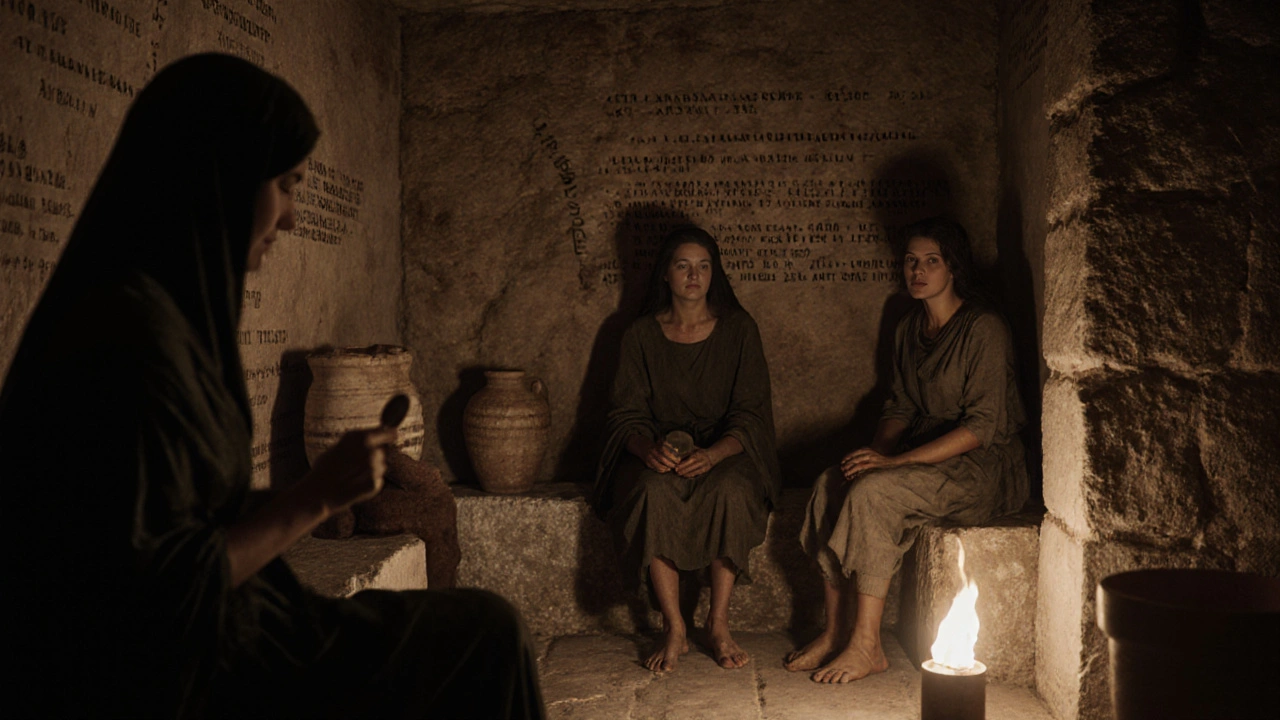
The pornai were the backbone of the system. Most were enslaved women, bought for as little as 50 drachmae (about 50 days’ wages for a skilled laborer). They worked in brothels, on street corners near the agora, in taverns, or even in small rooms built into city walls. The state regulated them tightly. Solon, the lawgiver, set up the first state-run brothels around 594 BCE, charging exactly one obol per visit-roughly 1/6 of a drachma. That price was fixed. No haggling. No exceptions. Archaeologists have found the remains of these brothels: tiny rooms, 3 meters by 2 meters, with stone benches. One inscription from the 4th century BCE shows a single brothel serving 300-400 men a day. That’s a lot of people, every single day.
These women had no rights. They couldn’t own property. Their children couldn’t become citizens. If they were metics (foreign residents), they paid a monthly tax of one obol to the city. If they were slaves, they were property. One woman named Nannion, mentioned in a court case, said she was sold by her mother to a procuress for 30 drachmae and forced to sleep with 20 men a day. That’s not a job. That’s slavery with a price tag.
The Hetairai: More Than Just Courtesans
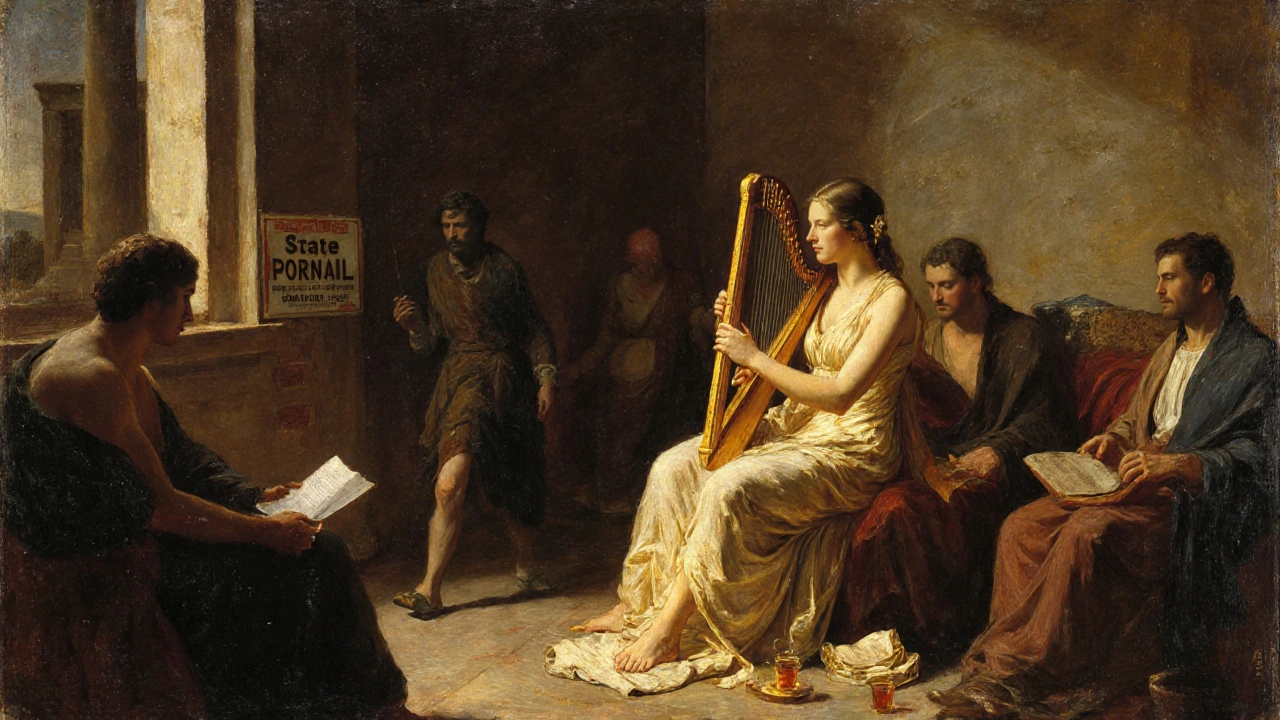
If the pornai were the visible, regulated underclass, the hetairai were the invisible elite. They weren’t slaves. Most were free women-often foreigners or former slaves who had earned their freedom. They didn’t work in brothels. They didn’t stand on street corners. They were invited to symposia, the all-male drinking parties where politics, philosophy, and poetry were discussed. A hetaira didn’t just provide sex. She provided conversation, music, dance, and intellectual companionship.
Training for a hetaira took years. She had to learn to play the lyre, recite poetry, debate philosophy, and navigate the complex social codes of elite men. Some, like Aspasia-Pericles’ partner-were so well-known they became central figures in Athenian intellectual life. Plato wrote about her in the Symposium. She wasn’t just a companion; she was a teacher. And she wasn’t cheap. While a pornai earned one obol, a top hetaira could charge a mina (100 drachmae) per night. That’s the same as a skilled laborer’s salary for three months.
But here’s the twist: even though they were wealthy and respected by some men, hetairai still had no legal rights. They couldn’t marry Athenian citizens. Their children were still barred from citizenship. And if they were accused of deceiving a man-like pretending to be a free woman when they were formerly enslaved-they could be prosecuted. The famous trial of Neaera, a woman who lived as a hetaira but was later revealed to have been a former slave, shows how easily the line between the two categories could blur in the eyes of the law. The prosecution didn’t care if she was educated or charming. They only cared that she had deceived a citizen.
How the System Worked
The Athenian state didn’t ban prostitution. It controlled it. Why? Because it made money. The brothels paid taxes. The pornai paid monthly fees. The state even collected a cut from the fees charged by musicians and dancers at symposia-something Aristotle mentions in his Constitution of the Athenians. The city didn’t care about morality. It cared about revenue and order.
There was no legal distinction between a pornai working on the street and one working in a brothel. Both were taxed the same. Both were subject to the same rules. The difference was in who hired them and how much they earned. A pornai at a tavern might charge two or three obols if the client was rich and the location was more private. But that wasn’t a new category-it was just market variation. No official title. No legal change.
The hetairai, meanwhile, operated outside the state system. They didn’t pay taxes. They didn’t register. They didn’t need to. Their value came from their connections, not their registration. A powerful man like Pericles could protect Aspasia from prosecution. A poor woman with no patrons could be thrown out of the city for being too visible.
Myths vs. Reality
The terms chamaitypa’i and perepatetikes sound Greek. They even look like Greek. But they’re not. There’s no record of them in any surviving Athenian text. The word chamaipolai (χαμαιπόλαι) appears in one fragmentary source, but it meant “low-city women”-a vague insult, not a legal category. Perepatetikes comes from peripatetikos, meaning “one who walks around.” It was used to describe Aristotle’s followers, not streetwalkers. The Romans later used terms like ambulatarae for streetwalkers, but that was centuries after Athens had fallen. Applying Roman labels to Athenian society is like calling a medieval knight a samurai.
Modern scholars like Thomas McGinn and Konstantinos Kapparis have spent decades studying Athenian prostitution. They’ve combed through court records, inscriptions, papyri, and vase paintings. Not one of them has found evidence of any category beyond pornai and hetairai. The idea of multiple subcategories is a 21st-century invention. It’s tempting to imagine ancient societies as having complex, modern-style classifications. But Athens didn’t work that way. It was brutal, pragmatic, and deeply unequal.

Life After Work
What happened to these women after their working years? Most of the pornai had no future. If they were slaves, they were sold again or abandoned. If they were free, they often became beggars or turned to other forms of survival. Archaeologists have studied skeletons from the Kerameikos cemetery and found that women buried with signs of prostitution had 47% more pelvic trauma than other women. That’s not just from sex. That’s from violence.
Some hetairai managed to build better lives. A few married wealthy foreigners. A few even owned property. But none of them became Athenian citizens. Citizenship was the one thing the city guarded fiercely-and prostitution, no matter how refined, was a barrier no woman could cross.
Why This Matters Today
Understanding the real structure of Athenian prostitution isn’t about gossip from antiquity. It’s about seeing how societies use legal systems to control the most vulnerable. The state didn’t protect the pornai. It profited from them. The elite didn’t respect the hetairai. They used them-until they didn’t need them anymore.
Today, when we talk about sex work, we still argue over whether it’s a job, a crime, or a form of exploitation. The Athenians didn’t waste time on that debate. They had a simple system: if you were poor, you were controlled. If you were useful to the powerful, you were tolerated. The labels didn’t matter. The power did.
So next time you hear someone mention chamaitypa’i or perepatetikes, you’ll know the truth: those names are ghosts. The real ghosts are the thousands of women whose names we never learned, whose voices were never recorded, and whose lives were reduced to one obol.
Were there different types of prostitutes in ancient Athens?
Yes, but only two official categories: pornai and hetairai. Pornai were low-paid, often enslaved sex workers regulated by the state. Hetairai were educated, free companions who worked at elite gatherings. No other categories like "chamaitypa'i" or "perepatetikes" existed in ancient sources.
How much did a prostitute charge in ancient Athens?
A pornai charged one obol per session-about 1/6 of a drachma-set by law in Solon’s brothels. Higher prices were sometimes charged in taverns or private settings, up to three obols. A top hetaira could charge up to 100 drachmae per night-equivalent to a skilled worker’s salary for three months.
Were Athenian prostitutes free women?
Most pornai were enslaved. About 85% of them were property, bought and sold like livestock. Hetairai were usually free women-often former slaves or foreigners-but they still had no citizen rights. Athenian-born women were legally forbidden from becoming prostitutes.
Did the Athenian government regulate prostitution?
Yes. The state established brothels, set fixed prices, and taxed all registered prostitutes. They collected one obol per month from each woman. Hetairai were not taxed because they operated outside the system. The state cared more about revenue than morality.
What was the difference between a hetaira and a wife in Athens?
A wife was expected to manage the household and bear legitimate children. She had no public role and rarely left the home. A hetaira was a public companion-educated, socially mobile, and sexually available-but she could never become a citizen’s legal wife. Her role was pleasure and conversation; a wife’s was reproduction and domestic control.