Cosmic Balance Simulator
Adjust the sliders to see how the interaction between active (Yang/Masculine) and receptive (Yin/Feminine) forces affects the world. Based on the article's premise that "stagnation is death" and "balance is life."
Crops
...
Water/Nile
...
Social Order
...
Cosmic Energy
...
When you look at the oldest stories humans tell about where we came from, a pattern jumps out. It’s not just about gods making stuff; it’s about tension. Specifically, it’s about how two opposite forces-often coded as male and female, or active and passive-have to collide to create life. This isn’t just a literary device. For ancient Chinese and Egyptian thinkers, this balance was the literal mechanism of reality. If one side won, the world died. If they balanced, crops grew and rivers flowed.
We often think of these cultures as distinct, separated by oceans and millennia. But when you strip away the specific names of deities, you find that both civilizations relied on a similar structural logic for fertility symbolism. They viewed creation not as a one-time event, but as a constant negotiation between complementary opposites. Understanding this helps us see why certain rituals, art styles, and social structures persisted for thousands of years in both regions.
The Core Mechanism: Collision vs. Union
To understand the gendered dynamics, you first have to define what "gender" meant in these contexts. It wasn't necessarily about biological sex in the modern sense. It was about energy states. In Chinese thought, this is encapsulated in the concept of Yin and Yang, which are complementary dualistic forces that interact to form all phenomena. Yin is often associated with the feminine, the dark, the receptive, and the earth. Yang is masculine, bright, active, and heavenly. Neither is good or bad; they are necessary halves of a whole.
In Egypt, the terminology was different, but the function was identical. The primary creative force was often personified through deities like Atum-Ra, who is the primordial sun god who created the universe through his own body and will. However, Atum’s power required an outlet. He didn't just think things into existence; he emitted them. This act of emission is inherently generative. The key here is that Egyptian creation myths frequently involve self-fertilization or the union of divine pairs (like Osiris and Isis) to restart the cycle of life after death.
So, while China focused on the *balance* of static energies (Yin/Yang), Egypt focused on the *action* of dynamic unions (Deification/Marriage). Both systems agree on one thing: stagnation is death. Movement and interaction are life.
Chinese Cosmology: The Void and the Egg
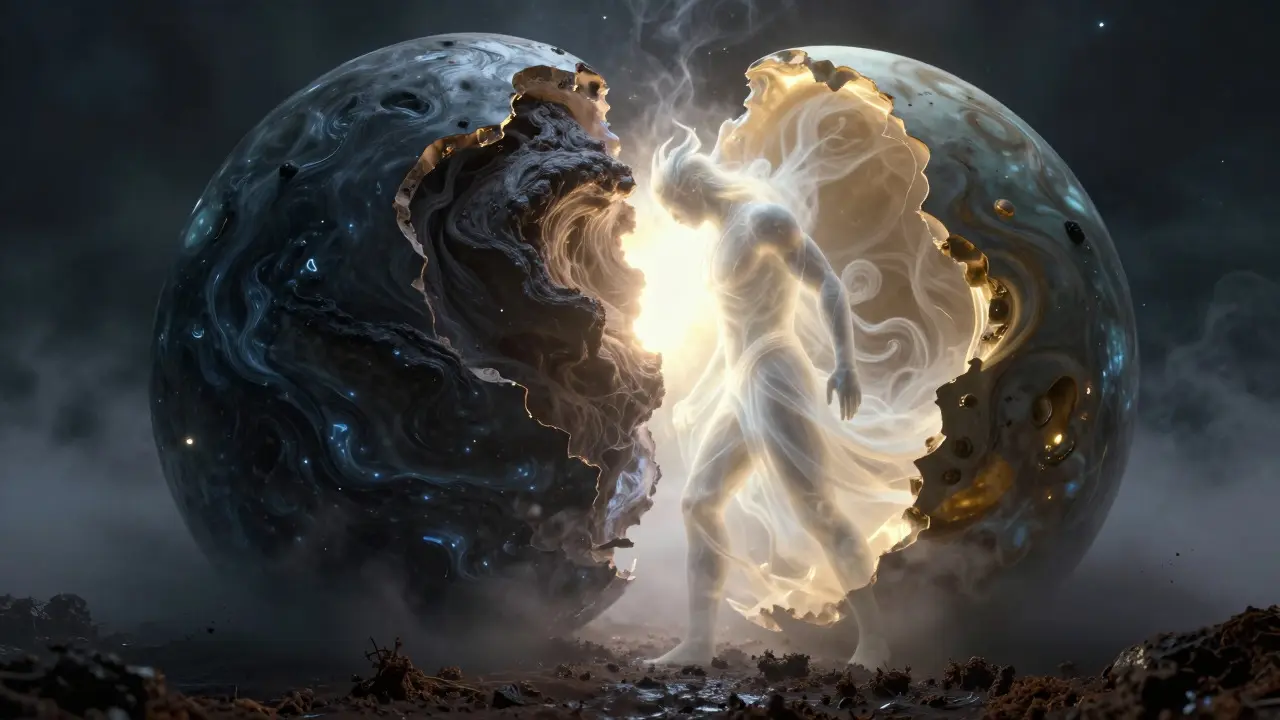
Let’s start with the classic Chinese creation myth involving Pangu, who is the primordial being who separated heaven and earth from the cosmic egg. Before Pangu, there was only a chaotic void, often described as a giant egg. Inside this egg, darkness (Yin) and light (Yang) were swirling together. When Pangu split them apart, he held up the sky with his head and pressed down the earth with his feet. His body then transformed into the landscape: his blood became rivers, his breath became wind, and his sweat became rain.
Notice the gendered coding here. The separation of Heaven (Yang/Male/Sky) and Earth (Yin/Female/Ground) is the foundational act of fertility. Without the space between them, nothing could grow. The Earth provides the substance (the soil, the water), while the Heaven provides the energy (the sun, the stars). This is why later Chinese agricultural rituals always involved offerings to both the Jade Emperor (Heaven) and the Dragon King (Earth/Water).
This duality extends to human society. Confucian philosophy, which emerged centuries later, reinforced this by assigning roles based on these cosmic principles. Men were expected to be active (Yang), public, and rational. Women were expected to be receptive (Yin), private, and nurturing. While this sounds restrictive today, in the context of the myth, it was seen as a functional necessity for social stability. Just as the earth needs the sun to grow crops, the household needed both roles to function. The failure of fertility, therefore, was often interpreted as a failure of balance between these two spheres.
Egyptian Cosmology: The Primordial Waters and Divine Birth
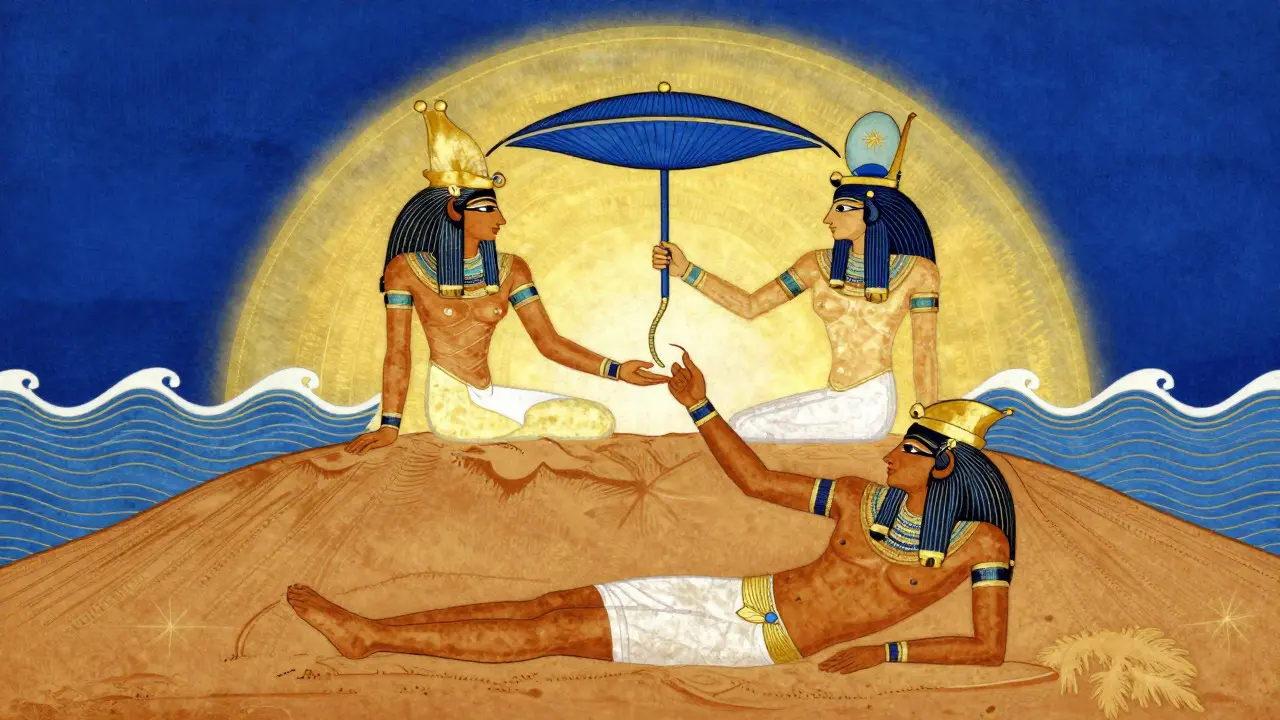
Across the globe, the Egyptians had their own version of the cosmic egg, but theirs started with water. The Nile was the lifeline of Egypt, so it makes sense that their creation myth began with Nun, who represents the primeval waters that existed before the beginning of time. From Nun, a mound of land rose-the Benchet. On this mound, the sun god Atum appeared. But Atum was lonely. To create, he needed another part of himself.
In some versions, Atum sneezed or spat out Shu (Air) and Tefnut (Moisture). In others, he masturbated to create them. Regardless of the method, the result was the same: differentiation. Shu and Tefnut then mated to produce Geb (Earth) and Nut (Sky). Geb and Nut eventually produced Osiris, Isis, Set, and Nephthys. This family drama isn't just gossip; it's a map of how the universe works.
Here, the gendered forces are explicit in the pairings. Nut (Sky) arches over Geb (Earth). They are physically separated by Shu (Air), who holds them apart. This mirrors the Chinese separation of Heaven and Earth almost perfectly. The fertility of the land depended on this gap. If Nut fell onto Geb, the world would collapse. If they were too far apart, no children (crops/people) could be born. The annual flooding of the Nile was seen as the sexual union of Osiris (resurrected) and Isis, ensuring the soil remained fertile. If the flood didn't come right, it was believed the gods' marriage was disrupted.

Comparing the Symbolic Logic
It’s tempting to say these myths are "similar." But there are critical differences in how they handle the *agency* of the feminine force. In the Chinese model, Yin (Earth/Feminine) is often portrayed as the container. It receives the Yang energy. The creativity comes from the interaction, but the *initiative* usually lies with the Yang principle. Pangu acts; the void reacts. The Sun shines; the Earth grows.
In the Egyptian model, the feminine force is more active in the reproductive cycle. Isis is a magician, a healer, and a mother who actively resurrects her husband. She doesn't just wait for Osiris to return; she hunts him down, reassembles his body, and conceives Horus. This reflects the Egyptian emphasis on magic (Heka) as a tool for maintaining order (Ma'at). The feminine aspect of fertility is not just passive reception; it is active preservation and regeneration.
| Aspect | Chinese Tradition | Egyptian Tradition |
|---|---|---|
| Primary Duality | Yin (Feminine/Earth) vs. Yang (Masculine/Heaven) | Nut (Sky) vs. Geb (Earth); Osiris vs. Isis |
| Mechanism of Creation | Separation of opposing energies; transformation of body parts | Divine birth; resurrection; union of pairs |
| Role of Feminine Force | Receptive, sustaining, foundational (Container) | Active, regenerative, magical (Agent of Resurrection) |
| Fertility Trigger | Harmonious balance of Yin and Yang | Annual ritual union of Osiris and Isis (Nile Flood) |
| Consequence of Imbalance | Cosmic chaos; natural disasters | Chaos (Isfet); crop failure; social disorder |
Why Balance Matters: The Practical Implications
You might wonder why these abstract myths mattered to farmers in 3000 BCE. Well, they weren't just stories; they were operational manuals. In China, the calendar was based on the precise alignment of Yin and Yang. The Winter Solstice (maximum Yin) marked the point where Yang begins to rise again. Farmers knew exactly when to plant because they were tracking the cosmic gender balance. If you planted during a phase of excessive Yin, your crops would rot. If you harvested during excessive Yang, they would dry out prematurely.
In Egypt, the priesthood of Amun and Ptah managed the temples that regulated the distribution of resources. The temple wasn't just a house for the god; it was the engine of the economy. The "wedding