Public Health Impact Calculator: Condom Distribution
Based on the article's data, it takes approximately 1,300 condoms to avert one infection, with an average unit cost of $0.18. Use this tool to estimate the impact of a distribution campaign.
The real turning point for condoms began with the law. For years, contraceptive access was a legal minefield, but the 1918 Crane ruling changed the game. The Crane ruling is a landmark 1918 legal decision that legalized doctor-prescribed contraceptives specifically for the prevention of disease . This didn't just help people avoid unplanned pregnancies; it gave the industry a layer of respectability. Suddenly, condoms weren't just something bought in a dark alley; they were medical tools. This shift in legitimacy triggered a production boom. By 1931, the top 15 U.S. manufacturers were churning out 1.44 million condoms every single day. It's a classic example of how removing a legal barrier can lead to an immediate explosion in public adoption.
When the Military Leads the Way
It might seem strange today, but some of the most effective "pro-condom" campaigns didn't start in clinics, but in army barracks. During World War I, the U.S. military was stubborn. They viewed giving out condoms as "an invitation to promiscuity," while European allies like the British and French were already handing them out to keep their soldiers healthy. The Americans stuck to their guns-until the infection rates became a crisis. When venereal diseases started knocking soldiers out of the fight, the military realized that operational readiness was more important than moral purity.
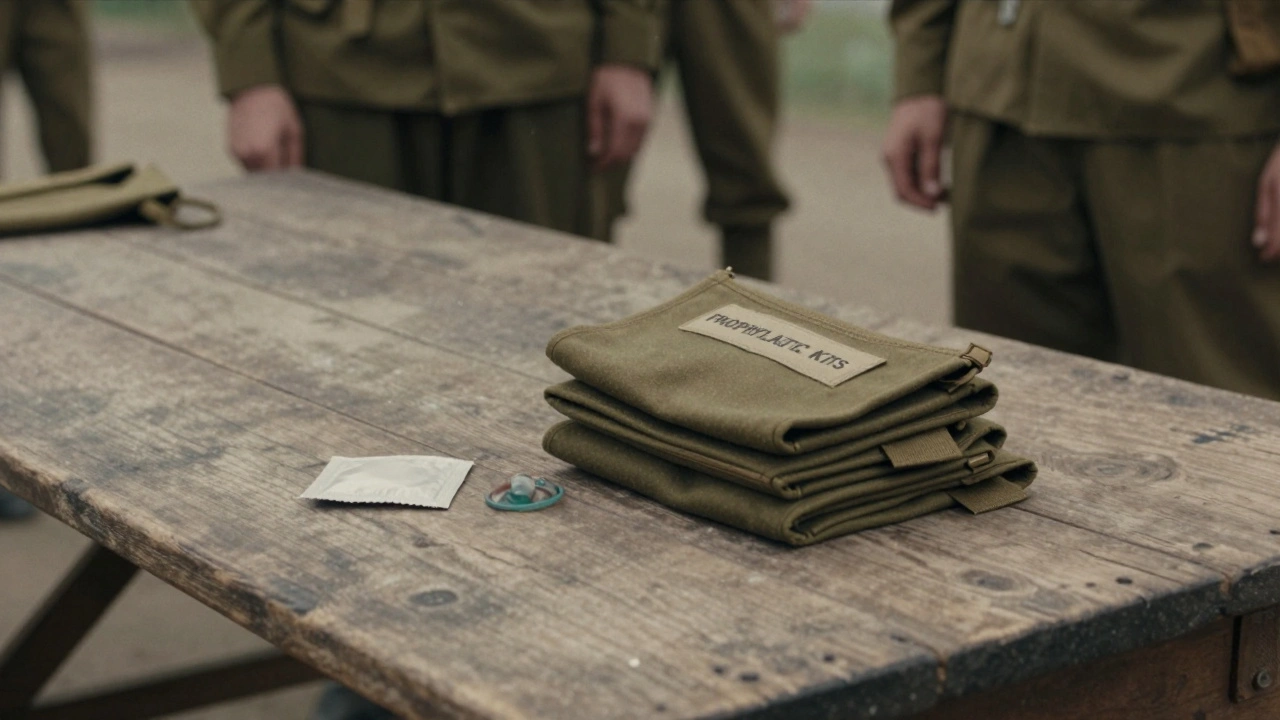
By 1927, the shift was official. Senior medical officers began distributing free condoms and running educational programs for the Army and Navy. By World War II, this had evolved into a full-scale system. The military used everything from posters and lectures to official training films. They even introduced Prophylactic Kits is specialized disease prevention packages, such as those made by Reese Chemical Company, containing condoms and chemical cleaners . They even set up "pro stations" where soldiers could grab three condoms for ten cents. When the military treats a health tool as a piece of standard equipment, it strips away the stigma faster than almost any other institution can.
Breaking Barriers in Civilian Care
While soldiers were getting protected, civilian activists were fighting a different battle. Margaret Sanger, a pioneer in birth control, pushed the boundaries of what was acceptable. In 1932, she tried to import diaphragms from Japan, only to have U.S. customs block the shipment. This sparked a legal fight that ended in a 1936 federal appeals court ruling. This decision established that the federal government couldn't stop doctors from providing contraception to their patients.
This legal victory paved the way for a massive network of care. By 1938, over 300 birth control clinics were operating across the U.S., providing free condoms and contraceptives to women who couldn't afford them. This was the first time a large-scale, government-supported infrastructure for condom access existed for the general public, proving that when the cost is removed and the location is accessible, people will seek out prevention.
| Era/Event | Primary Barrier | Key Driver of Change | Outcome |
|---|---|---|---|
| Early 1900s | Moral/Legal Taboo | 1918 Crane Ruling | Legalization via medical prescription |
| World Wars | Military Resistance | Disease Epidemics | Normalization via free distribution to troops |
| 1930s-40s | Customs/Law | Sanger's Legal Battles | Network of 300+ free clinics |
| 1970s-80s | Advertising Bans | Supreme Court (1977) | Direct public health messaging |
The 1980s and the HIV/AIDS Pivot
For decades, condoms were seen as a way to prevent pregnancy or "the clap," but the 1980s changed everything. The HIV/AIDS epidemic turned the condom from a contraceptive into a lifeline. This era introduced Social Marketing is a strategy that uses commercial marketing techniques to achieve public health goals by making products like condoms affordable and acceptable . Instead of lecturing people, health organizations started treating condoms like any other consumer product-making them available in vending machines, social venues, and through targeted branding.
By the early 2000s, cities like New York and San Francisco had normalized free condom distribution in nightclubs and bars. This wasn't just about altruism; it was about economics. Local health departments realized that giving away a condom for a few cents was infinitely cheaper than paying the medical bills for a patient with a lifelong chronic infection. The scale of this effort is staggering: between 1990 and 2019, roughly 160 billion condoms were consumed globally specifically for HIV prevention.

Why It Still Matters Today
Despite the rise of new technologies like PrEP (Pre-Exposure Prophylaxis), the condom remains the only tool that handles multiple threats at once. It's the only method that prevents both unintended pregnancy and the transmission of most STIs. Current global data shows about 16 billion condoms are used annually to fight infections. At an average cost of about $0.18 per unit, the cost-benefit ratio is insane-roughly 1,300 condoms distributed for every single infection averted.
The lessons from the last hundred years are clear. First, we learned that military institutions are great at normalizing health tools when the stakes are high. Second, we saw that legal autonomy for doctors is a prerequisite for public health. Third, we discovered that product innovation-like the round, individually wrapped packaging introduced by the company ONE in 2003-makes a difference in how people perceive and use a product. Most importantly, we've learned that when you stop judging the behavior and start protecting the person, the numbers improve.
Why was condom advertising illegal in the U.S. until 1977?
Many states had "comstock laws" or similar moral codes that classified contraceptives as obscene materials. This meant that promoting them publicly was seen as promoting "vice" or promiscuity. It took a 1977 Supreme Court decision to invalidate these laws, finally allowing public health campaigns to speak directly to the public without fear of prosecution.
How did the U.S. military influence condom use?
The military acted as a massive testing ground for normalization. By shifting from a moral stance (viewing condoms as an invitation to promiscuity) to a medical stance (viewing them as a way to keep troops fit for duty), the military integrated disease prevention into routine training, distributing free kits and creating a culture of proactive health management.
Were there any specific products that helped normalize condoms?
Yes, innovations in packaging and delivery were huge. From the "Doughboy" kits of WWII to the modern round-packaged condoms released by ONE in 2003, changing how the product looked and was distributed helped remove the "shame factor," making them feel more like a health accessory and less like a taboo item.
What is the cost-effectiveness of free condom programs?
Extremely high. Research indicates that the average cost per condom distributed is around $0.18. When compared to the massive healthcare costs associated with treating HIV or other lifelong infections, the cost of distribution is negligible. On average, it takes about 1,300 condoms to avert a single infection.
Do condoms still play a role in the "Fast-Track" initiative?
Absolutely. The Fast-Track initiative, which aims to end AIDS as a public health threat by 2030, still lists condoms as a primary tool. While medications like PrEP are powerful, condoms provide a broader shield against other STIs and pregnancy, making them indispensable to total disease elimination goals.