Medieval Sodomy Law Timeline
Explore how medieval European laws transformed same-sex intimacy from a moral failing into a capital offense. Click any event to see details about locations, punishments, and historical context.
First Capital Punishment Codified
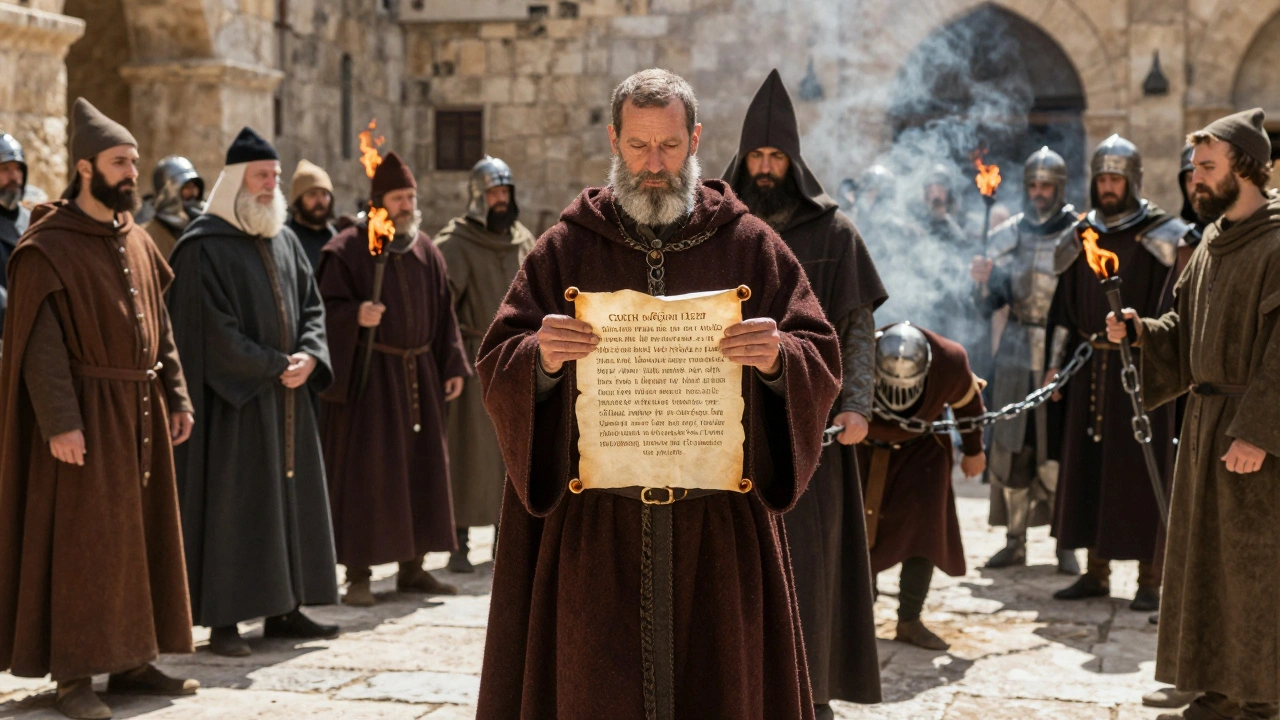
The Council of Nablus established Canon 5: "Whoever shall be proved to have defiled themselves willingly with sodomitical depravity, both the active and the passive partner shall be burned." First Western legal death penalty for same-sex acts.
This marked the shift from moral sin to capital crime
Legal Codification & Expansion
French legal texts like the Livres de jostice et de plet adopted burning penalties from Nablus. Philippe de Beaumanoir classified sodomy with murder and treason: "Whoever errs against the faith... or who commits sodomy, he must be burned and forfeit all his goods."
Law linked sodomy to heresy and treason, framing it as social threat
Specialized Enforcement
Exiled men caught in the act; added castration for men seducing boys (1325). Punishments depended on sexual role: performing oral sex was treated as if penetrated. First city to create specific enforcement mechanisms.
First evidence of systematic enforcement targeting specific sexual roles
Dedicated Law Enforcement
Established the Signori di Notte (Lords of the Night) - a specialized police unit. Recorded hundreds of cases with detailed testimonies and confessions. Punishments included fines, whipping, castration, and public shaming.
First professionalized enforcement of sodomy laws
Secular Criminalization
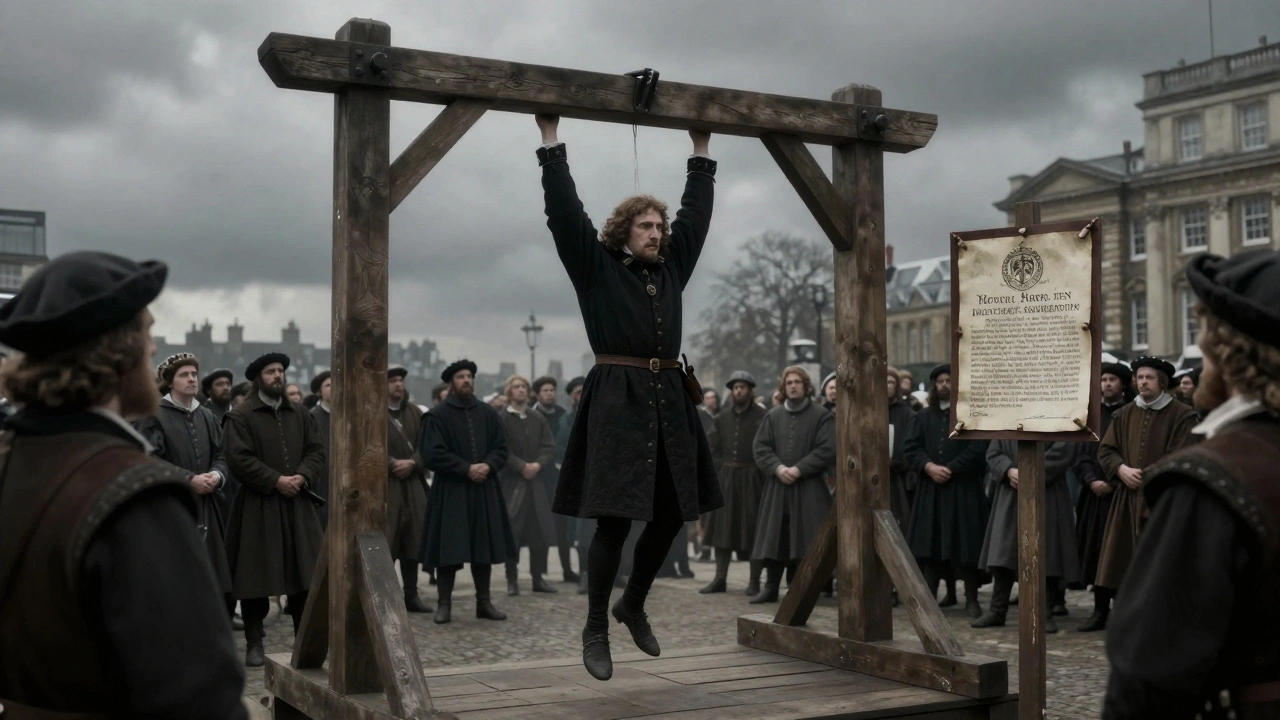
Henry VIII passed the Buggery Act - first secular law making sodomy capital offense. Punishment: Hanging. Based on Leviticus verse: "Thou shalt not lie with mankind, as with womankind: it is abomination."
Demonstrated political motivation - consolidating royal power after breaking from Rome
Reduced Punishment
Death penalty replaced with life imprisonment. This was still a criminal offense, but the most severe punishment was reduced. The law remained in effect until 2003.
First step toward modern decriminalization
Before the 12th century, same-sex intimacy wasn’t a crime in most of Europe. It wasn’t ignored - but it wasn’t punished with death, castration, or burning either. The Church might have frowned upon it, but it was treated like any other moral failing: a sin to be confessed, not a crime to be prosecuted. That changed. Between 1120 and 1533, something terrifying happened across Europe: sodomy went from a whispered taboo to a capital offense. And it wasn’t just one law. It was a wave - sweeping from the crusader kingdoms of the Levant to the streets of Florence, Venice, and London.
The Turning Point: Nablus, 1120
The first clear, brutal shift came not in Paris or Rome, but in the Latin Kingdom of Jerusalem. In 1120, a council of bishops and knights gathered in the city of Nablus. Their goal? To codify laws for the Christian settlers living in a land they’d conquered. Among their rulings was Canon 5 - a law that didn’t just punish adultery. It mandated emasculation and exile. But the real shock came with what they did to men who had sex with other men.
"Whoever shall be proved to have defiled themselves willingly with sodomitical depravity, both the active and the passive partner shall be burned." That’s not a metaphor. That’s a legal order. Burning. Not imprisonment. Not fines. Not exile. Fire. This was the first time in Western legal history that consensual same-sex sex between adults was punishable by death. And it wasn’t an isolated incident. Scholars still debate how often it was enforced, but the fact that it was written into law at all changed everything. Suddenly, sodomy wasn’t just a sin - it was treason against nature itself.
From East to West: How the Law Spread
The idea didn’t stay in the Holy Land. Within decades, it traveled back to Europe. In Orléans, French scribes writing the Livres de jostice et de plet in the 1200s copied the burning penalty from Nablus and mixed it with castration rules from other crimes. Around the same time, Philippe de Beaumanoir, a French judge compiling local customs, included sodomy in the same category as murder and treason. "Whoever errs against the faith... or who commits sodomy, he must be burned and forfeit all his goods."
This wasn’t just about sex. It was about purity. Order. Control. By linking sodomy to heresy and treason, the law made it a threat to the entire social fabric. If a man could violate the "natural order" of sex, what else might he break? The logic was terrifyingly simple: one immoral act meant a broken soul - and a broken society.
Florence, Venice, and the Rise of Special Courts
While France and England were writing laws, Italy was building institutions. In Florence, the city government didn’t wait for a royal decree. In 1284, they started exiling men caught in the act. By 1325, they’d added castration for men who seduced boys - and fines for the boys themselves. The punishment didn’t just depend on who did what. It depended on how they did it. If a man performed oral sex on another man, he was punished as if he’d been penetrated. The law didn’t just punish the act - it punished the role.
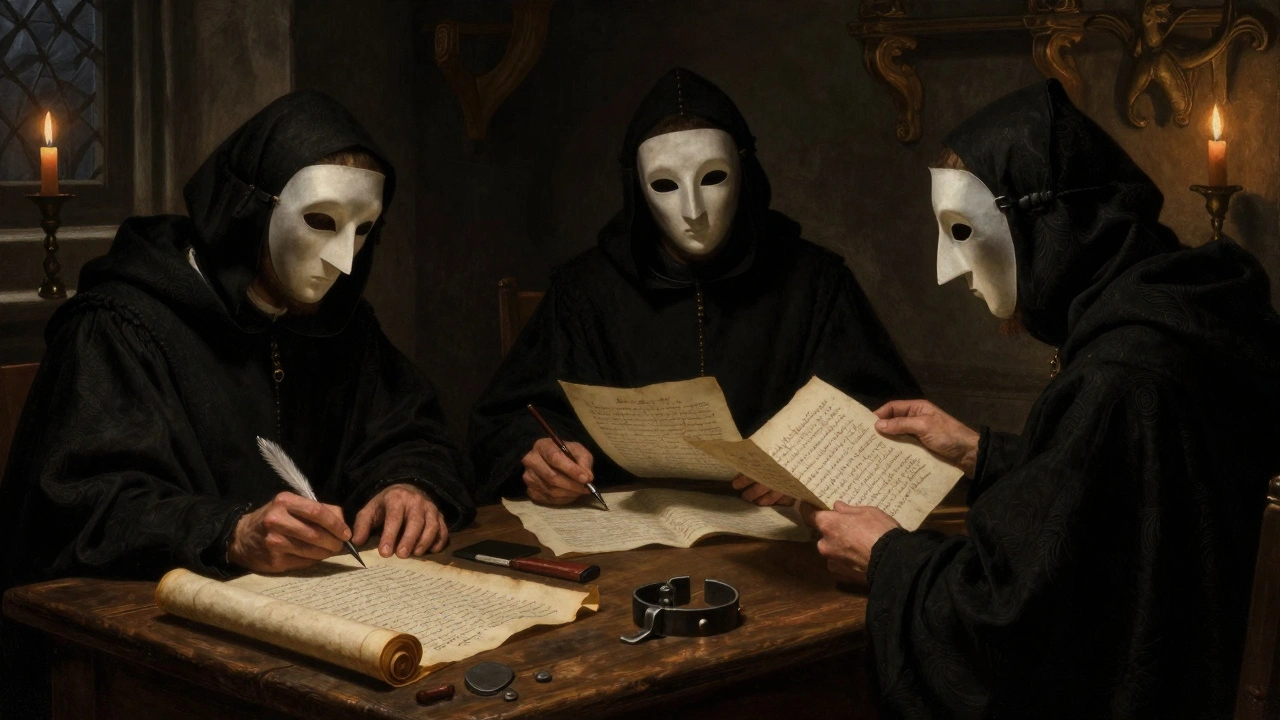
And then there was Venice. In 1348, the city created the Signori di Notte - the Lords of the Night. This wasn’t a moral patrol. It was a full-blown police unit dedicated to hunting down men accused of sodomy. Their court records still exist. Hundreds of cases. Names. Dates. Testimonies. Accusations. Confessions. This wasn’t sporadic panic. This was systematic. Professional. And it worked. Men were fined, whipped, castrated, or burned. Some were forced to wear signs. Others were banished. The city didn’t just want to stop the crime - it wanted to make an example.
England’s Buggery Act: When Religion Met Power
By 1533, England had its own version. Henry VIII, freshly broken from Rome, needed to prove he was more devout than the Pope. So he passed the Buggery Act - the first secular law in England to make sodomy a capital crime. It didn’t matter if the act was consensual. It didn’t matter if it was private. If two men were caught, they could be hanged. The law was based on a single verse from Leviticus: "Thou shalt not lie with mankind, as with womankind: it is abomination."
But this wasn’t about religion. It was about control. Henry was building a new state. He needed to show he could enforce morality better than the Church. And what better way than to make the most shocking sin a state crime? The death penalty wasn’t always used - records show fewer than 100 executions in 200 years. But the threat was real. It gave authorities a weapon. A way to silence rivals. To punish the unpopular. To scare the public into obedience.
The "Natural Law" Justification
Behind the laws were thinkers like Thomas Aquinas. He didn’t just say sodomy was wrong because the Bible said so. He argued it was wrong because it went against nature. Sex, he claimed, existed only for reproduction. Anything else - oral, anal, same-sex, even masturbation - was a perversion of the body’s "natural purpose." This wasn’t theology. It was philosophy. And it gave the laws a new kind of power. They weren’t just God’s rules anymore. They were science. Biology. Truth.
This idea stuck. For centuries, courts would cite "nature" to justify punishment. It didn’t matter that no one had ever studied human sexuality scientifically. It didn’t matter that animals engaged in same-sex behavior. The idea was simple: if it didn’t lead to a baby, it was unnatural. And unnatural meant criminal.
Who Got Punished? And Who Was Left Out?
Here’s the uncomfortable truth: sodomy laws didn’t just target gay men. They targeted anyone who broke the rules - even if they weren’t gay at all. In some places, a man who had sex with his wife in the wrong position - on his back, for example - could be accused of sodomy. Women were rarely prosecuted, but in parts of the southern Netherlands, women were charged with sodomy for having sex with other women. In Spain, having sex with a Muslim or Jewish person could be labeled as sodomy. It wasn’t about orientation. It was about control. About purity. About who belonged - and who didn’t.
And yet, the men most often punished? Often the wealthy. In Florence, records show that nobles, priests, and merchants were the ones caught. Not the poor. Not the anonymous. The powerful. Why? Because they had enemies. Because they were visible. Because their downfall served a purpose. A duke’s scandal could distract from a failed war. A bishop’s arrest could silence a rival. The law wasn’t blind. It was political.
The Legacy: From Medieval Fire to Modern Persecution
The laws didn’t vanish after the Middle Ages. They evolved. The British Empire carried the Buggery Act to India, Africa, and the Caribbean. In 1861, England reduced the penalty from death to life imprisonment - but it was still a crime. In 2003, the U.S. Supreme Court struck down sodomy laws. But in 2026, over 60 countries still criminalize same-sex relations - many with laws directly descended from these medieval codes.
What began in Nablus as a single burning sentence became a continent-wide machine of fear. It wasn’t about protecting morality. It was about power. About who gets to define sin. About who gets to decide who lives - and who dies.
Was sodomy always illegal in medieval Europe?
No. Before the 12th century, same-sex sexual acts were not systematically punished by secular law. The Church might condemn them as sins, but they were handled through confession, penance, or excommunication - not imprisonment or execution. The shift to criminalization began around 1120 with the Assembly at Nablus, which introduced death by burning as a legal penalty - the first of its kind in Western Europe.
Why did medieval courts punish sodomy so severely?
Sodomy was linked to heresy, treason, and moral corruption. By the 13th century, it was grouped alongside murder and arson in legal codes. Authorities believed it threatened the natural order, God’s will, and social stability. Punishing it with death sent a message: this wasn’t just private behavior - it was a public danger.
Did sodomy laws target only gay men?
No. While most prosecutions focused on men, the definition of sodomy was broad. In some places, it included oral sex between men and women, sex during menstruation, or even intercourse with non-Christians. Women were rarely prosecuted, but records from the southern Netherlands show cases against women who had sex with other women. The term was often used as a catch-all for any sexual act deemed "unnatural."
In medieval Spain, having sex with a Muslim or Jew could be labeled as sodomy - showing how the law blended religious bigotry with sexual control.
How were sodomy laws enforced?
Enforcement varied. In Venice, specialized courts called the Lords of the Night kept detailed records and conducted regular trials. In Florence, citizens were encouraged to report suspects. In England, accusations often came from rivals or enemies. Punishments included fines, exile, castration, and death. Many trials relied on confessions, sometimes extracted under torture. The threat of punishment was often more powerful than the actual executions.
Did the Church support these laws?
Initially, no. In the 11th century, even Peter Damian’s extreme call to punish clerical sodomy was rejected by the Pope. But as secular rulers began using sodomy laws to assert control, the Church gradually aligned with them. By the 13th century, Church doctrine - especially through thinkers like Aquinas - provided the philosophical foundation for these laws, arguing that sodomy violated "natural law." The Church didn’t create the laws, but it gave them moral authority.
Why did England pass the Buggery Act in 1533?
Henry VIII didn’t pass it because he was morally outraged. He passed it to consolidate power. After breaking from Rome, he needed to prove his new English Church was more righteous than the Catholic one. By taking control of sexual morality from the Church and turning it into a state crime, he demonstrated his authority over both religion and law. The Buggery Act was as much about politics as it was about sex.
Are any medieval sodomy laws still in effect today?
Not directly. But the legal logic behind them lives on. Over 60 countries still criminalize same-sex relations today, many of them former British colonies where the Buggery Act was imported. The idea that same-sex intimacy is a crime - not a personal choice - traces directly back to these medieval laws. The punishment changed, but the mindset didn’t.