Pompeii Art Context Identifier
In ancient Pompeii, sexual imagery wasn't just about desire—it was a language of power, luck, and business. Select an image type or location below to discover what that specific piece of art was actually communicating to the Romans.
Interpretation
AnalysisSelect options to see the cultural meaning.
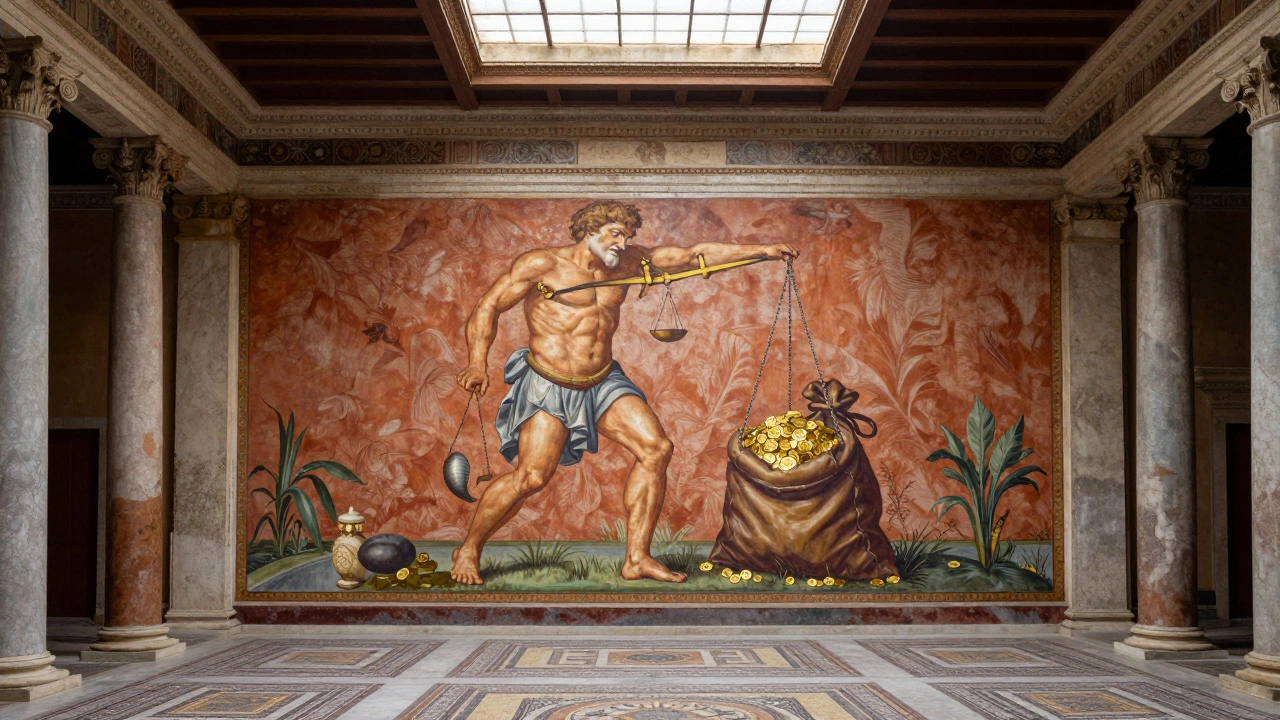
Imagine walking into a wealthy home 2,000 years ago and seeing a giant painting of a god weighing his own erection against a bag of gold coins. For us, that sounds like a joke or a scene from a wild movie, but for the residents of Pompeii, it was a standard way to show off their bank accounts. The Pompeii erotic art is a collection of frescoes, sculptures, and symbols that reveal how ancient Romans viewed sex, money, and status. Far from being hidden in secret basements, these images were woven into the very fabric of their city-from bakeries to bathhouses.
The Quick Take on Pompeian Sexuality
- Not just porn: Sexual imagery often represented fertility, prosperity, and social status.
- Public and Private: Explicit art appeared in brothels, private villas, and even public streets.
- The Phallus as a Shield: Phallic symbols were used as lucky charms to ward off evil (the "evil eye").
- Class Dynamics: Erotic art often highlighted the gap between the elite, freedmen, and enslaved people.
The Great Cover-Up: Why We Almost Forgot These Paintings
When archaeologists first started digging up Pompeii and Herculaneum in the 18th century, the people in charge were absolutely horrified. The Victorian-era morals of the time couldn't handle the openness of Roman sexuality. King Charles of Naples was so shocked by a statue of Pan-the goat-legged god-having sex with a goat that he literally locked the art in a cabinet. You needed written permission from the King just to look at it.
This systematic suppression lasted for nearly 200 years. Scholars basically tried to erase the sexual nature of the city to make it more "respectable." It wasn't until later that the restrictions loosened, and today, these works are viewed as vital historical documents rather than scandals. The volcanic ash from the 79 CE eruption of Mount Vesuvius acted as a time capsule, protecting these paintings from the kind of religious censorship that destroyed similar art in other parts of the empire.
Sex as a Status Symbol: The House of Vettii
If you want to see where sex and money meet, look at the House of Vettii. The owners weren't old-money aristocrats; they were freedmen-former slaves who had struck it rich in the agricultural trade. In Roman society, moving from slave to wealthy business owner was a huge deal, and they wanted everyone to know they had "made it."
They didn't just buy fancy furniture; they commissioned art that signaled power. The most famous example is the painting of Priapus, the god of fertility. He's shown weighing his massive phallus against a bag of coins. This wasn't meant to be "sexy" in the modern sense; it was a boast. It basically said, "My fertility and my wealth are both overflowing." It was a visual shorthand for success and social mobility.
The Lupanar and the Business of Pleasure
Of course, not all erotic art was about status-some of it was just a menu. The Lupanar, Pompeii's most famous brothel, is the prime example. This wasn't a luxury lounge; it was a gritty, functional space with small, dank rooms called cubicula.
The walls here were covered in explicit paintings of different sexual positions. Think of these as the ancient version of a service menu. By displaying specific acts on the walls above the stone beds, the establishment could communicate exactly what was available without needing a long conversation. It was practical, commercial, and stripped of the "high art" pretentions found in the villas.
Interestingly, this kind of business happened in other places too. In the House of Vettii, there was a room off the kitchen-hidden behind a heavy iron door-that served as quarters for enslaved people. Evidence suggests a small-scale brothel operated there, and inscriptions on the walls even advertised specific workers, like a Greek woman named Eutychis, whose services cost two copper coins.
Phalluses on the Pavement: Luck and Protection
One of the biggest shocks for early excavators was that phallic symbols weren't just in bedrooms or brothels. They were everywhere. You'd find them carved into the paving stones of the streets or mounted on the outside of bakeries. To a Roman, an erect phallus wasn't necessarily a sign of lust; it was a powerful amulet.
The Romans believed these symbols could ward off the "evil eye" and bring good luck to a business. A bakery with a phallic carving on its oven wasn't trying to be provocative; it was trying to ensure the bread rose and the business stayed profitable. This highlights a fundamental difference between our current view of sexuality and the Roman one: for them, the sexual organ was tied to the concept of fascinum-a protective magic.
| Location | Primary Purpose | Target Audience | Key Example |
|---|---|---|---|
| Private Villas | Status & Sophistication | Elite guests/peers | Priapus in House of Vettii |
| Brothels (Lupanar) | Commercial Advertising | Clients | Position frescoes in cubicula |
| Public Streets/Bakeries | Protection & Luck | General Public | Carved phalli on pavements |
| Public Baths | Entertainment/Leisure | Bathers | Suburban Baths murals |
Beyond the Bedroom: The Suburban Baths
While most Roman baths were places for hygiene and networking, the Suburban Baths are a bit of an anomaly. In the long entry hall leading to the dressing rooms, there is an unusual concentration of explicit sexual scenes. Unlike the Lupanar, which was clearly a place of business, the baths suggest a more leisure-oriented approach to eroticism.
These murals served as conversation starters and entertainment for people who were already in a state of undress and relaxation. It shows that sexuality was normalized across different environments. Whether you were at a banquet, at the baths, or just walking to buy bread, sexual imagery was a constant, unremarkable part of the visual landscape.
What This Tells Us About Ancient Life
The real value of these frescoes isn't the "shock factor." It's that they give us a glimpse into the lives of people who didn't write history books. Most of what we know about Rome comes from elite writers who had a very specific, often judgmental, view of sexuality. But the walls of Pompeii don't lie.
They show us the reality of social mobility-how a former slave could use art to claim a spot among the elite. They show us the cold reality of the sex trade and the precarious position of enslaved women. Most importantly, they prove that the "shame" we associate with sexuality is a relatively modern invention. In Pompeii, the body was a tool for luck, a symbol of wealth, and a straightforward commodity.
Were the erotic paintings in Pompeii considered pornography?
Not in the way we think of it today. While some served a commercial purpose (like in the Lupanar), many were tied to religion, fertility, and status. For example, the image of Priapus was more about wealth and abundance than sexual arousal. The concept of "pornography" as a forbidden or shameful category didn't exist in the same way in Roman culture.
Why are so many phallic symbols found in public spaces?
Phallic symbols were believed to be apotropaic, meaning they had the power to ward off evil spirits or bad luck. Placing them at the entrance of a bakery or on a street corner was intended to protect the business or the pedestrians from the "evil eye."
Who were the owners of the House of Vettii?
The House of Vettii was owned by two brothers who were freedmen (former slaves). They became wealthy through commerce in agricultural products. Their use of lavish and erotic art was a way to signal their newfound social status and success.
Where can you see these frescoes today?
Many are still in situ (in their original place) at the Archaeological Park of Pompeii, including the Lupanar and the House of Vettii. Others are housed in the National Archaeological Museum in Naples. Most sites now allow visitors over the age of 14 to view them.
Did all Romans have these paintings in their homes?
No. The prevalence of high-quality frescoes was generally linked to wealth. While phallic symbols were common across all classes, detailed and artistic erotic murals were typically found in wealthier villas or professional establishments like brothels.