Reproductive Strategy Simulator
Environmental Conditions
Adjust sliders to simulate habitat pressures
Evolutionary Outcome
How would this environment shape reproduction?
Results will appear here as you adjust environmental factors
Think about how life begins. For most animals, it starts with a simple moment: sperm meets egg. But where that meeting happens changes everything. External fertilization and internal fertilization aren’t just different methods-they’re two evolutionary paths shaped by water, land, and survival. One works in oceans. The other built humans.
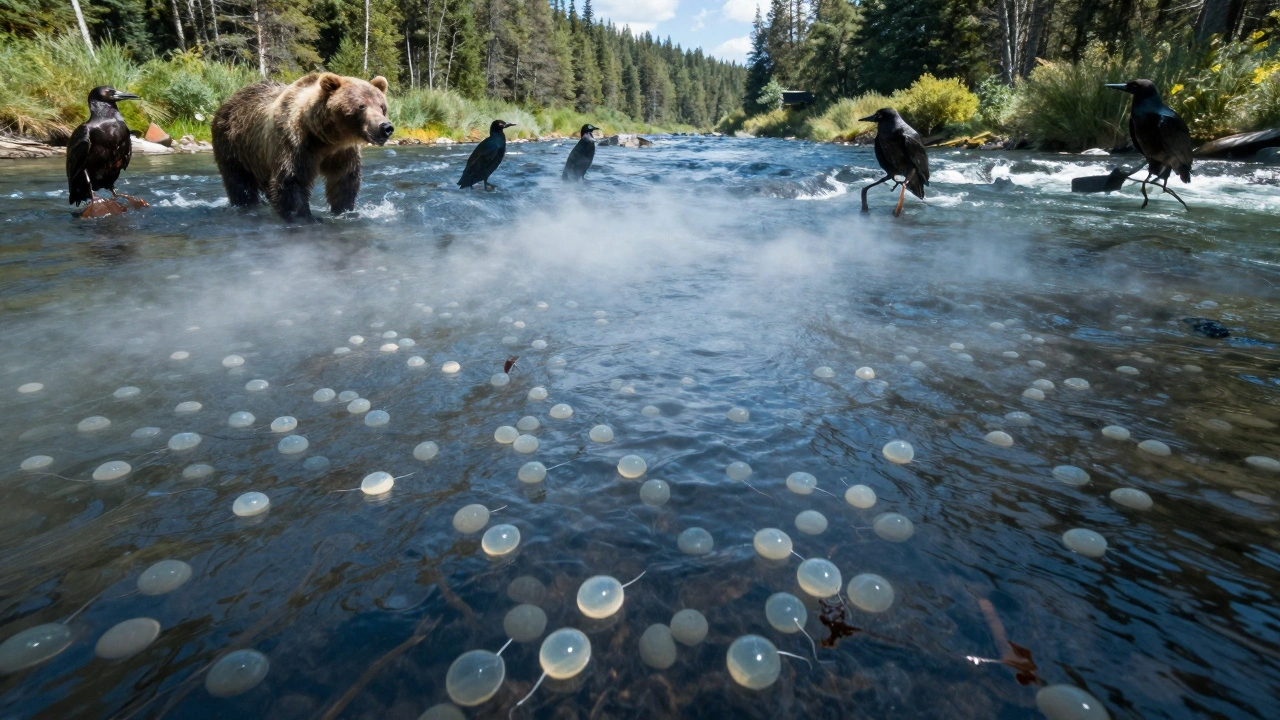
External fertilization is nature’s shotgun approach. Fish, frogs, and corals release thousands of eggs and sperm into the water. No courtship. No protection. Just a mass release during spawning season. The water carries the gametes together. It’s efficient in a way: a single female salmon can lay over 5,000 eggs. But the cost? Almost all of them die. Less than 1% survive to adulthood. Predators, currents, temperature shifts, pollution-it’s a lottery with terrible odds. Yet it works because the environment is forgiving. Water keeps eggs moist, buffers temperature, and carries sperm efficiently. No need for complex anatomy. Just quantity.
But when life moved onto land, that strategy collapsed. Dry air kills eggs. Sunlight dries out sperm. Temperature swings fry delicate cells. Land animals couldn’t afford to gamble with thousands of unprotected embryos. So evolution forced a change. Internal fertilization emerged as the solution. Sperm no longer floated in open water. They were delivered directly into the female’s body, often through copulation. The egg was fertilized inside, shielded from the outside world. This wasn’t just a small tweak-it was a complete overhaul of reproduction.
Inside the female body, the environment is controlled. Temperature stays steady. pH is balanced. Pathogens are kept out. Sperm don’t just swim randomly-they navigate a complex, viscous system. That’s why sperm in internally fertilizing species evolved differently. Studies show their sperm heads are 1.4 times longer, midpieces 18 times longer, and flagella 1.3 times longer than those of external fertilizers. Why? Because swimming through cervical mucus and uterine fluids is like swimming through syrup. Longer, more powerful sperm win the race to the egg. In frogs and salamanders that switched to internal fertilization, sperm evolved 27 times faster in head size and 139 times faster in midpiece length. Evolution didn’t just adapt-it accelerated.
And it’s not just about sperm. Internal fertilization changed how embryos grow. In external fertilization, the egg develops alone, relying on yolk. But internal fertilization opened the door to something far more powerful: viviparity. That’s when the young develop inside the mother, fed directly through a placenta. Humans, whales, and even some sharks use this method. The placenta doesn’t just deliver nutrients-it filters toxins, regulates hormones, and even shields the fetus from the mother’s immune system. This level of control is impossible in water. It’s why human babies are born with large brains. Nine months of protected growth inside the womb allowed neural complexity to explode. No other reproductive system does this.
There’s a hidden advantage too: selective fertilization. In external fertilization, any male’s sperm can reach the egg. But inside the female, only the strongest, fastest, most genetically fit sperm make it through. The female reproductive tract acts like a filter. Cervical mucus thickens or thins depending on fertility. Uterine contractions help guide sperm. Chemical signals attract or repel. This isn’t random. It’s a quality control system. Fewer offspring, yes-but each one has a better shot at survival. That’s why mammals, birds, and reptiles that use internal fertilization invest so heavily in parenting. One or two babies, raised with care, outperform thousands of abandoned eggs.
Now, here’s the twist: humans can fertilize eggs outside the body-through IVF. We take eggs from the ovary, mix them with sperm in a lab dish, and watch them form embryos. Sounds like external fertilization, right? But it’s not. The lab dish mimics the inside of a fallopian tube: precise temperature, nutrient-rich fluid, sterile conditions. Even then, the embryo must be placed back into the uterus. It can’t develop on its own. That’s the key. Human embryos need the womb. No artificial environment can replicate the hormonal signals, immune tolerance, or nutrient exchange of the placenta. IVF is a temporary workaround, not a replacement.
The shift from water to land didn’t just change how animals reproduce-it changed how they think, behave, and survive. Internal fertilization allowed for longer gestation, complex brains, social bonding, and extended parental care. These traits built human societies. Fish that spawn in rivers don’t raise their young. But mammals? We carry, nurse, teach, and protect. That’s not just biology. It’s evolution in action.
Even today, the environment decides the strategy. Coral reefs still rely on external fertilization because the ocean gives them what they need. But desert lizards? They use internal fertilization. No water? No chance. The same logic applies to humans. Our entire reproductive system-from sperm shape to placenta function-is fine-tuned for life on land. Try to replicate it outside the body? We can get close. But we can’t beat nature’s design.
Understanding this transition isn’t just about ancient history. It explains why fertility treatments work the way they do. Why some species thrive in changing climates while others vanish. Why human reproduction is so delicate-and why it’s worth protecting.
Why can’t external fertilization work on land?
External fertilization fails on land because eggs and sperm dry out without water. Eggs need moisture to survive, and sperm lose mobility in dry air. Temperature fluctuations and UV exposure also damage gametes. Water acts as a buffer-on land, there’s no natural protection. That’s why terrestrial animals evolved internal fertilization: to keep the process safe inside the body.
How does internal fertilization improve offspring survival?
Internal fertilization protects the embryo from predators, dehydration, and environmental stress. It allows for selective fertilization-only the healthiest sperm reach the egg. Combined with extended gestation and parental care, this leads to far higher survival rates. While external fertilizers produce thousands of eggs, only a handful survive. Internal fertilizers produce fewer, but most live to reproduce themselves.
Why do sperm in internal fertilizers have longer tails and midpieces?
The female reproductive tract is thick, viscous, and chemically complex. Sperm must swim through cervical mucus, uterine fluids, and fallopian tube contractions. Longer midpieces hold more energy-producing mitochondria. Longer flagella (tails) provide stronger propulsion. These adaptations evolved because navigating this environment demands more power and precision than swimming in open water.
Is IVF the same as external fertilization?
No. IVF mimics the internal environment using controlled lab conditions-temperature, pH, nutrients-but the embryo still can’t develop outside the uterus. It must be implanted to receive oxygen, nutrients, and hormonal support from the placenta. True external fertilization, like in fish, allows embryos to develop independently. Human embryos cannot survive this way.
Why did mammals evolve viviparity?
Viviparity evolved because it gave offspring a survival advantage. By keeping the embryo inside and feeding it directly through the placenta, mammals could protect it from predators, temperature swings, and disease. It also allowed for longer brain development, leading to complex behaviors and social structures. This strategy outweighed the cost of fewer offspring per pregnancy.
Can external fertilization evolve into internal fertilization?
Yes-multiple times in evolutionary history. Some amphibians, like certain salamanders and caecilians, transitioned from external to internal fertilization as they moved into drier habitats. This shift required changes in anatomy, behavior, and sperm structure. It’s not common, but it’s happened. Evolution doesn’t follow a set path-it responds to pressure.
What role did environmental pressure play in this transition?
Environmental pressure was the driving force. When animals left water, they faced dehydration, temperature extremes, and predation. External fertilization became too risky. Internal fertilization solved these problems by keeping gametes and embryos protected. It wasn’t a choice-it was a necessity. The transition wasn’t about intelligence or desire. It was about survival in a harsher world.