IVF History Timeline Explorer
Instructions: Use the slider or buttons to explore how different scientific discoveries built upon each other to make IVF possible.
Sperm Capacitation Discovered
Key Figures: Colin Austin & Min Chueh Chang
Scientists discovered that mammalian sperm need time to undergo physiological changes in the female tract before they can fertilize an egg. This explained why simply mixing sperm and eggs in a lab dish failed for decades.
First Mammalian IVF Births
Key Figure: Min Chueh Chang
Chang successfully simulated the female reproductive environment in a lab dish, keeping rabbit sperm alive for hours before introducing them to eggs. This resulted in the first robust mammalian IVF births, validating the capacitation theory.
Human Oocyte Maturation in Lab
Key Figure: Robert Edwards
Edwards proved that immature human eggs retrieved from ovaries could complete their maturation process outside the body within 24–36 hours. This In Vitro Maturation (IVM) breakthrough meant scientists didn't have to wait for natural ovulation.
Optimized Culture Media
Key Figure: Barry Bavister
Bavister developed a chemically defined medium with precise osmolarity (280–300 mOsm/kg), bicarbonate buffer, and pyruvate. Edwards adapted this for humans, creating the perfect chemical environment for embryos to survive and grow.
Laparoscopic Retrieval Refined
Key Figure: Patrick Steptoe
Steptoe pioneered minimally invasive laparoscopy, replacing dangerous open abdominal surgery. By inserting a needle through a small incision guided by visual inspection, he could safely retrieve 1–5 oocytes per procedure with minimal risk.
First Human Fertilization in Vitro
Key Figures: Edwards, Bavister, Steptoe
With all pieces in place, the team achieved the first convincing fertilization of human oocytes in vitro. They observed sperm penetration, extrusion of the second polar body, and formation of pronuclei—though success rates were still under 20%.
Birth of Louise Brown
Key Figures: Edwards & Steptoe
After approximately 457 attempted cycles and years of setbacks, Lesley Brown gave birth to Louise Joy Brown on July 25, 1978—the first successful live birth from IVF. This proved clinical viability and changed medicine forever.
Current Breakthrough Details
Sperm Capacitation Discovered (1951)
The Problem: For decades, scientists couldn't fertilize mammalian eggs in a lab dish, even though sea urchin eggs fertilized easily.
The Discovery: Colin Austin (UK) and Min Chueh Chang (USA) independently discovered that mammalian sperm aren't ready to fertilize immediately. They must undergo capacitation—a physiological change inside the female reproductive tract over several hours.
Impact: This revealed that timing was everything. Scientists had to mimic the biological timeline of the female body in the lab, not just mix gametes together.
Before July 25, 1978, if your fallopian tubes were completely blocked, natural pregnancy was effectively impossible. There was no magic bullet, no miracle drug. Then, at 23:47 that evening in Oldham, England, a baby girl named Louise Joy Brown was born. She weighed just under six pounds, but her arrival shook the world of medicine to its core. She was the first human being conceived outside the body.
We often look at modern fertility treatments as routine medical procedures. We see them on social media or hear about friends trying them. But getting from "impossible" to "routine" took more than just good intentions. It required a specific, messy, and brilliant decade of scientific detective work between the 1960s and 1970s. This wasn't just about mixing sperm and egg in a dish. It was about cracking the code of human oocyte biology-understanding exactly how an egg matures, when it is ready, and what it needs to survive outside the womb.
The Missing Link: Sperm Capacitation
You might think fertilization is simple: put sperm next to an egg, and boom, life begins. If you tried that in a lab in the 1950s, nothing would happen. For decades, scientists knew this. They could fertilize sea urchin eggs easily (Oscar Hertwig did it back in 1878), but mammalian eggs were stubborn. Why?
The answer lay in a process called capacitation. In 1951, two researchers working independently-Colin Austin in the UK and Min Chueh Chang in the USA-figured out the secret. Mammalian sperm aren't ready to fertilize an egg straight out of the male tract. They need time. They need to undergo a physiological change inside the female reproductive tract over several hours to become capable of penetrating the egg.
Chang proved this by simulating that environment in a lab dish. He kept rabbit sperm alive for a few hours before introducing them to eggs, resulting in the first robust mammalian IVF births in 1959. This was the first major pillar of IVF. You couldn't just mix gametes; you had to mimic the biological timeline of the female body. This insight was directly imported into human protocols later, proving that timing was everything.
Mastering the Egg: In Vitro Maturation
While Chang worked on sperm, another team in Cambridge, led by Robert Geoffrey Edwards, was obsessed with the egg. Specifically, he wanted to know if a human egg could complete its maturation process outside the body.
In the early 1960s, retrieving human eggs was brutal. There were no gentle needles or ultrasound guidance. Edwards obtained oocytes from small sections of ovaries removed during surgery for benign conditions like cysts. These eggs were often immature, stuck at the germinal vesicle stage. Most scientists believed they needed to be fully mature before removal. Edwards disagreed.
Between 1965 and 1968, Edwards and his colleagues systematically cultured these immature eggs. They discovered something crucial: if you collected eggs from follicles that were at least 5-6 mm in diameter, they could resume meiosis and reach the metaphase II stage (the fertile state) within 24 to 36 hours in a culture dish. This process is known today as In Vitro Maturation (IVM).
This was a massive deal. It meant you didn't have to wait for ovulation to happen naturally to get a usable egg. You could retrieve an immature egg and let it finish growing in the lab. However, Edwards noted that the success rates were low, and the sample sizes were tiny (fewer than 100 eggs). But it proved the concept: human eggs could mature outside the body.
The Chemical Bridge: Culture Media
Having a mature egg and capacitated sperm isn't enough. You need a home for them to meet and grow. In the 1960s, most lab media were crude mixes of blood serum and salts. They worked okay for some animals, but human embryos are picky.
Enter Barry Bavister. Working with hamster eggs in 1968-1969, Bavister developed a chemically defined medium. He realized that osmolarity (the concentration of solutes) mattered immensely. His formula included bicarbonate buffer, pyruvate for energy, and maintained an osmolarity of roughly 280-300 mOsm/kg. Under these conditions, hamster fertilization rates jumped to 50-70%.
Edwards saw this and adapted it for humans. He tweaked the ionic composition and added human serum protein. He set the temperature to exactly 37 °C and the atmosphere to 5% CO2 to maintain a pH of 7.4. This specific recipe became the standard "human IVF medium" for years. Without Bavister’s precise chemical adjustments, the embryos simply wouldn't have survived the journey from fertilization to implantation.
The Surgical Leap: Laparoscopy
All the biology in the world is useless if you can't get the egg out without harming the patient. Before the late 1960s, the only way to get an egg was via laparotomy-a major open abdominal surgery. No infertile woman would agree to that just to try for a baby.
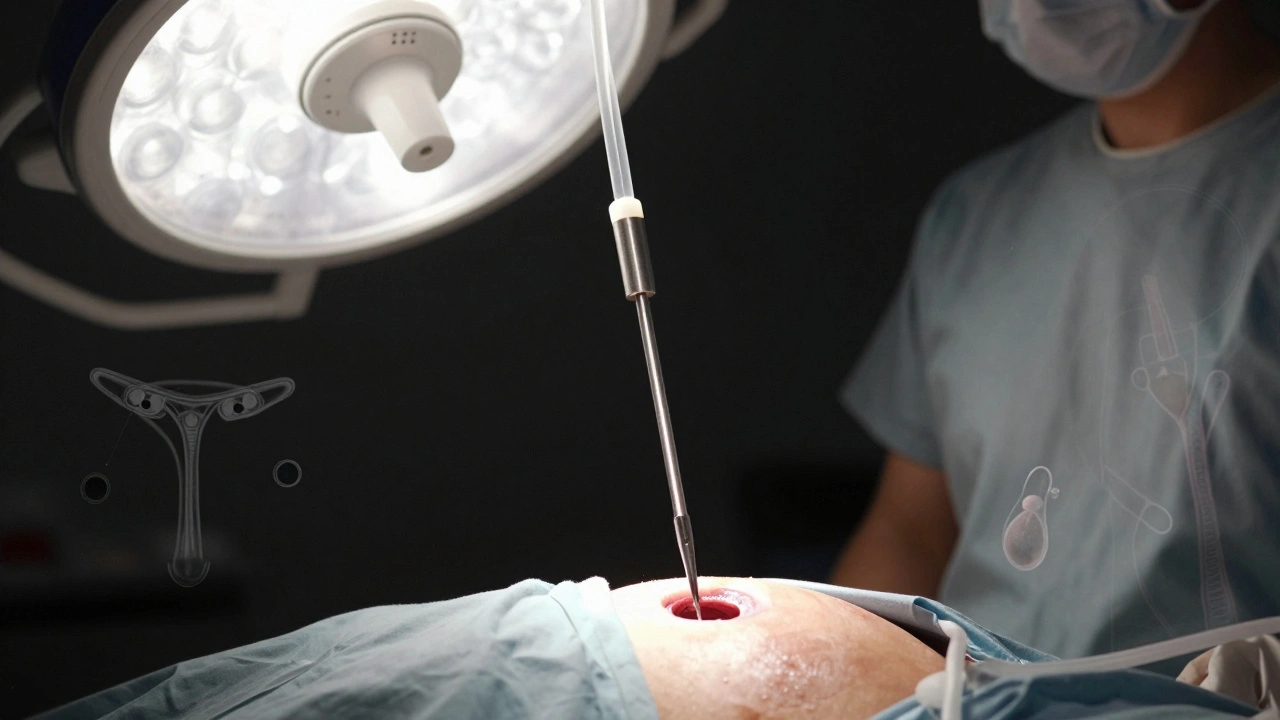
This is where gynecologist Patrick Christopher Steptoe changed the game. Steptoe was a pioneer in laparoscopy, a minimally invasive technique using a thin tube inserted through a small incision in the navel. He had published a monograph on the technique in 1967.
Steptoe refined the procedure to aspirate follicles. By 1969, he could insert a needle attached to suction through the laparoscope, guided by visual inspection of the ovary. He timed these retrievals to occur about 36 hours after the administration of human chorionic gonadotrophin (hCG), which mimics the body's natural luteinizing hormone surge. This allowed him to pull 1-5 oocytes per procedure with minimal risk and a hospital stay of just one or two days. This surgical innovation made IVF clinically feasible for real patients, not just research subjects.
First Contact: 1969 Fertilization
With mature eggs (thanks to Edwards), viable sperm (thanks to Chang’s principles), good food (thanks to Bavister), and a way to retrieve them (thanks to Steptoe), the pieces fell into place. In 1969, the team reported the first convincing fertilization of human oocytes in vitro.
They didn't just see sperm sticking to the egg. They observed three objective criteria:
- Sperm penetration of the egg.
- Extrusion of the second polar body (a sign the egg has completed meiosis).
- Formation of male and female pronuclei (the genetic material coming together).
However, fertilization rates were still low-under 20%. And crucially, they did not transfer these embryos to women yet. Ethical concerns and safety fears held them back. The Medical Research Council (MRC) in the UK even declined to fund the project in 1971-1972, worried about the "reputation of British science" and the ethics of embryo research. The team had to rely on private charity and small grants, slowing their progress significantly.
The Long Wait: Early Failures and One Success
The 1970s were a grind. Steptoe and Edwards started clinical cycles around 1971. They tried natural cycles and mild stimulation. They transferred embryos at the 2-8 cell stage. Most failed. Some resulted in very early biochemical pregnancies that miscarried. In 1976, they documented an ectopic pregnancy, proving implantation could happen, but not in the right place.
Pregnancy rates were abysmal-probably below 3% per transfer. Meanwhile, other groups were trying. In Australia, Carl Wood’s team reported early pregnancies in 1973, but they also ended in miscarriage. The technology was unproven and risky.
Then came Lesley Brown. Born in 1947, she had bilateral tubal occlusion-her tubes were completely blocked. Her chance of natural pregnancy was near zero. After years of failed attempts, she joined the program in 1977.
On November 10, 1977, Steptoe retrieved a single mature oocyte from Lesley using laparoscopy. Edwards inseminated it. It fertilized. By day 2-3, it had cleaved into an 8-cell embryo. On November 14, Steptoe transferred that single embryo into Lesley’s uterus. The rest is history. Louise Brown was born healthy on July 25, 1978.
To put that success in perspective: it took roughly 457 attempted treatment cycles to achieve that one live birth. That’s a success rate of about 0.2% per initiated cycle. It sounds terrible, but for a condition deemed hopeless, it was a miracle.
| Year | Breakthrough | Key Figures | Significance |
|---|---|---|---|
| 1951 | Sperm Capacitation Discovered | Colin Austin, Min Chueh Chang | Proved sperm need time to mature in female tract/lab before fertilizing. |
| 1959 | First Mammalian IVF Births | Min Chueh Chang | Rabbits born via IVF, validating the capacitation theory. |
| 1965-1968 | Human Oocyte Maturation in Lab | Robert Edwards | Showed immature human eggs can mature outside the body (IVM). |
| 1968-1969 | Optimized Culture Media | Barry Bavister | Created chemical environment supporting fertilization and cleavage. |
| 1969 | Laparoscopic Retrieval Refined | Patrick Steptoe | Made egg retrieval minimally invasive and safe for patients. |
| 1969 | First Human Fertilization in Vitro | Edwards, Bavister, Steptoe | Confirmed human eggs can be fertilized outside the body. |
| 1978 | Birth of Louise Brown | Edwards, Steptoe | First successful live birth from IVF, proving clinical viability. |
Why It Matters Today
We take IVF for granted now. With controlled ovarian hyperstimulation (COH), we can get multiple eggs. With intracytoplasmic sperm injection (ICSI), we can bypass fertilization issues entirely. With vitrification, we can freeze embryos successfully. But none of this exists without the foundation laid in those dark, underfunded labs in the 1960s and 70s.
The core principles remain unchanged. We still respect the timing of the LH surge. We still use media based on Bavister’s formulas. We still retrieve eggs laparoscopically. The difference is efficiency. Where Edwards and Steptoe had a 0.2% success rate, modern clinics often see 30-40% live birth rates per cycle for women under 35.
But remember the cost of that breakthrough. It wasn't just money. It was years of emotional toll on patients like Lesley Brown, who endured dozens of failures. It was the skepticism of the scientific community. It was the ethical battles fought in newspapers and government offices. The story of IVF isn't just a story of biology; it's a story of persistence against overwhelming odds.
Who invented IVF?
IVF was developed primarily by physiologist Robert Geoffrey Edwards and gynecologist Patrick Christopher Steptoe. While many scientists contributed foundational knowledge (like Min Chueh Chang and Barry Bavister), Edwards and Steptoe combined these insights into the first successful clinical program, leading to the birth of Louise Brown in 1978. Edwards was awarded the Nobel Prize in Physiology or Medicine in 2010 for this work.
What is sperm capacitation?
Sperm capacitation is a physiological process that sperm must undergo in the female reproductive tract (or simulated in a lab) to become capable of fertilizing an egg. Discovered in 1951, it involves changes in the sperm membrane that allow it to penetrate the egg. Without this step, fertilization cannot occur, even if sperm and egg are mixed together.
How were eggs retrieved in the 1960s?
Initially, eggs were retrieved surgically via laparotomy (open abdominal surgery) from tissue removed for other medical reasons. This was high-risk and unsuitable for infertility treatment. In the late 1960s, Patrick Steptoe pioneered the use of laparoscopy, a minimally invasive technique using a small camera and needle, which made egg retrieval safe enough for clinical IVF.
Why did it take so long to achieve the first birth?
It took nearly a decade because each component had to be perfected separately. Scientists had to figure out how to mature eggs in a dish, create the right nutrient medium, safely retrieve eggs, and time the transfers correctly. Additionally, funding was scarce due to ethical concerns, and early success rates were extremely low (around 0.2% per cycle), requiring hundreds of attempts to prove the method worked.
What role did Barry Bavister play in IVF?
Barry Bavister developed the culture media-the liquid environment-in which eggs and embryos grow. His work in the late 1960s identified the precise chemical balance (including osmolarity and pH) needed for mammalian fertilization and early development. Robert Edwards adapted Bavister’s medium for human use, which was critical for keeping embryos alive outside the body.