Why do organisms bother with sex? It seems like a lot of work. You need to find a partner, you only pass on half your genes, and the process is risky. Yet, almost every complex life form on Earth uses sexual reproduction. This creates a massive puzzle for biologists. If asexual reproduction is faster and more efficient, why did sex take over? The answer lies deep in our evolutionary past, around 2 billion years ago, when the last common ancestor to all eukaryotes made a switch that changed life forever.
The Big Switch: When Sex First Appeared
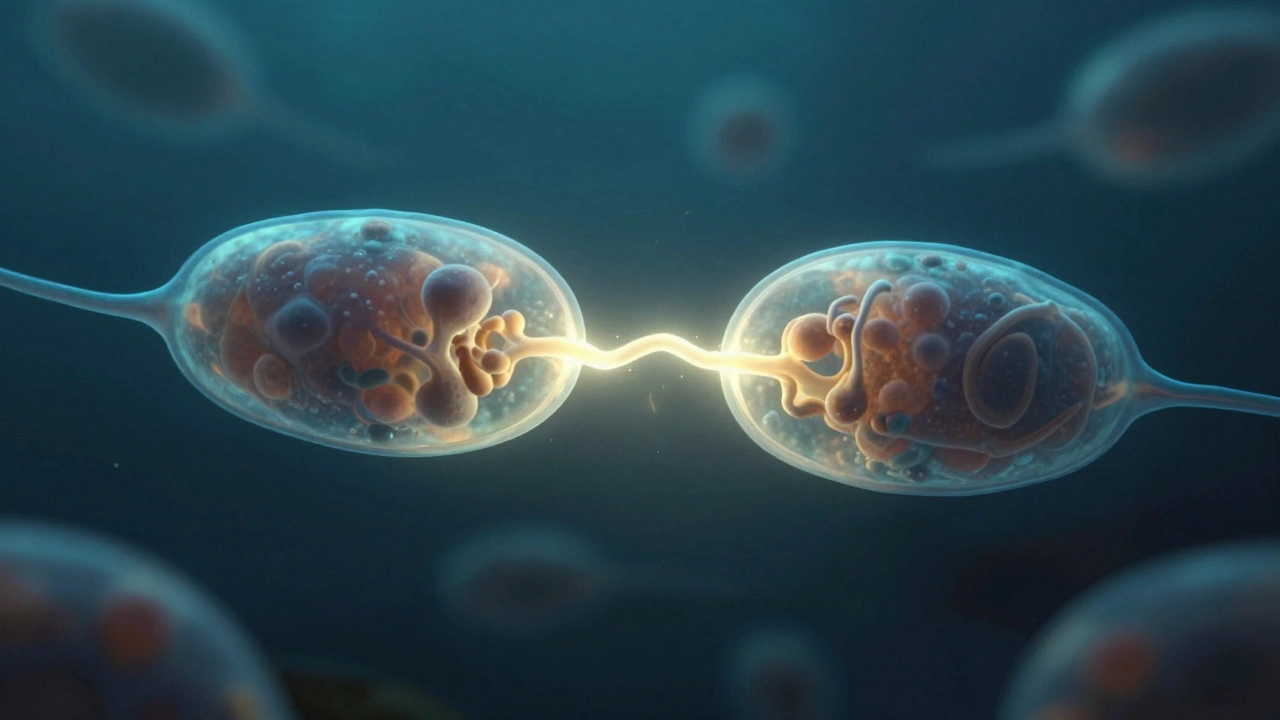
The story starts with the Last Eukaryotic Common Ancestor, often called LECA. LECA was the single-celled organism that lived approximately 2 billion years ago and passed down the genetic blueprint for sexual reproduction to all modern eukaryotes. Before this point, life was mostly asexual. Organisms simply copied themselves. But LECA introduced a system where cells could fuse and divide in a specific way. This wasn't a gradual slide; it was a complex set of innovations happening at once.
Scientists have found genes involved in meiosis in all major eukaryotic groups. This confirms that LECA was indeed sexual. It wasn't a later addition; it was foundational. This means that from the moment complex cells with nuclei appeared, the machinery for sex was already there. The transition involved four major changes working together. First, cells learned to alternate between having one set of chromosomes and two sets (ploidy). Second, they developed ways to regulate which cells could fuse. Third, they linked this fusion to forming resting spores that could survive tough conditions. Finally, they figured out how to pass organelle genomes correctly.
The Cellular Machinery: Meiosis and Chromosomes
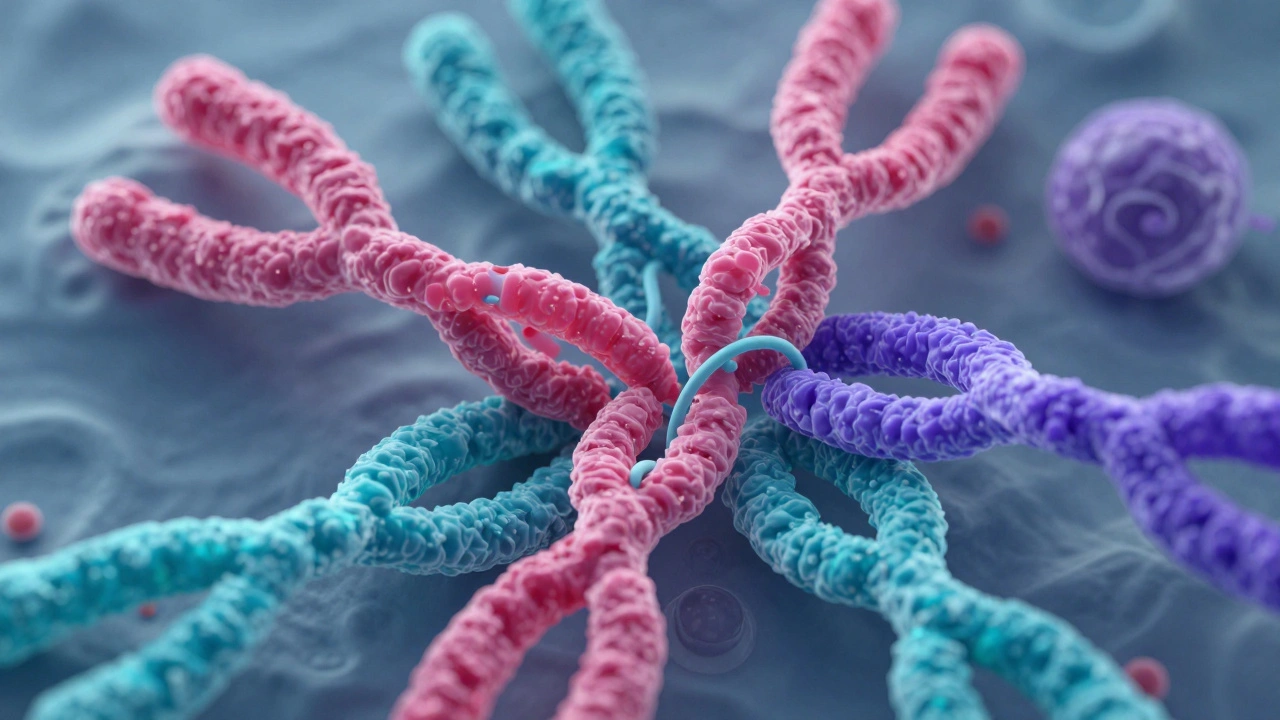
At the heart of sexual reproduction is Meiosis. Meiosis is a specialized type of cell division that reduces the chromosome number by half, creating gametes for sexual reproduction. This process is incredibly specific. It requires homologous chromosomes to pair up, swap genetic material, and then separate. This swapping, called crossing over, is what creates genetic diversity. Without it, offspring would just be clones.
One critical protein in this process is Spo11. Spo11 is a protein derived from an ancestral archaeal topoisomerase that introduces DNA double-strand breaks to provoke meiotic recombination. This protein didn't just appear out of nowhere. It came from an ancient source and was adapted for meiotic purposes in the protoeukaryote genome. This adaptation was necessary because meiosis requires DNA breaks to start the recombination process.
Another big change was the shape of our DNA. Early life likely had circular chromosomes. But when sexual crosses happened, circular chromosomes caused problems. If two circular chromosomes recombine, they can form a dicentric chromosome with two centromeres. If these attach to opposite spindle microtubules during division, the chromosome breaks. To fix this, linear chromosomes evolved. This required new structures like centromeres and telomeres to protect the ends and ensure faithful segregation. The advent of sexual crosses essentially drove the development of linear chromosomes.
Charles Darwin's Struggle with Sex
Even Charles Darwin, the father of evolution, had a hard time explaining sex. In his early notes from 1837-1838, he grappled with the idea. He famously stated, "If it could be demonstrated that any complex organ existed, which could not possibly have been formed by numerous, successive, slight modifications, my theory would absolutely break down." Sexual reproduction looked like one of those complex organs.
Darwin initially thought asexual life evolved into sexual life through natural selection via "survival of the fittest." But he quickly saw the problem. Sex is costly. It requires energy to find mates and produces fewer offspring than asexual cloning. He explored alternative mechanisms, including hermaphroditism, where one individual has both male and female reproductive organs. This was a potential answer to how physical differences between males and females could arise. However, the full picture of how sex evolved remained a mystery for over a century after his work.
From Water to Land: The Fertilization Shift
Once sexual reproduction was established, organisms had to adapt to new environments. The move from sea to land required a major change in how fertilization happened. In water, External Fertilization works well. External fertilization involves male sperm fertilizing a female-produced egg outside of the female's body, typically occurring in water to facilitate sperm movement. Sperm can swim to the egg. But on land, water isn't always available. Sperm would dry out instantly.
This led to Internal Fertilization. Internal fertilization involves sperm being introduced via insemination to combine with an egg inside the female's body, contingent upon proper conditions. This prevented desiccation and allowed life to thrive on dry land. The three main structural components that characterize this system are the gametes (sperm and ova), the gonads (testes and ovaries), and the copulatory organs (penis and vagina). This transition wasn't instantaneous. It involved multiple genetic and cellular innovations occurring in parallel.
| Feature | External Fertilization | Internal Fertilization |
|---|---|---|
| Location | Outside the body (water/moist) | Inside the female body |
| Environment | Aquatic or moist areas | Terrestrial or aquatic |
| Sperm Movement | Swimming through water | Insemination via copulation |
| Desiccation Risk | High if water dries | Low (protected inside) |
The Placoderm Discovery: Rewriting the Story
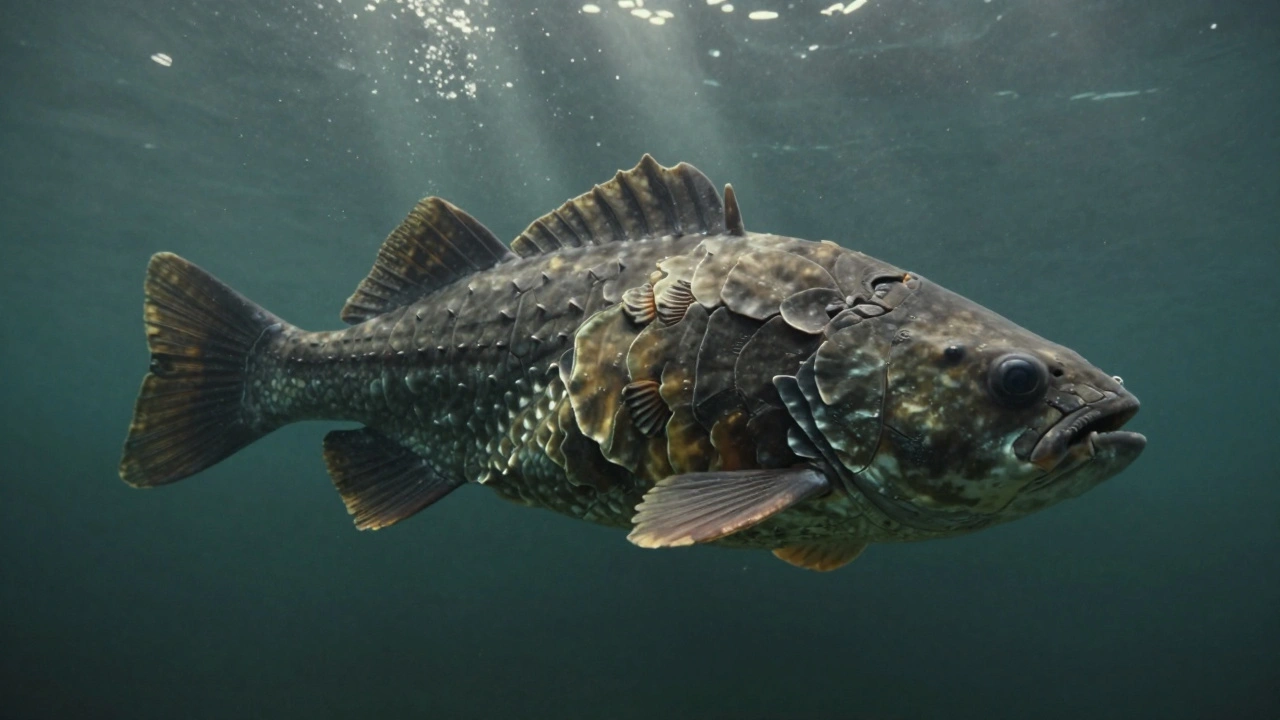
For 150 years, scientists assumed internal fertilization only evolved from external fertilization. They thought life went from simple water spawning to complex land mating. But recent research published in the journal Nature by Long et al. challenged this. They studied Placoderms, an extinct fish group whose front body section is encased in broad, flat bony plates. Placoderms were an ancient group of armored fish that lived during the Paleozoic era and provide key insights into vertebrate evolution.
The study suggested that external fertilization may have actually evolved from internal fertilization in the most recent common ancestor of placoderms. This discovery implies that internal fertilization originally characterized all placoderms. External fertilization and spawning, which characterize most extant aquatic jawed vertebrates (gnathostomes), must be derived from internal fertilization. This transformation was previously considered implausible. It shows that evolution isn't always a straight line from simple to complex. Sometimes, complex traits come first, and simpler ones evolve later.
Why Sexual Reproduction Won
Despite the costs, sexual reproduction became the dominant mode across virtually all eukaryotic lineages. Why? The genetic advantages are clear. Asexual reproduction creates clones. If the environment changes or a disease strikes, the whole population is vulnerable. Sexual reproduction mixes genes. This creates variation. Some offspring might have traits that help them survive new threats.
Modern eukaryotic organisms display multiple reproductive strategies built upon this foundation. The first is oviparity, where young are hatched from eggs. In this system, both parents release gametes. Other organisms lay eggs on a surface for subsequent fertilization. In larger, more mobile animals, fertilization is internal, with eggs then laid and hatching outside the mother's body. This strategy is employed by invertebrates, amphibians, birds, and reptiles. The transition to an amniotic egg system represents another significant evolutionary development, though this transformation has never been documented in the fossil record.
The absence of fossil evidence for these transitions occurs not only because soft tissue fossilizes poorly, but because the evolution of a new reproductive system faces the fundamental problem that the system cannot allow for survival until hundreds of required changes are each complete. This presents a significant challenge to explaining intermediate stages. However, the ubiquity of sexual reproduction across eukaryotic life indicates that despite its apparent costs, the genetic advantages conferred by sexual reproduction have proven substantially more beneficial for long-term species survival and adaptation.
When did sexual reproduction first evolve?
Sexual reproduction emerged approximately 2 billion years ago in the last common ancestor to all eukaryotes (LECA).
What is the main advantage of sexual reproduction over asexual?
Sexual reproduction creates genetic diversity through meiosis and recombination, allowing populations to adapt to changing environments and resist diseases better than clones.
How does meiosis contribute to evolution?
Meiosis reduces chromosome numbers and facilitates crossing over, which shuffles genetic material and creates unique combinations of traits in offspring.
Did Darwin understand how sex evolved?
Darwin struggled with this question. He recognized the complexity and cost of sex but could not fully explain how it evolved from asexual ancestors through natural selection alone.
What recent discovery changed our view on fertilization?
Research on placoderms in the journal Nature suggested that external fertilization may have evolved from internal fertilization, reversing the long-held assumption.
Understanding the emergence of sexual reproduction gives us a window into the fundamental history of life. It wasn't a simple step. It was a complex convergence of genetic, cellular, and anatomical changes. From the circular chromosomes of early protoeukaryotes to the internal fertilization of land mammals, the journey has been long and intricate. The evidence suggests that once this strategy was established, it provided such substantial evolutionary advantages that it became the dominant reproductive mode. Even today, the mechanisms driving this system remain topics of active research investigation, proving that the story of life is still being written.