Ancient Intersex History Explorer
Dive deeper into the article's themes by testing your knowledge, exploring key historical moments, and analyzing specific legal and artistic cases from the ancient world.
Did You Know?
Loading fact...
Key Historical Moments
Select an event
Click on a timeline item on the left to view details about how intersex individuals were perceived or treated during this period.
When we think of ancient Greece and Rome, images of marble statues, epic poetry, and rigid social hierarchies usually come to mind. But hidden within the cracks of these well-known narratives is a complex history of how these civilizations understood bodies that did not fit neatly into male or female categories. The concept of intersex in antiquity was not a modern medical diagnosis but a lived reality interpreted through lenses of mythology, law, and art. For scholars and readers interested in LGBTQ+ history, understanding how the ancients navigated these identities reveals a world far more nuanced than simple binary thinking suggests.
The Mythological Foundation: Gods and Monsters
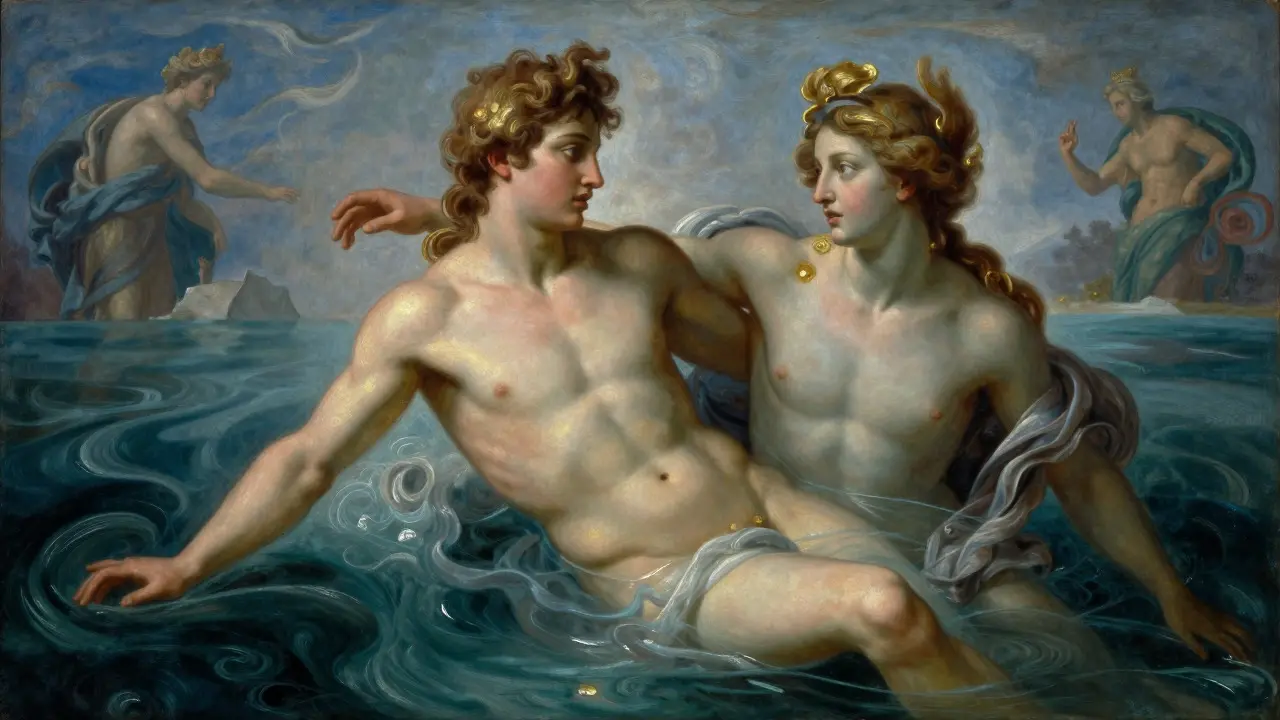
In both Greek and Roman cultures, the first place to look for evidence of intersex recognition is mythology. The most famous figure here is Hermaphroditus, who is a deity born from the union of Hermes and Aphrodite, depicted as having both male and female characteristics. Unlike later medieval depictions that often framed such beings as monsters or omens of bad luck, early Greek literature treated Hermaphroditus with a mix of curiosity and acceptance. In Ovid's Metamorphoses, the story of Hermaphroditus is actually one of tragic transformation rather than divine creation, showing how the Romans viewed the merging of genders as a specific narrative event rather than a static state of being.
Beyond the gods, everyday literature referenced individuals with ambiguous sex. Plutarch, the Greek biographer, wrote about a Spartan woman named Aristodamus's daughter, though this is often confused with other accounts. More clearly, there are references in Athenian comedies where characters with "two sexes" appear as comic relief or objects of fascination. This literary treatment tells us that while these individuals were recognized, they often occupied a liminal space-neither fully accepted into the standard social order nor completely erased. They were visible enough to be written about, but their status remained precarious.
Legal Frameworks: Citizenship and Status
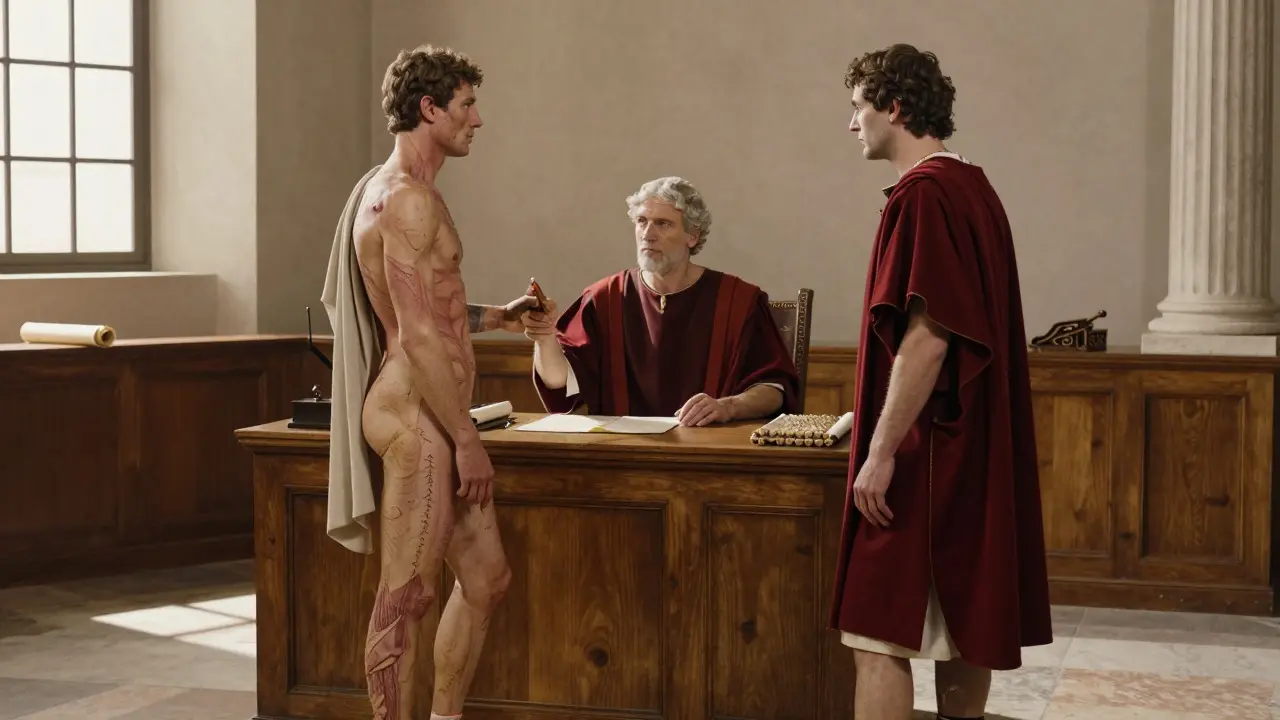
If mythology provides the cultural backdrop, Roman law provides the hard evidence of how intersex people were treated in daily life. Roman jurisprudence was obsessed with defining legal capacity, which depended heavily on sex. A person had to be legally male or female to inherit property, marry, or serve in the military. So, what happened when the body didn't match the expectation? The key term used by Roman jurists like Gaius and Ulpian was hermaphroditus, which functioned as a legal category distinct from both vir (man) and femina (woman).
The legal principle was pragmatic: if an individual displayed male characteristics (such as testicles), they were generally classified as male for legal purposes, even if they also had female organs. This wasn't necessarily out of prejudice, but because Roman society lacked a third legal gender slot. Being male meant you could own land and vote; being female meant you were under the guardianship of a male relative. Therefore, the law forced a binary choice based on physical markers. This created a specific legal niche where an intersex person's rights fluctuated depending on which part of their anatomy the judge focused on at any given moment. It was a system built on observation rather than identity, highlighting how deeply intertwined biology and citizenship were in the ancient world.
Artistic Depictions: The Body in Stone and Bronze
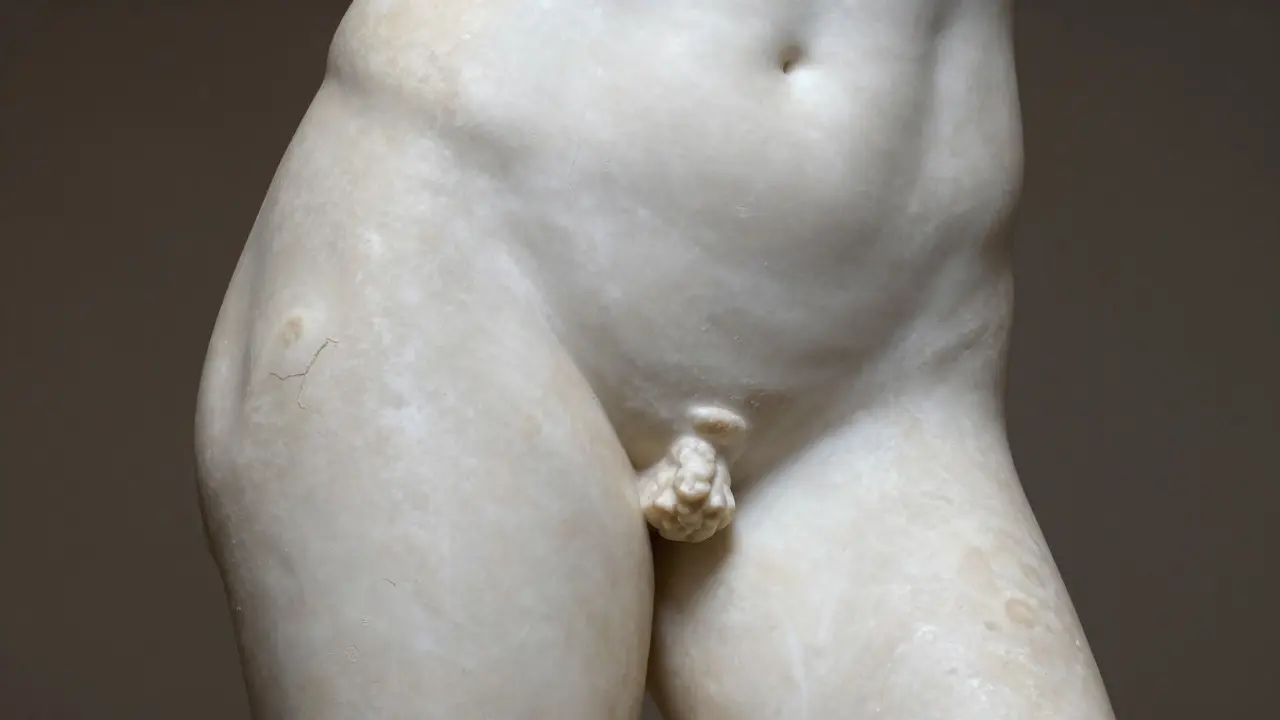
While laws were dry and myths were dramatic, art offers the most intimate glimpse into how intersex bodies were perceived aesthetically. The most iconic artifact is the statue known as the Hermaphroditus, discovered in the Baths of Diocletian in Rome in 1638. This marble sculpture shows a reclining youth with a soft, rounded torso and hips, yet distinctly masculine legs and face. For centuries, artists copied this pose, blending male and female forms in a way that celebrated beauty rather than pathology. In the Hellenistic period, this ambiguity was seen as a peak of artistic achievement-a blend of strength and grace.
However, not all artistic representations were neutral. In some Roman mosaics and frescoes, figures with ambiguous genitalia were sometimes depicted in contexts associated with divination or prophecy. This connects to a broader ancient belief that those who existed between categories had special access to spiritual knowledge. By examining these visual records, we see a shift over time: earlier Greek art tended to normalize the form as beautiful, while later Roman art sometimes exoticized it, linking it to the mystical or the foreign. This artistic evolution mirrors the changing social attitudes toward difference in the Mediterranean world.
Social Perception and Daily Life
How did ordinary people interact with intersex neighbors? Evidence suggests that social stigma existed, but it was not universal. In Athens, where civic duty was paramount, an intersex male might struggle to join a phratry (a brotherhood of citizens) if his status was questioned. However, in less rigidly structured cities or during periods of social upheaval, these barriers could blur. Medical texts, such as those by Galen, discussed hermaphrodites in clinical terms, noting variations in anatomy without always attaching moral judgment. Galen believed that nature sometimes "missed" its mark, resulting in mixed forms, but he did not necessarily view them as cursed.
There is also evidence from papyri found in Egypt (which was part of the Roman Empire) showing administrative confusion regarding tax obligations for individuals with unclear sex. These documents reveal the bureaucratic headache that intersex existence caused for officials who needed clear categories for census-taking. Yet, despite the paperwork struggles, many intersex individuals simply lived their lives, married (often men marrying women with male traits, or vice versa), and worked trades. Their stories are rarely recorded in detail because they weren't considered newsworthy by the elite writers of the day, but their presence in legal and medical records confirms they were part of the fabric of ancient society.
Comparison of Cultural Approaches
To better understand the nuances, it helps to compare how different aspects of ancient culture handled the topic. The table below summarizes the key differences between mythological, legal, and artistic treatments of intersex bodies in Greece and Rome.
| Category | Greek Approach | Roman Approach | Key Implication |
|---|---|---|---|
| Mythology | Often linked to trickster gods or tragic transformations | Focused on Ovidian narratives of metamorphosis | Viewed as a narrative event, not just a state |
| Law | Less documented; local city-state variations | Codified in Justinian's Digest; strict binary enforcement | Legal status depended on physical markers |
| Art | Hellenistic sculptures emphasized aesthetic harmony | Imperial copies often exoticized or mystified the form | Shift from beauty to otherness over time |
| Medicine | Aristotle’s biological hierarchy influenced views | Galen’s anatomical observations were more descriptive | Nature’s "error" vs. natural variation |
Why This History Matters Today
Studying intersex history in antiquity isn't just an academic exercise. It challenges the modern assumption that binary gender systems are timeless and natural. When we see that Romans had a legal category for hermaphrodites, or that Greeks sculpted ambiguous bodies as ideals of beauty, we realize that our current frameworks are historically constructed. This knowledge can help contemporary intersex advocates argue for greater flexibility in legal documentation and social acceptance. It reminds us that human diversity has always existed, and societies have always had to decide how to accommodate it. Whether through myth, law, or art, the ancient world left us a record of struggle, creativity, and adaptation that remains relevant in our ongoing conversations about gender and identity.
Did ancient Greeks and Romans use the word 'intersex'?
No, the modern medical term 'intersex' was not used. Instead, they used terms like hermaphroditus (in Latin) or described individuals as having 'both sexes.' These terms were based on observable anatomy rather than internal identity.
Were intersex people persecuted in ancient times?
Persecution varied. While they faced social stigma and legal uncertainty, there is no widespread evidence of systematic state-sponsored persecution like that seen in later centuries. Many lived normal lives, though their legal rights could be contested.
What was the legal status of an intersex person in Rome?
They were often classified as male if they had male genitalia, granting them certain rights. If female characteristics dominated, they might be placed under guardianship. The law forced a binary choice based on physical appearance.
How did art depict intersex bodies in the Hellenistic period?
Hellenistic art often depicted them as aesthetically pleasing, blending male and female features to create an idealized form of beauty, as seen in the famous statue of Hermaphroditus.
Are there any surviving writings by intersex people from antiquity?
There are no confirmed autobiographical writings by intersex individuals from ancient Greece or Rome. Most evidence comes from external sources like legal codes, medical texts, and literary works written by others.