Consent of the Governed Simulator
Select a historical scenario below to see how different political models would handle it, and determine if "consent of the governed" is present.
1 The Tax Dispute
A government imposes new taxes on citizens to fund a war they did not vote for. Citizens have no representatives in the legislature making the decision.
2 The Free Election
Citizens vote every two years to choose representatives who then debate and pass laws regarding property rights and public safety.
3 The Broken Contract
A leader holds office for life, ignores the will of the majority, and systematically violates the natural rights (life, liberty) of the people.
4 The Divine Right
A King rules because he claims his authority comes directly from God, not from the people. Subjects are expected to obey regardless of their opinion.
Authority Model:
Source of Power:
Imagine a world where your government doesn't need your permission to rule you. Where kings claim their power comes from God, not from you. That was the standard for most of human history until The Declaration of Independence changed everything in 1776. This document didn't just start a war; it launched a new way of thinking about power. At its heart is one simple, explosive idea: government only has the right to rule if the people agree to be ruled.
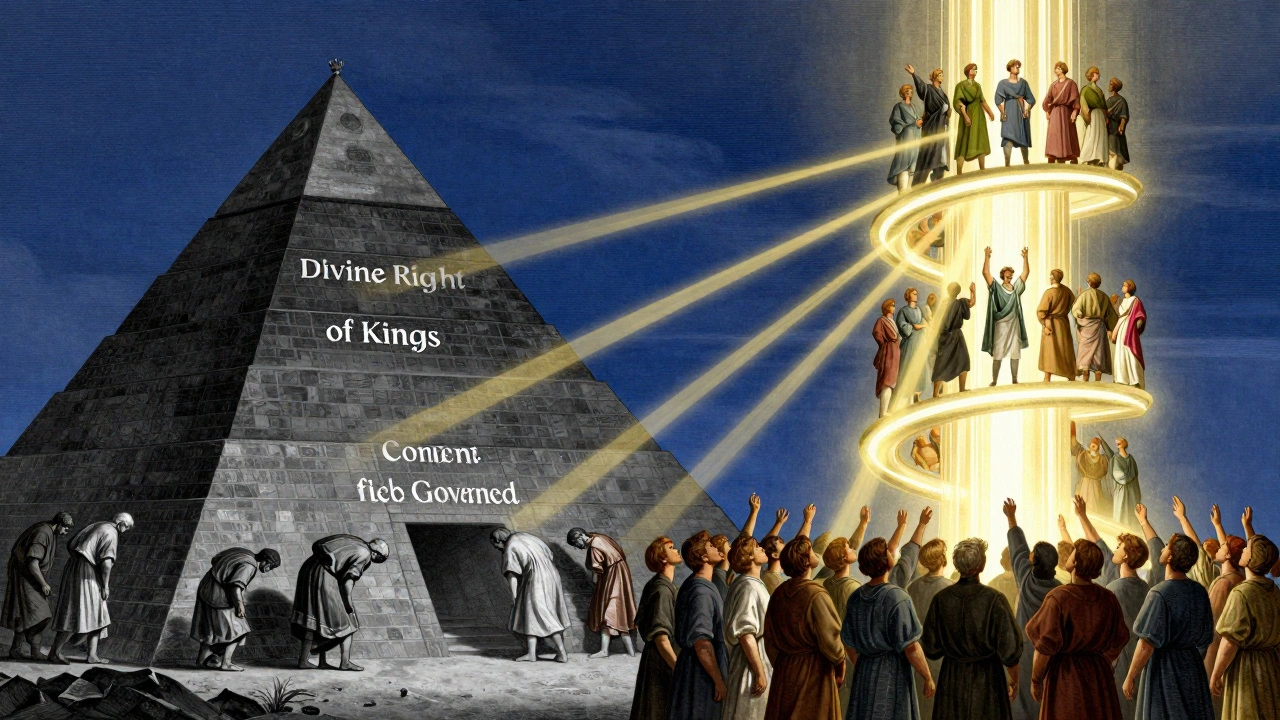
We call this "consent of the governed." It sounds like common sense today, but back then, it was radical. It flipped the script on who holds the ultimate authority. Before this, authority flowed down-from God to King to subjects. After this, authority flows up-from the people to their representatives. Understanding this shift helps us see why democracy works the way it does, and why we still fight over what "consent" really means in modern politics.
Where Did This Idea Come From?
To get consent right, we have to look at where it came from. The phrase didn't pop into Thomas Jefferson's head out of nowhere. He was standing on the shoulders of giants, specifically John Locke. Locke, an English philosopher, argued that all humans are born free and equal. No one owns another person. Therefore, any government must be built on a "social contract." You give up some freedom (like the right to steal) in exchange for protection (police, courts). But crucially, you only do this if you agree to it.
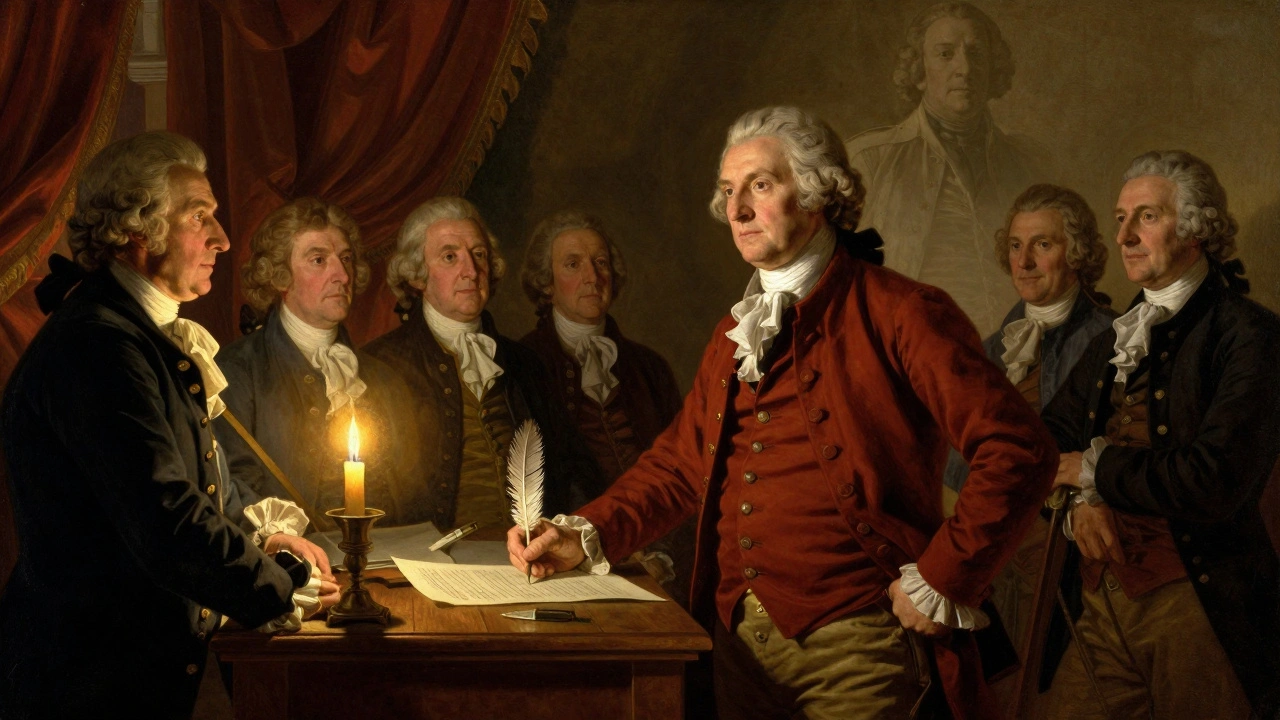
Jefferson took Locke’s theory and made it punchy. In the second paragraph of the Declaration, he wrote that governments derive "their just powers from the consent of the governed." This wasn't just poetry. It was a legal argument against King George III. The colonists were saying, "You aren't our boss because God said so. You're our boss because we hired you. And since you're failing, we're firing you."
This marked a huge break from the British tradition. Britain believed in parliamentary sovereignty-that Parliament could make laws for anyone, anywhere. The Americans said no. If you don't represent us, you can't tax us. Hence, "no taxation without representation." Consent became the line in the sand between tyranny and liberty.
The Virginia Connection: Rights Before Revolution
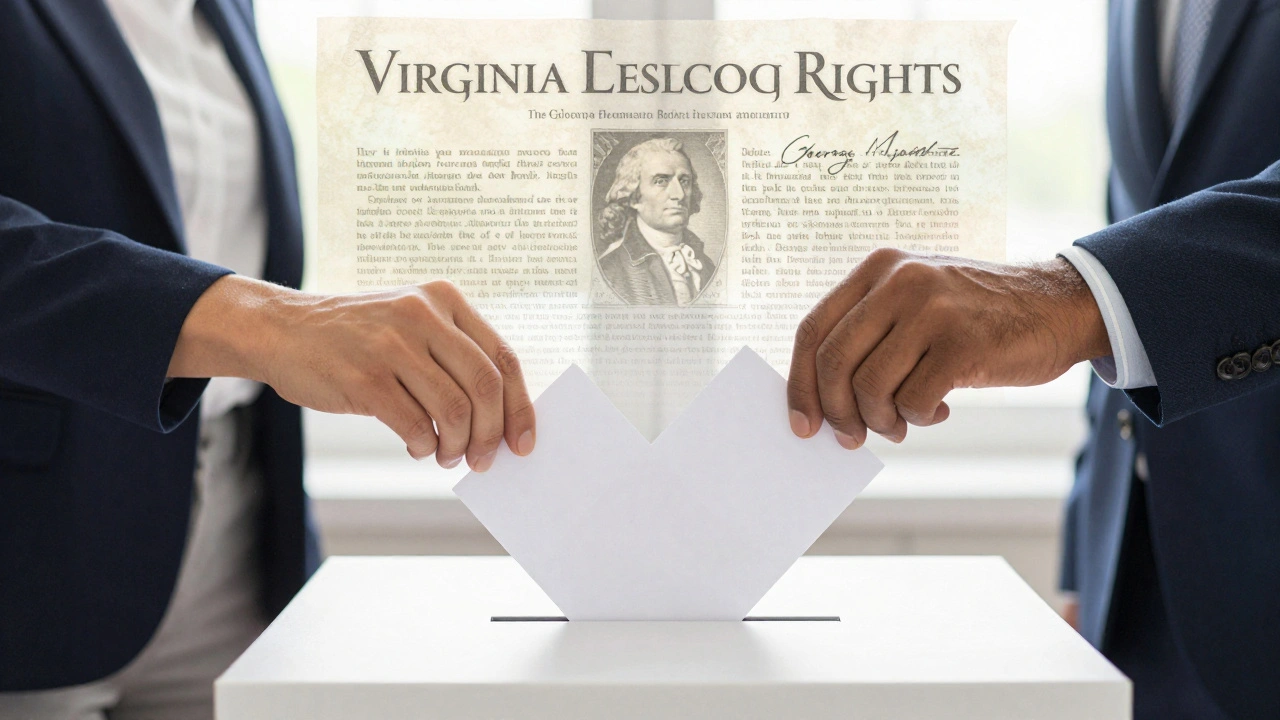
While everyone focuses on Philadelphia, the real groundwork was happening in Virginia. Just weeks before the Declaration of Independence, George Mason drafted the Virginia Declaration of Rights. Passed in June 1776, this document spelled out exactly how consent should work in practice.
Mason’s Section 6 is a masterpiece of clarity. It states that elections must be free. It says that people cannot be taxed or deprived of property without their own consent or that of their elected representatives. It explicitly links voting rights to the concept of consent. If you don't have a say in who represents you, they can't legally take your money. This local document showed that consent isn't just a vague feeling; it requires specific mechanisms: free elections, suffrage, and representative bodies.
| Model | Source of Power | Role of People | Key Document |
|---|---|---|---|
| Divine Right of Kings | God/Monarch | Subjects (obey) | European Monarchy Traditions |
| Parliamentary Sovereignty | Parliament | Citizens (represented indirectly) | British Constitution |
| Consent of the Governed | The People | Sovereigns (vote, consent) | Declaration of Independence |
Consent Is Not Static: The Right to Revolt
A lot of people think consent is a one-time deal. You vote, you pick a leader, and that's it. But the Declaration of Independence says otherwise. It treats consent as dynamic. If the government stops protecting your rights-if it becomes "destructive" of life, liberty, and happiness-you have the right to change it.
This is the "right of revolution." It’s the ultimate check on power. The Declaration argues that when a government breaks the social contract, the people can abolish it and create a new one. This makes consent an ongoing process, not a historical event. Every election is a renewal of that consent. If leaders ignore the will of the people, they lose their moral authority. This principle keeps rulers accountable. It reminds them that they work for us, not the other way around.
From Theory to Practice: Madison and Lincoln
Writing a declaration is easy. Building a system that actually runs on consent is hard. Enter James Madison. In Federalist No. 39, he defined a republic as a government deriving power directly or indirectly from the people. He emphasized two things: first, the power must come from the majority of society, not a small elite. Second, officials must serve for limited terms. You can’t have consent if someone holds office forever.
Madison designed the U.S. Constitution to institutionalize this consent. The House of Representatives, with short terms and direct elections, was meant to be the voice of the people. Checks and balances ensured no single branch could override the popular will too easily.
Later, Abraham Lincoln added another layer during the Civil War. In his First Inaugural Address, he talked about majority rule and consent. But he warned that consent isn't just about winning votes. It requires "free and reasonable deliberation." Minorities must accept the outcome, but majorities must rule justly. Lincoln understood that consent needs fairness, not just numbers. Without fair debate and protection for minority rights, "consent" becomes tyranny by the majority.
Global Impact: From America to the UN
The idea of consent didn't stay in America. It spread. During the 20th century, anti-colonial movements used the Declaration’s logic to fight empires. If consent is required for legitimate rule, then colonized peoples had the right to self-determination. They hadn't consented to British, French, or Dutch rule, so those rules were illegitimate.
This philosophy reached its peak in 1948 with the Universal Declaration of Human Rights. Article 21 states: "The will of the people shall be the basis of the authority of government." This moved consent from an American constitutional principle to a global human right. Today, whether in Europe, Asia, or Africa, the legitimacy of a government is judged by this same standard: did the people agree to this?
Calvin Coolidge, speaking at the Declaration’s 150th anniversary, clarified a key point. He noted that "just powers" must come from consent. This means not every single law needs unanimous approval. We use majority rule, constrained by constitutions, to express collective consent. It’s a practical compromise that allows large societies to function while keeping the source of power rooted in the people.
Why Consent Matters Today
In 2026, we often take voting for granted. But the principle of consent is under constant pressure. When governments bypass elections, suppress dissent, or ignore public opinion, they violate this core tenet. The Declaration reminds us that legitimacy isn't automatic. It has to be earned, again and again, through fair processes.
Consent also limits power. It prevents the concentration of authority in one person or party. By requiring regular elections and representative structures, it ensures that power remains diffuse and accountable. Whether we’re debating climate policy, healthcare, or foreign wars, the question remains: do the people consent? If not, the government has overstepped.
Understanding this principle helps us navigate modern politics. It teaches us to look beyond slogans and ask: who gave the authority? Was it freely given? Can it be taken back? These questions keep democracy alive. They ensure that government serves the people, rather than ruling over them.
What does "consent of the governed" mean in simple terms?
It means that a government only has the right to exist and make laws if the people it rules agree to let it. Power comes from the citizens, not from force, inheritance, or divine right. If the people withdraw their consent, the government loses its legitimacy.
Who originally came up with the idea of consent of the governed?
The philosophical roots lie with John Locke, an English thinker who argued for natural rights and social contracts. Thomas Jefferson adapted Locke’s ideas for the Declaration of Independence, making consent the central justification for American independence from Britain.
How is consent different from majority rule?
Majority rule is a method for making decisions within a consent-based system. Consent is the broader principle that establishes the government's authority. Majority rule decides policies, but consent validates the entire structure of government. Importantly, consent includes protections for minorities, ensuring that majority rule doesn't become tyrannical.
Does consent mean everyone must agree to every law?
No. As Calvin Coolidge and James Madison explained, consent operates through representative institutions and majority rule. You don't need to personally agree with every tax or regulation. Instead, you consent by participating in the democratic process-voting, debating, and electing representatives who act on your behalf.
How did the Declaration of Independence influence international human rights?
The principle of consent became a global standard. It inspired anti-colonial movements seeking self-determination. Eventually, it was codified in Article 21 of the United Nations' Universal Declaration of Human Rights (1948), which states that the will of the people is the basis of governmental authority worldwide.
What role did George Mason play in defining consent?
George Mason authored the Virginia Declaration of Rights, which preceded the national Declaration of Independence. His work specified practical mechanisms for consent, such as free elections, suffrage rights, and the requirement that taxes only be levied with the consent of representatives.