
Parasite Resistance Calculator
Red Queen Survival Calculator
Based on the article about why sex persists despite its costs - due to parasite pressure.
Results
Enter values and click Calculate to see survival estimates
Imagine running on a treadmill that keeps speeding up-no matter how hard you sprint, you never move forward. That’s the reality for life in the wild, according to the Red Queen hypothesis. Named after Lewis Carroll’s character who tells Alice, "It takes all the running you can do to keep in the same place," this idea explains why sex hasn’t been eliminated by evolution, even though it seems deeply inefficient.
Sexual reproduction is costly. Asexual organisms-like many lizards, insects, and worms-can reproduce alone, producing clones that carry 100% of their genes. Each offspring is a perfect copy. Sexual organisms, by contrast, must find mates, invest energy in producing males (who don’t bear offspring directly), and shuffle genes through recombination. Logically, asexual lineages should outcompete sexual ones. Yet sex dominates complex life. Why?
Parasites Are the Hidden Architects of Evolution
The answer lies not in climate, food, or predators-but in parasites. These tiny organisms evolve faster than their hosts. A single bacterium can reproduce in minutes. A human takes decades. That means parasites are constantly adapting to exploit common host genotypes. If you’re genetically identical to your neighbor, you’re likely to get the same infections. And if your entire population looks the same, a single parasite strain can wipe it out.
This is where sex becomes a shield. Sexual reproduction doesn’t just mix genes-it creates novelty. Each child is a unique genetic cocktail. A parasite that evolved to infect your parent’s genome won’t recognize your mix. Your rare combination of alleles becomes a moving target. While asexual clones get picked off one by one, sexually reproducing populations stay one step ahead.
Proof in a Worm and a Bacteria
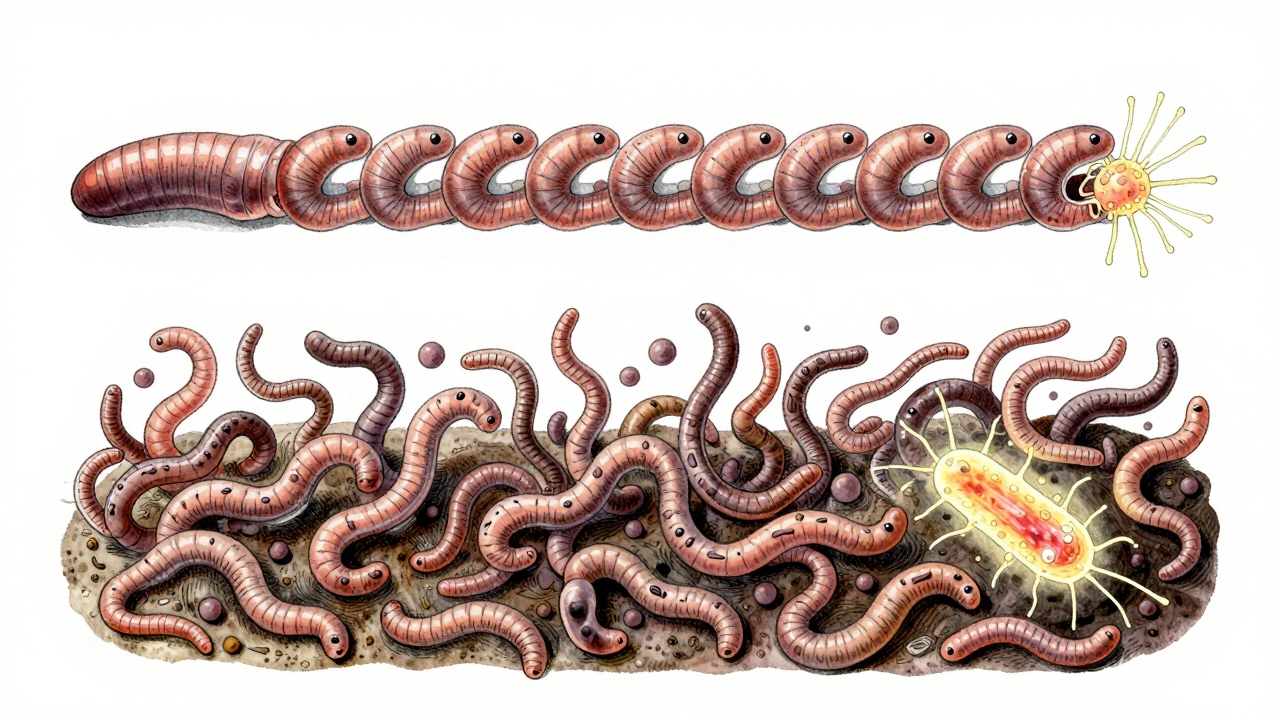
In 2002, scientists at Indiana University tested this directly using the tiny nematode Caenorhabditis elegans. They created three populations: one that reproduced only sexually, one that reproduced asexually (via self-fertilization), and one that did both. Then they exposed them to the deadly bacterium Serratia marcescens.
The results were dramatic. Within just ten generations, the purely asexual populations collapsed. Every individual was genetically identical. The parasite adapted to infect them efficiently-and wiped them out. The sexual populations, however, kept going. Their constantly shifting gene combinations kept the parasite guessing. Some individuals still died, but enough survived to keep the lineage alive. This experiment didn’t just support the Red Queen hypothesis-it confirmed it.
Immune Genes Are Evolving at Lightning Speed
Look at your immune system. The genes that detect and fight pathogens-like those coding for antibodies, T-cell receptors, and immune signaling proteins-are among the fastest-evolving in your entire genome. Why? Because they’re locked in a never-ending duel with parasites.
Compare these immune genes to, say, genes that build your bones or regulate your metabolism. Those change slowly. They don’t need to. But immune genes? They’re in a race. Every time a parasite evolves a new way to sneak past your defenses, your immune system must evolve a new lock. This constant back-and-forth creates what scientists call "positive selection"-where new mutations that help you survive are rapidly spread through the population.
Studies show that genes involved in recognizing pathogens evolve up to 10 times faster than the average gene. This isn’t random. It’s the fingerprint of Red Queen dynamics. The same pattern shows up in plants fighting fungi, fish battling viruses, and even fruit flies and their parasitic wasps.
Why Don’t Asexuals Just Catch Up?
You might wonder: if sex is so advantageous, why haven’t asexual species evolved better defenses? The problem is timing. Asexuals rely on slow, random mutations. A single mutation might give them resistance to one parasite strain. But parasites evolve faster. By the time the mutation spreads through the population, the parasite has already shifted again.
Sexual reproduction, by contrast, doesn’t wait for mutations. It shuffles existing variation. Imagine you have 100 different gene versions in your population. Asexual reproduction picks one combo and repeats it. Sexual reproduction mixes them like a deck of cards-every hand is different. That means even if no new mutation occurs, the population still generates thousands of new genetic combinations every generation. Parasites can’t keep up.
Three Ways the Red Queen Plays Out
Evolutionary biologists now recognize three main patterns of Red Queen dynamics:
- The Fluctuating Red Queen: Host and parasite genotypes rise and fall in frequency over time. A common host type gets hit hard by a parasite, then becomes rare. The parasite shifts focus. The cycle repeats.
- The Escalatory Red Queen: Both sides get better over time-faster immune responses, stronger toxins, more complex defenses. Think of it like an arms race, where each side builds bigger weapons.
- The Chase Red Queen: One side is always chasing the other. The parasite evolves to exploit the host, the host evolves to escape, and the parasite must keep adapting just to stay effective.
All three can happen at once. In nature, it’s rarely just one. A single host species might face dozens of parasites, each with its own evolutionary tempo. That’s why sex isn’t just useful-it’s essential for long-term survival.

The Peppered Moth and the Gene That Wouldn’t Die
The classic example of industrial melanism-the peppered moth turning dark during the Industrial Revolution-is often taught as a case of natural selection. But the Red Queen adds a deeper layer. The dark mutation didn’t just help the moth blend into soot-covered trees. It also likely helped it evade parasites that targeted lighter-colored individuals.
Even more striking: the same gene responsible for melanism in peppered moths has independently mutated at least four times in different species-including humans. Why does this gene keep showing up? Because it’s under constant pressure. Whether you’re a moth, a mouse, or a human, dark skin or fur might help you avoid parasites that thrive on lighter skin. The gene survives not because it’s perfect-but because it’s useful in a world that never stops changing.
Sex Isn’t About Progress. It’s About Survival.
For decades, people thought evolution was about becoming "better." Stronger. Faster. Smarter. The Red Queen hypothesis flips that. Evolution isn’t a ladder. It’s a spinning wheel. You don’t climb up-you just keep running.
Sex didn’t evolve because it made organisms more advanced. It evolved because asexual lineages kept getting wiped out by parasites. Sex isn’t a luxury. It’s a defense mechanism. A genetic insurance policy. A way to stay alive when the enemy is always changing.
That’s why every human, every bird, every fish, every tree, and every mushroom that reproduces sexually is still here. Not because they’re perfect. But because they’re unpredictable. And in a world ruled by parasites, unpredictability is the only thing that lasts.