Modern Sex Research & Hormone Impact Simulator
Click "Compare Approaches" to see how scientific understanding has evolved from fixed categories to fluid biology.
Adjust the estimated estrogen/testosterone levels to see their impact on neural processes and pain perception based on current research.
Biological Impact Analysis
Neural Architecture Effects
Pain Perception & Opioid System
Key Takeaway
For decades, we were taught that men and women are biologically distinct in simple, binary ways. You either had one set of traits or the other, with little overlap. That view is crumbling. Today, modern sex research is a multidisciplinary field integrating neuroscience, endocrinology, and behavioral science to understand how biological sex shapes human experience beyond simple binaries. We now know that sex hormones do not just drive reproduction; they sculpt our brains, influence our pain tolerance, and shape our cognitive abilities throughout our entire lives.
This shift isn't just academic nitpicking. It changes how we treat mental health, how we design medications, and how we understand human behavior. The old model assumed sexual dimorphism was fixed and non-overlapping. The new model sees a complex web of interactions between genes, hormones, and environment. Let’s look at what this transition means for science and society.
From Fixed Categories to Fluid Biology
The classical approach to studying sex differences relied on a rigid framework. Researchers often looked for clear-cut distinctions between male and female brains, assuming these differences were hardwired at birth and unchangeable. This perspective ignored the vast gray area where most humans actually live.
Sexual dimorphism is the condition where sexes of the same species exhibit different characteristics beyond their reproductive organs. While physical differences exist, the idea that these translate directly into completely separate neural architectures has been refuted by modern neuroscience. Behavioral neuroendocrinology shows us that hormonal systems are not genetically fixed silos. Instead, they are dynamic and responsive.
Psychological findings consistently highlight the similarities between men and women rather than the differences. Developmental research adds another layer of complexity, suggesting that categorizing people strictly as male or female oversimplifies the biological reality. We are moving toward an era where we recognize the great variety of sex differences observed across populations without forcing them into neat boxes.
Hormones as Brain Architects
To understand why this shift matters, you have to look at what sex hormones actually do. They are not just chemical messengers for fertility. They are potent architects of the nervous system.
During development, sex hormones regulate:
- Neurogenesis: The creation of new neurons.
- Programmed cell death: Which cells survive and which do not.
- Neuronal migration: Where cells end up in the brain.
- Synaptogenesis: How connections between neurons form.
Estrogen is a primary female sex hormone that plays a critical role in brain development, mood regulation, and cognitive function through both genomic and non-genomic pathways. For example, estrogen influences the hippocampus, a region vital for memory and learning. It doesn’t just sit there; it triggers complex molecular cascades. Estradiol rapidly stimulates acetylcholine release, which then triggers downstream signaling events like PI3 kinase activation. This leads to the translation of PSD-95 in dendrites, providing the scaffold for spine synapse maturation.
This process involves cholinergic modulation of inhibitory interneurons. In simpler terms, estrogen helps fine-tune how your brain processes information by adjusting the balance of excitation and inhibition in key areas. These mechanisms explain why subtle sex differences exist in mood, cognitive function, and even blood pressure regulation.
The Opioid System and Pain Perception
One of the most practical implications of this research is in pain management. For years, medical treatments were largely designed based on trials involving mostly men. But pain perception is heavily influenced by sex-dependent organization in neural tissue.
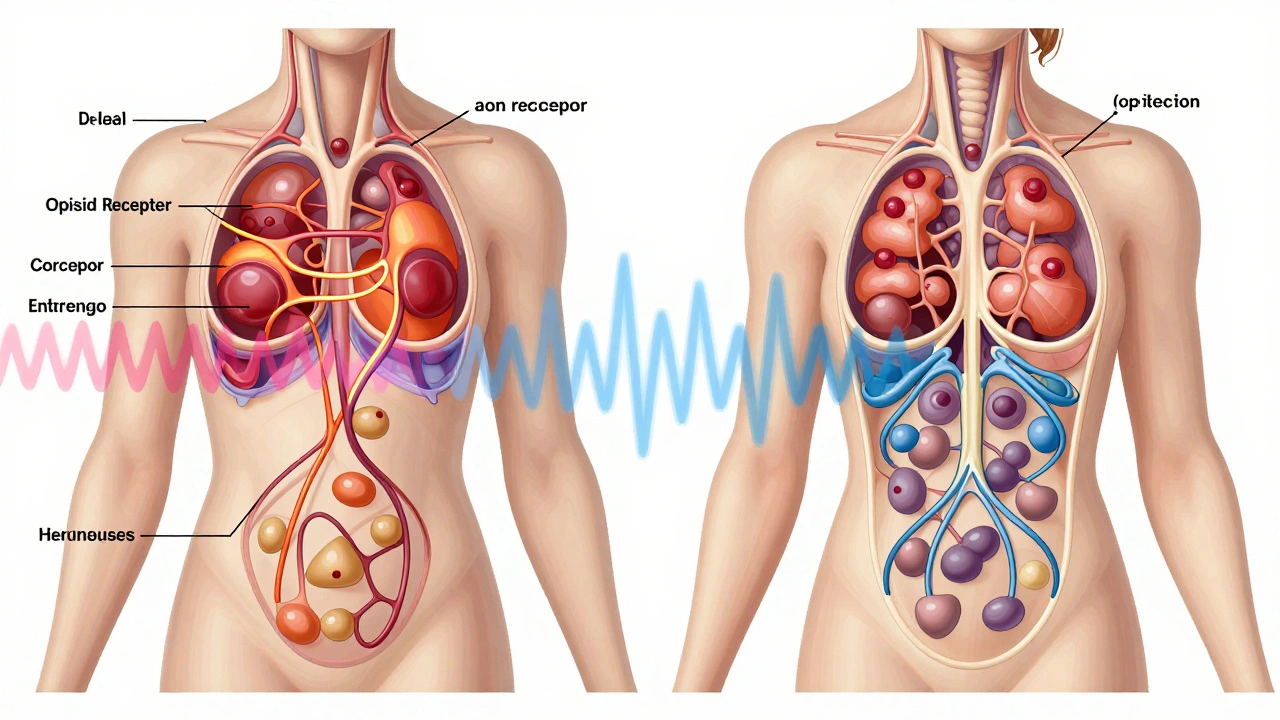
The opioid system is a network of neurotransmitters and receptors in the brain and body that regulates pain, reward, and stress responses, showing significant sex-based variations. In the hippocampus, the positioning of enkephalins, mu-opioid receptors (MORs), and delta-opioid receptors (DORs) changes depending on estrogen levels. When estrogen is high, these components are positioned to enhance excitability and learning. Enkephalins can directly inhibit DORs on CA3 pyramidal cells, creating a unique modulation of hippocampal function in females compared to males.
This means that opioids may work differently in men and women. A dose that works for a man might be ineffective or cause different side effects in a woman, simply because their receptor landscapes are organized differently by their hormonal states. Recognizing this allows for more precise, effective healthcare for everyone.
Methodology: How We Study These Differences
How do scientists prove that hormones cause these differences? They use a two-stage method known as endocrine ablation and hormone replacement therapy.
- Endocrine Ablation: Researchers remove the source of gonadal secretions (like ovaries or testes) in animal models to see if the sex difference disappears.
- Hormone Replacement: They then reintroduce specific hormones to see if the trait returns.
This approach helps distinguish between "organizing" effects-changes that happen during development and last a lifetime-and "activating" effects-temporary changes that occur in adulthood due to current hormone levels. For instance, glucocorticoids (stress hormones) briefly overlap with testosterone or its estrogenic metabolites during development. This interaction contributes to normal sexual dimorphisms in the brain.
We also now know that these effects aren't limited to neurons. Astrocytes and microglia, the support cells of the brain, also exhibit sex-dependent responses to steroid hormones. This expands our understanding of brain health and disease, such as Alzheimer's, which affects women more frequently than men.
Evolutionary Context and Social Implications
Why did these differences evolve? They didn't happen by accident. Sex differences in the brain are features shaped by natural and sexual selection. They determined the evolutionary success of individuals over millions of years.
However, understanding this biology does not justify discrimination. On the contrary, it supports gender equality. True equality requires understanding the individual resources and needs of all people. If we ignore biological realities, we risk creating policies and healthcare systems that fail half the population.
Behavioral neuroendocrinology is the study of how hormones influence behavior and brain function, bridging the gap between biology and psychology. By integrating scattered findings into a comprehensive theory, we can see that sex hormones affect neurotransmitters and shape the adult brain during transitional periods like puberty, pregnancy, and menopause. This expanded perspective acknowledges that these differences arise from complex interactions between multiple biological systems operating across the lifespan.
| Aspect | Classical Approach | Modern Approach |
|---|---|---|
| View of Dimorphism | Fixed, non-overlapping categories | Nuanced, overlapping, and fluid |
| Hormone Role | Primarily reproductive | Brain architecture and lifelong function |
| Research Focus | Anatomical differences only | Molecular, cellular, and behavioral outcomes |
| Medical Application | One-size-fits-all treatments | Personalized medicine based on sex |
Key Takeaways for the Future
The transition to modern sex research is not just about updating textbooks. It is about improving lives. Here is what you need to keep in mind:
- Biology is Complex: Sex differences are real but not binary. They involve intricate interactions between genes, hormones, and environment.
- Hormones Shape Brains: Estrogen and testosterone influence everything from memory to pain sensitivity through specific molecular pathways.
- Healthcare Needs Adjustment: Treatments for pain, mental health, and neurological disorders must account for sex-specific biological mechanisms.
- Equality Requires Understanding: Acknowledging biological differences helps create fairer societies by addressing the specific needs of all individuals.
As we move forward, the integration of neuroscience, endocrinology, and behavior will continue to reveal new insights. The goal is not to divide, but to understand the full spectrum of human biology so we can serve every person better.
What is the main difference between classical and modern sex research?
Classical research viewed sex differences as fixed, binary categories with little overlap, focusing mainly on anatomy. Modern research recognizes sex differences as nuanced, overlapping, and influenced by complex interactions between hormones, genetics, and environment across the entire lifespan, affecting brain structure and function significantly.
How do sex hormones affect the brain beyond reproduction?
Sex hormones like estrogen and testosterone regulate neurogenesis, neuronal migration, and synapse formation. They influence cognitive function, mood, pain sensitivity, and blood pressure regulation by modulating neurotransmitter systems and receptor positioning in areas like the hippocampus.
Why is the opioid system relevant to sex research?
The opioid system shows sex-dependent organization in neural tissue. Estrogen levels influence the positioning of opioid receptors and enzymes like enkephalins, which can alter pain perception and response to opioid medications, making sex-specific treatment approaches necessary for effective pain management.
What are organizing vs. activating effects of hormones?
Organizing effects refer to permanent changes in brain structure and function caused by hormones during critical developmental periods. Activating effects are temporary changes in behavior or physiology triggered by hormones in adulthood, such as fluctuations during menstrual cycles or stress responses.
Does recognizing biological sex differences undermine gender equality?
No. Understanding biological differences allows for more equitable healthcare and social policies by addressing the specific needs of all individuals. Gender equality functions best when we accurately understand the resources and needs of both men and women, rather than ignoring biological realities.
How do astrocytes and microglia relate to sex differences?
Astrocytes and microglia are support cells in the brain that also exhibit sex-dependent responses to steroid hormones. Their involvement suggests that sex differences extend beyond neurons to include immune and metabolic functions of the brain, impacting conditions like neurodegenerative diseases.
What methods do researchers use to study these differences?
Researchers use endocrine ablation (removing hormone sources) followed by hormone replacement therapy to determine causation. This helps distinguish between developmental (organizing) and adult (activating) effects of hormones on brain structure and behavior.